How Operations Leaders Sequence the Death of Legacy Processes When Building AI Agent Workflows From Zero
Retire processes in dependency order, or the agents inherit the dysfunction.
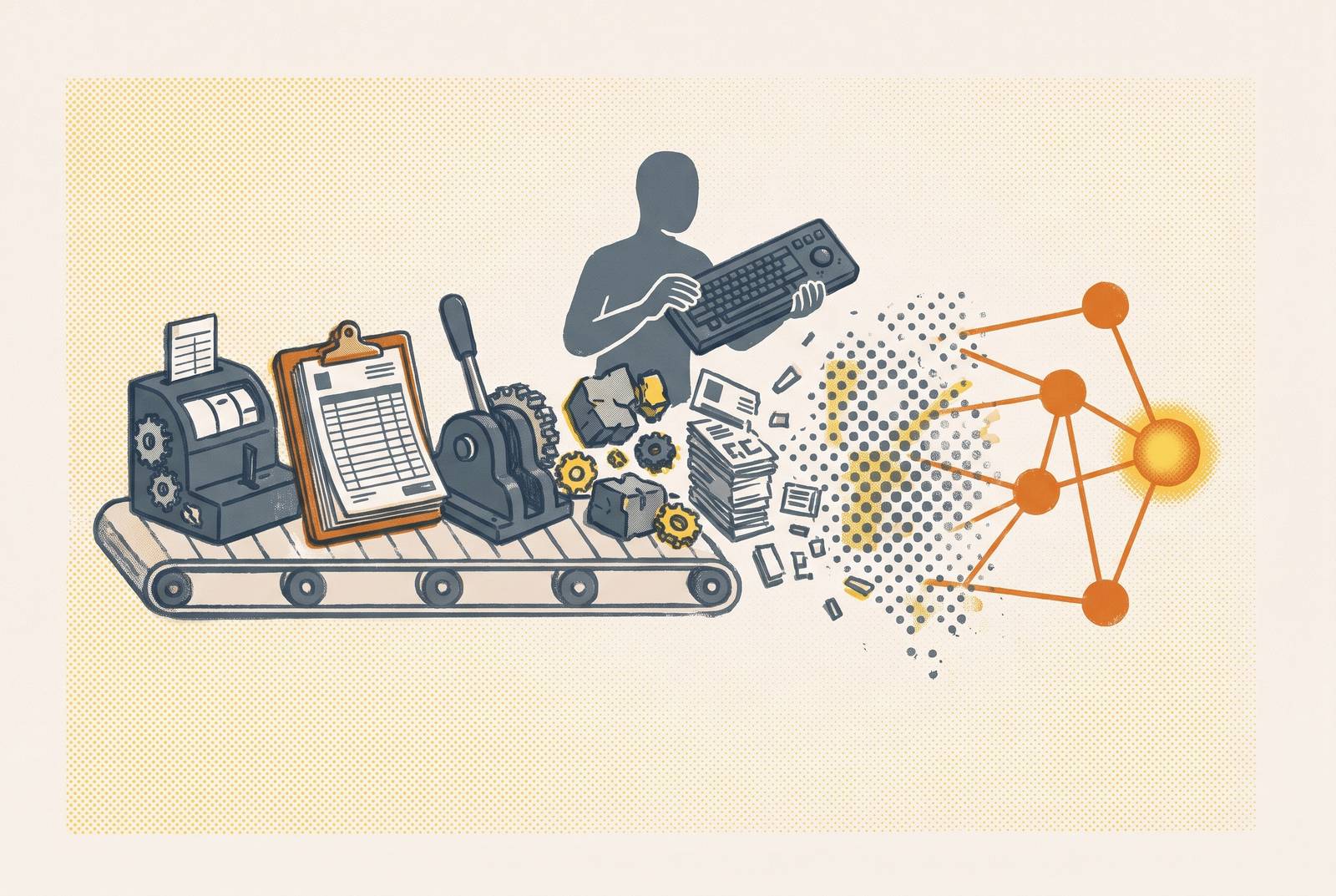
Rebuilding department workflows with AI agents from scratch requires retiring legacy processes in dependency order. Operations leaders should first audit how work actually happens, then replace a bounded process whose redesign unlocks downstream work. Retiring processes in the wrong sequence leaves the new architecture with the dysfunction it was meant to remove.
Why the sequence of process retirement matters more than the choice of AI agent
Henry Ford’s observation about building automobiles applies to agent workflows. Finding a better way to do a useless thing is not progress. Deloitte’s 2025 Emerging Technology Trends study identifies the corresponding failure in enterprise AI, where organizations automate tasks designed by and for human workers without reimagining the work itself. An agent can speed up those tasks and keep the assumptions and workarounds that made the process work poorly.
Sequencing compounds that problem because processes do not operate independently. Retiring a dependency before its replacement is ready leaves downstream work without an input it can trust. Leaving a defective feeder process untouched forces the downstream agent to act on unreliable information or inherited logic. Neither failure requires choosing the wrong technology. Tool selection sets an agent’s capabilities, while the surrounding operation needs the right retirement order to support them.
What makes a process "agent-ready" versus one that will poison the architecture
An agent-ready process has decision logic that repeats at high volume, clean bi-directional access to the systems it reads and writes, and a clear boundary for when to use human escalation. These properties let an agent do multi-step work across systems as conditions change. Agentic AI extends RPA with exception handling, but that capability requires a clear distinction between an exception it may resolve and one a person must own.
Deloitte’s agentic AI strategy report identifies organizational data architecture as a structural constraint, with ETL-based pipelines creating friction for agents that need business context. Traditional enterprise systems were not designed for agentic interactions, and conventional APIs and pipelines can limit autonomous operation. A workflow that must update operational records needs more than read access. Bi-directional integration offers a path through existing systems without making a multi-year ERP replacement the prerequisite for process redesign.
The opposite profile is recognizable in field operations. Data originates in radio calls, WhatsApp threads, paper forms, and clipboard notes, while decision logic remains undocumented and exceptions go to whoever knows how to resolve them. This is an upstream data gap. A controlled pilot can conceal it by supplying information that production work never captures. Governance presents a similar constraint when nobody can say who is accountable for an agent’s actions, because approval at every step then becomes the substitute for a defined autonomy boundary.
How to audit a candidate process before deciding whether to retire or redesign it
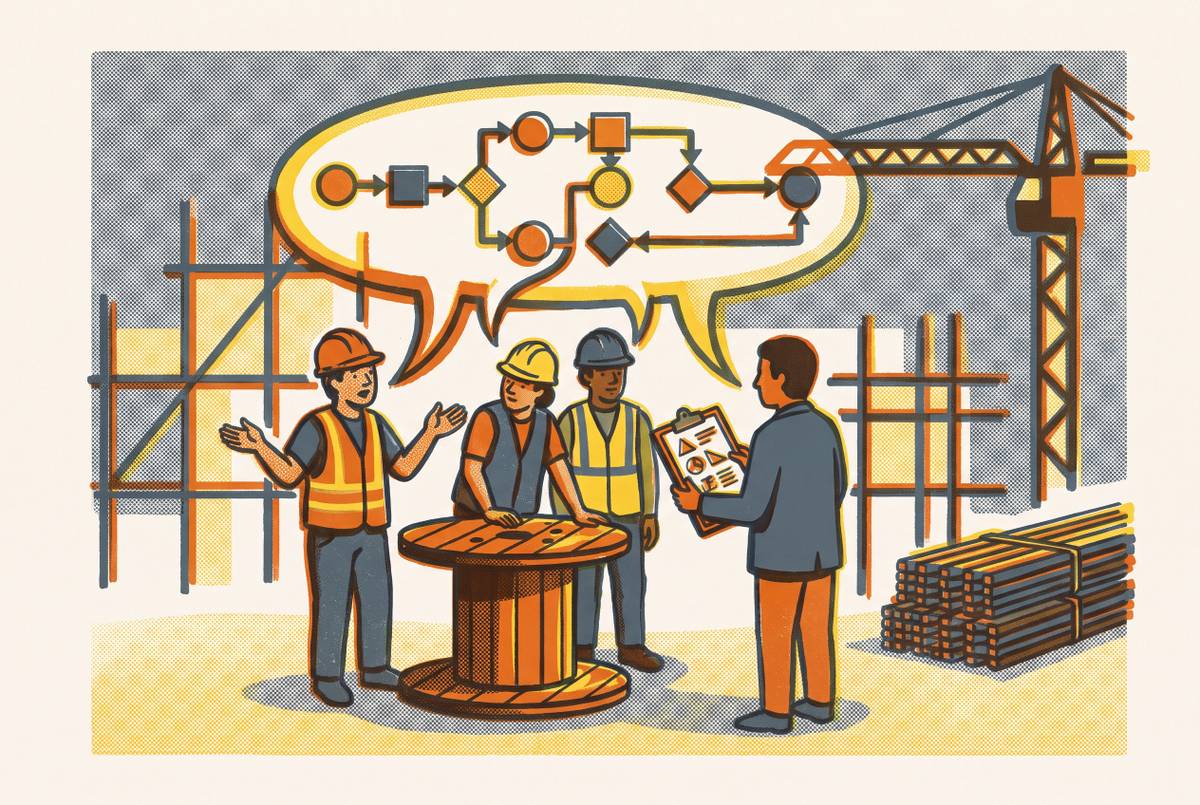
The audit should establish what the process would look like if it were built for an agent from scratch. Redesign must bring current operation into line with that design. Observation must precede reliance on documented process maps. Those maps show how work is meant to happen, while construction sites and manufacturing floors show the handoffs, missing information, and informal decisions that shape how it gets done. An audit that stops at the map cannot distinguish a functioning dependency from a workaround.
Operations leaders should trace where each input originates, which downstream processes consume each output, and how many exceptions occur and where they go. Off-system inputs require a data-capture solution before retirement. A replacement must satisfy downstream dependencies to support the work that follows, regardless of how painful the candidate process feels today. Exception handling needs equally close examination. If one experienced person resolves the difficult cases, the audit has found a knowledge-transfer problem whose relevant judgment must be encoded before retirement, with a defined boundary for what remains human.
Each decision point should then be examined for judgment, relationship, or accountability that belongs with people. This separates transferable work from human responsibility without assuming that every repeated task needs an agent. The Deloitte report also identifies “agent washing,” including vendors relabeling existing automation and enterprises applying agents where simpler tools would suffice. Complexity is not evidence of a better redesign. A process that needs straightforward automation should not acquire an agent merely because the wider program is agent-led.
Construction scheduling makes the audit’s data-fidelity requirement concrete. Cost, commitments, progress, and change control must line up in live project data before an agent can use them as a coherent operational picture. A schedule alone cannot provide that fidelity. Where those inputs remain inconsistent across a portfolio, the prerequisite becomes portfolio-wide investment in data alignment before deployment, rather than a scheduling pilot supplied with unusually clean inputs.
The sequencing logic: which process to kill first and what that choice commits you to next
The first retirement should maximize dependency leverage, which is the downstream work that becomes possible when a process is rebuilt agent-native. Painful processes often sit where several dependencies meet, so removing them prematurely creates a vacuum for legacy workarounds. The easiest candidate can be misleading for the opposite reason. Success on unusually clean data validates that condition without exposing the infrastructure problems that will obstruct later deployments.
Toyota’s supply chain visibility redesign illustrates the leverage available from clearing a shared dependency. Its vehicle management tool retires 50 to 100 mainframe screens and gives team members real-time vehicle information from pre-manufacturing through delivery to the dealer. That change reduces the hands-on navigation previously needed to establish vehicle status. The sequencing significance lies in the information it makes available downstream. Rebuilding that access process both speeds up the task and clears a dependency for logistics visibility.
P&G’s supply chain redesign applied the same logic to the planning architecture. OMP’s case study describes a consolidation of a large set of processes into a significantly smaller set through Unison Planning™, the backbone of an AI-enabled planning transformation. Planning architecture came before isolated process retirement. The redesign also created the supply flow analyst and supply flow engineer roles, showing how responsibilities can emerge from changes across connected processes that would be difficult to see through task-by-task automation.
For construction, manufacturing, and logistics, the selection filter has four conditions that must hold together. The candidate must be small enough to redesign independently, yet broad enough to deliver meaningful business impact as a domain. It must also have a clean data source or a solvable capture problem. Finally, it needs a defined human escalation boundary under which the agent acts and people audit within its authorized scope. None of these conditions compensates for another’s absence.
The choice also commits later work to an architecture. The first replacement establishes the data model that subsequent agents will read and update, and revising it mid-sequence can force expensive partial rollback. Coordinated agents add another dependency layer. Strategic scheduling, real-time anomaly detection, and compliance documentation must work together, so the retirement order must account for orchestration between agents as well as handoffs between processes.
What field data reveals about sequencing failures that declared project schedules hide
Mission-critical infrastructure exposes the cost of treating declared schedules as operational truth. In data center delivery, switchgear and transformer timelines can differ between procurement records and project plans. One document says 52 weeks while another says 78 weeks. The contradiction can remain buried in PDFs until commitments have become sunk costs, making the discrepancy more than a planning error. A sequence that looks executable in the schedule may already be impossible under the procurement assumptions.
Agents are being deployed to surface these conflicts before they become irreversible. They compare vendor-stated lead times, utility assumptions, and project schedules to flag contradictions across documents. Here, the agent audits before it executes. That distinction is essential because automating compliance with a defective sequence would reinforce the error. Operational evidence must establish whether the plan is achievable before autonomous work proceeds against it.
P6 schedules and similar tools show what is planned, while procurement lead times, coordination handoffs, and commissioning readiness decide whether the work can go as planned. An activity can appear on track in the schedule and be off track in procurement reality. Suffolk and MIT’s September 2026 whitepaper treats scheduling as one of six co-equal construction levers. For process retirement, the comparable error is treating the documented workflow as sufficient evidence that its dependencies are ready.
HPE provides a useful contrast in candidate selection. CFO Marie Myers’ team developed Alfred, a multi-agent system, for its operational performance review process, which involved large datasets that were time-consuming to process. The data was already structured and the process boundary clear. Selection therefore rested on what the available information could support, rather than on a process map’s description of how work should flow.
How to prevent retired legacy processes from re-emerging as shadow workflows
A process remains operational if its informal channels continue supplying work that the replacement cannot absorb. Radio calls, WhatsApp groups, and clipboard notes do not disappear when an agent goes live. If their information stays outside the system, the old workflow persists in shadow form. Teams still need a place to handle the exceptions and informal communications that the retired process dealt with.
Operations leaders should make clear who does which work when the old process is retired. High-repetition, low-judgment work moves to the agent, while judgment, accountability, and relationship work stays with people. Otherwise, teams can continue doing both. P&G’s new planning roles show how a redesign changes who is responsible as it removes tasks, and spelling out those responsibilities at retirement helps keep people from carrying on in their old roles informally.
Governance should make clear when an agent can run a process end to end within its authorized scope and when it needs approval at each step. The target is for agents to run the process while humans audit outcomes and handle defined escalations. Without that target, approval chains can recreate the legacy workflow with an agent attached. Full logging, anomaly detection, and rollback capability for every agent action make the replacement observable and provide a basis for detecting departures from it. Monitoring must therefore be in place before retirement, as a condition of closing the old process.
How operations leaders should approach the second and third retirement decisions once the first is live
The first live process should guide later retirement decisions through the operational evidence it produces. It is not an isolated proof of concept. The Deloitte report states that only 11% of organizations operate agents at full production scale, with the remainder in pilots or exploration. That gap shows how few organizations have reached the conditions under which dependencies must work continuously. Treating each replacement as a separate pilot postpones that test.
Once a process is live, it shows how many exceptions go where and which downstream processes they set in motion. It also tests whether the first data model extends to adjacent work without revision. Both findings can change the next retirement decision. If an adjacent process requires an architecture change, that work belongs in the sequence before its replacement goes live. Informal channels missed by the first deployment must likewise be addressed before their shadow workflows interfere with the second.
The next candidate should be a process the live agent already partially touches through data reads or decision writes. Those integrations have connections that already work and dependencies that are partly cleared, though the candidate still needs an audit. In manufacturing, successive redesigns can deepen the fit between AI and a specific operation’s products, processes, equipment, workforce, suppliers, and customers. That accumulated fit gives later agents operational context that generic tools do not provide.
The goal in asset-heavy operations is for agents to work together to update the same operational record across scheduling, anomaly detection, and compliance documentation. Reaching it requires more than selecting a platform. Each retirement must keep the dependencies that work needs today while making way for the next replacement. The first live process therefore begins discovery rather than completing a predetermined roadmap, and each subsequent retirement is audited, monitored, and evaluated for what it reveals.