Why Construction Workflow Mapping Must Happen at the Work Face Before Any Platform Demo Lands on the Calendar
Mapping how work really flows shows what a platform must fit.
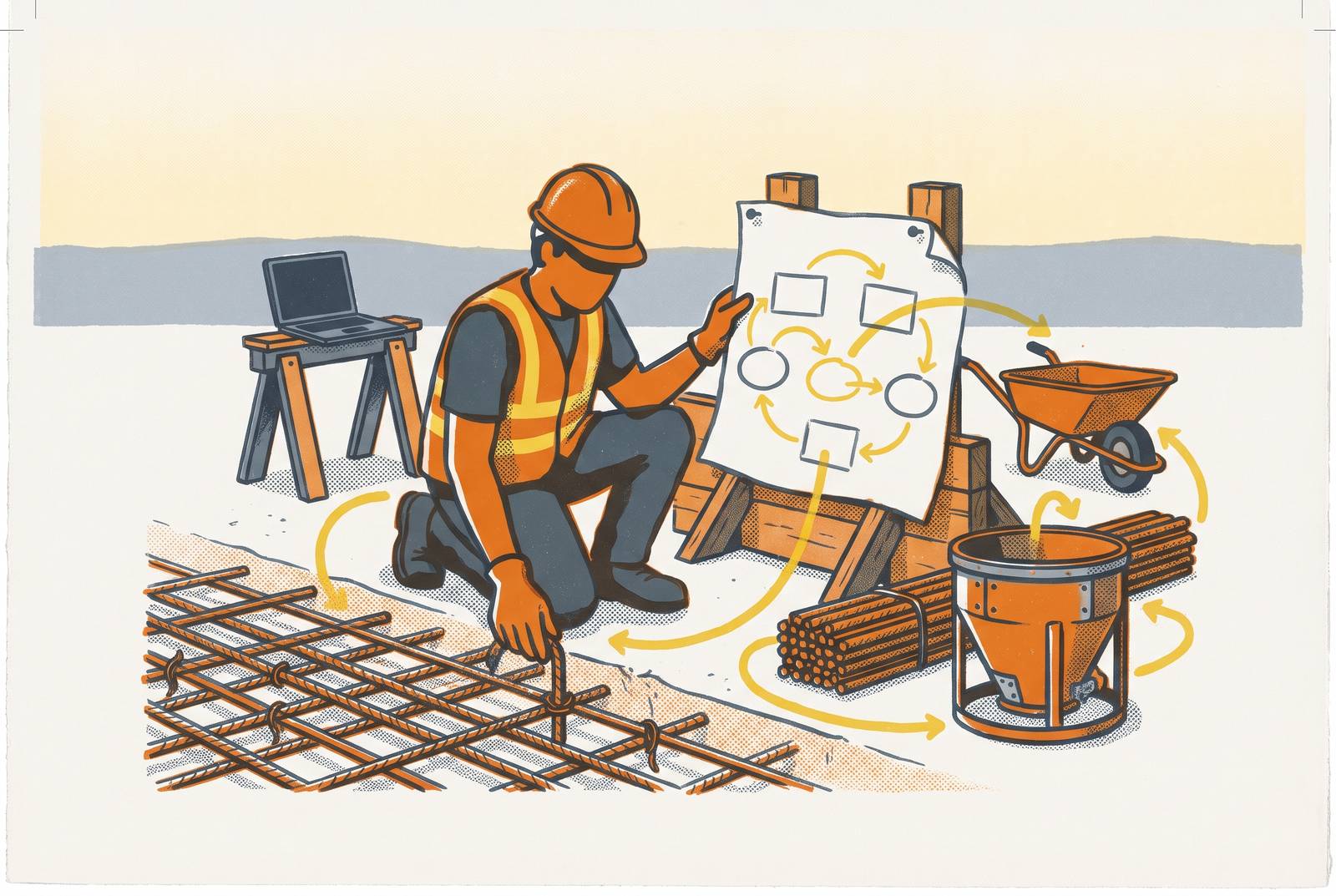
Construction workflow mapping must happen at the work face before platform selection because the process people follow is rarely the process a demo assumes. Before AI deployment in construction and logistics operations, a process audit must show who does the work, where hand-offs fail, and what keeps the work from producing a usable result. Without that grounding, technology selection risks automating a broken workflow.
Why platform demos evaluate the wrong problem when they come first
A vendor call lands on the calendar before anyone has walked the site to trace the workflow under discussion. The team has identified an administrative burden or a coordination problem, but it has not established how that problem develops. From that point, the vendor’s modeled workflow becomes the frame through which the team judges its own needs.
The sequence is wrong. A demo can show how a platform handles the process it was designed to support. It cannot show whether that process fits the order in which people act, make decisions, and exchange information informally on a given project. When discovery comes later, the team evaluates capabilities against an idealized account of the work.
What, exactly, does the platform need to fit? A document workflow may look suitable without revealing who finds the current version, who resolves conflicting information, or who absorbs the delay when a hand-off fails. Those details define the problem against which the product must be evaluated.
What construction work actually looks like when you map it at the work face
Document search and version tracking take time from people who are also responsible for field supervision. Coordinating submittals pulls superintendents and project engineers away from decisions in the field, while actions from meetings stay scattered across email threads and personal notes. Every day, some of that work takes place outside the formal systems. A process map that includes only recorded transactions misses the effort required to make those transactions possible.
The missing steps become visible by following the work. Discovery must establish who searches for information, what happens before it reaches the person who needs it, and how responsibility passes between people. Nominal ownership does not answer those questions. The person assigned a task and the person who keeps it moving may not be the same, particularly when a system does not support the coordination the task requires.
A photo of an MEP duct installed out of position may sit in a messaging thread while downstream trades cover the problem. Weeks later, rework becomes necessary without a traceable decision point connecting the evidence to the missed response. Discovery must establish whether field evidence reaches a person who can act before the consequence becomes harder to reverse.
What is installed can also differ from what is modeled, with a sanitary riser behind the wrong wall or a missing round branch connection. Those differences require structured field capture to become legible. A complete map must follow both the administrative task and the physical condition it records, keeping documentation tied to the work in the field.
Why field evidence and declared plans diverge so reliably in construction
The gap between a schedule and a site is not adequately explained as an execution failure. Construction plans describe intended sequences, while delivery depends on project conditions, contractor practices, and coordination across changing constraints. Some dependencies are real restrictions. Others are assumptions. A plan that looks sound can hide that difference unless someone checks its logic against how the project will actually get built.
Data fragmentation makes that comparison harder to sustain. Project information is captured late, inconsistently, or not at all, and much of the information captured across engineering and construction goes unused. Most AEC firms report that their technology systems are not fully integrated. Introducing AI into that environment can expose the fragmentation, but exposure does not itself connect the systems or establish responsibility for missing information.
Historical data does not remove the need for interpretation. Even an AI-generated schedule built from a large library of previous projects requires a planner to judge whether its dependencies reflect this site, this contractor, and these delivery conditions. The distinction is between a plausible sequence and an executable one. That judgment depends on knowledge of the work.
nPlan’s work on the HS2 rail programme illustrates what becomes possible when project evidence is structured well enough to compare with the declared plan. Its analysis found substantial schedule risk and helped avoid extra costs at the Adelaide Road site. The useful evidence lay in the gap. The case shows how sticking to a sound process makes data usable and gives risk analysis value, while a platform alone cannot make people follow that process.
Where construction workflows most reliably break — procurement, coordination, and energization readiness
Some of the most consequential breaks sit upstream of the activities a platform manages. On data center and energy infrastructure programmes, procurement and energization readiness can govern whether construction can proceed at all. Real estate, permitting, and logistics may be in order while the utility path cannot support the required load or energization window. A process audit must identify that dependency before treating construction progress as all that delivery requires.
Transformer availability can gate Notice to Proceed more decisively than civil works, while developers winning repeat hyperscale work reserve transformers, switchgear, and HV cable before projects formally start. Those commitments pull procurement risk forward. If discovery starts only with the formal construction schedule, it can miss decisions already shaping what that schedule can achieve.
The design-to-procurement hand-off is therefore a critical audit target. When a topology revision changes transformer quantities on a job with lead times measured in months, procurement needs that information within hours. Selecting an ERP or supply chain AI system before identifying who owns that connection leaves the team unable to judge whether the proposed workflow reaches the consequential decision in time.
Permitting and grid readiness present a different limit. They are systemic delivery barriers. Discovery must distinguish an information delay that the organization can address from an external constraint it must plan around. Otherwise, a tool may help the team handle its own tasks better without changing whether that work leads to a usable result.
What should a process audit at the work face actually cover?
An audit needs to watch how work gets done today. It follows information from the field to the back office, identifies where manual steps cause delays or errors, and establishes who absorbs the coordination cost when systems do not connect. A requirements session in a conference room cannot take the place of watching the work. Its account of responsibility must be tested against the people who actually perform the task.
The audit must reconstruct the sequence between system touchpoints. That includes where a document goes before reaching its user and which informal steps keep it moving. Some workarounds have become load-bearing because the formal system does not support what delivery requires. Removing or automating a visible step without understanding those workarounds can leave the underlying dependency untouched.
The next distinction is between tool gaps and organizational gaps. A slow process may need better ways to handle information, or it may need clear decision rights and an agreed way to handle exceptions. Those conditions demand different responses. The audit’s output should show exactly how the process runs and where it hurts, so that technology is considered against a defined cause.
Evidence must also extend beyond whether people use AI. Usage frequency does not establish workflow impact. Before-and-after assessment needs cycle time, review load, throughput, error rates, exception rates, and qualitative accounts of how people describe the work. AI can help analyze field reports, telematics, and project management data, but a human must first structure the process well enough for those records to support a coherent interpretation.
The strongest objection to doing discovery first — and why it answers itself
Hyperscale construction creates a credible objection to discovery-first sequencing. Procurement and interconnection windows move quickly, and organizations cannot count on having months for an audit before they start choosing technology. The pressure is operational. A discovery approach that ignores those windows would fail to respect the same delivery constraints it is supposed to uncover.
That objection changes the pace of discovery. Autonomous execution still requires process standardization, decision rights, exception thresholds, human escalation paths, and audit logging. A demonstration does not deliver those prerequisites. Skipping the work that defines them leaves an organization attempting to accelerate a process whose decisions and exceptions remain unresolved.
Buying computer vision or schedule simulation before daily logs are consistent can produce alerts without a workflow for resolving them. The platform then adds another step to the work. That is a diagnostic signal that the end-to-end process needs redesign, rather than evidence that the team simply needs to use the interface more often.
AI-assisted discovery is a more substantial counterargument. Tools can find patterns in the data already on hand and help show where time is lost again and again. But people still need to trace informal hand-offs, manual workarounds, and decision gaps outside the system of record. The practical response to urgency is faster auditing, with analytical assistance where useful, rather than treating the absence of a recorded problem as evidence that no problem exists.
What to map before any demo lands on the calendar
The lesson for an operations team is to identify the workflow whose failure has the highest downstream cost. Most teams should begin with generative AI and human-reviewed document workflows because they are easier to test, correct, and reverse than automated decisions. That points discovery toward work where human review already happens but consumes time it should not.
For that workflow, the team should find out who owns each step, both formally and in practice. It should then trace the hand-offs where work leaves one person or system and depends on an untracked manual action. The data needs its own map. An AI tool’s input is only as reliable and complete as the available data, its form, and its gaps allow.
Procurement lead times, permitting status, and grid readiness can decide whether a workflow that seems to work well produces a result the team can use. In logistics operations, the same audit logic applies to ownership, information movement, manual workarounds, and upstream procurement constraints. The boundary of discovery must follow the dependencies of the work.
A partner helping with this discovery should be able to show the current process, the specific break, and the capability needed to address it before proposing automation. Exception handling must be defined as well. Once those conditions are clear, the team can talk with a vendor to test whether the platform handles the failing hand-off within the constraints the project actually faces. The demo is then evaluated against a mapped process.