The Operational Signals That Tell a Process Auditor Where Field Workflows Break Before AI Enters the Room
Repeat findings, slow fixes, and missing decisions show what automation would amplify.
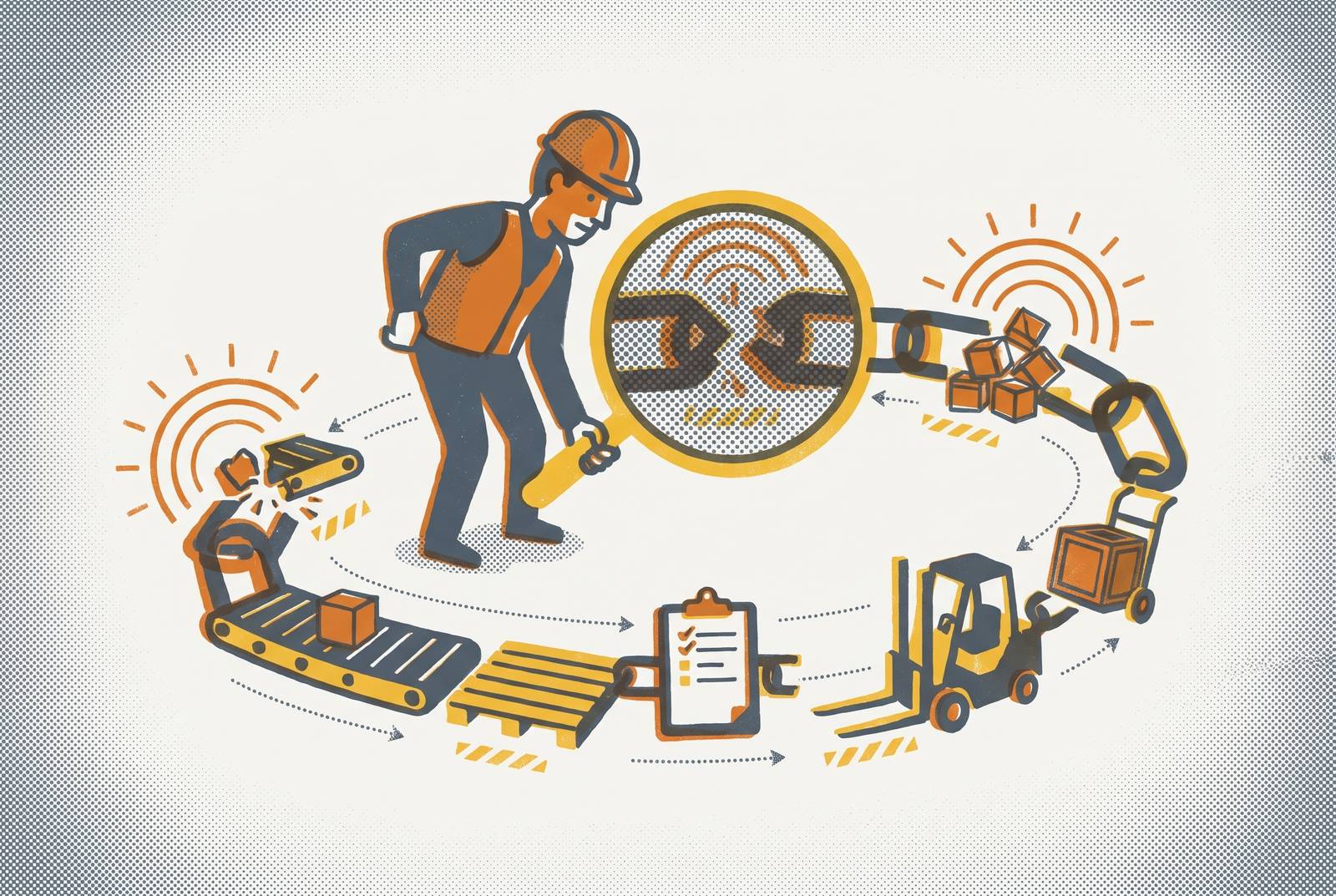
A process audit before AI deployment in construction and logistics operations identifies where field work has already separated from the documented workflow. Repeat findings, delayed corrective actions, conflicting records, evidence hunts, and undocumented decisions reveal which breaks automation would amplify. A skilled process auditor uses those signals to decide what needs to be redesigned before any choice of technology.
Why the gap between documented process and executed process is the real audit target
A schedule, a checklist, and a workflow diagram can describe an orderly process while field teams keep work moving through informal corrections. A delayed approval prompts a workaround, or a material substitution changes what actually happens without changing the record. The paperwork still describes the intended sequence. The executed process has become something else, and the systems intended to support AI may contain only the documented version.
That separation is the auditor’s real target. A business process audit evaluates current work against defined standards and business objectives, identifying deviations, inefficiencies, compliance gaps, and opportunities for automation. In field operations, this requires attention to the undocumented work that allows the formal process to function. A workflow can appear complete precisely because employees compensate for its omissions.
The audit therefore starts by examining what the process actually does and where it has drifted. Whether it can be automated comes later. AI deployed across an undocumented gap encodes and accelerates a version of work that was already incomplete.
How repeat findings expose a process that cannot correct itself
A finding that recurs across two consecutive audit cycles makes the separation between declared and executed work visible. The organization has recognized the problem, yet the workflow continues to produce it. That is more than a stubborn site-level issue. It indicates that audit output is not feeding back into the way work runs.
The mechanism has several possible forms. The first corrective action may never have been implemented, may have been implemented incorrectly, or may have treated the symptom while leaving the process step that produced it untreated. The diagnostic value lies in the recurrence after the organization had an opportunity to respond.
Consistent detection does not rebut that diagnosis. Catching the same issue reliably is a lagging measure, while the absence of an upstream change explains why it remains detectable. For a pre-deployment auditor, the distinction is decisive. Automation would enter a workflow that can identify failure without preventing its return.
What corrective action latency reveals about ownership gaps in field operations
Even when a finding gets attention, the time between its discovery and corrective action assignment shows whether someone takes ownership in practice or only on paper. A named owner is not necessarily an effective owner. The assignment timestamp shows how soon someone takes responsibility for an observation, while resolution time shows how long the exposure stays open. Those are related but distinct measures.
High assignment latency points to an authority or handoff gap. The owner may lack the authority to act, the resolution process may be undocumented, or the finding may cross departments without clear accountability. The delay is therefore not merely administrative. It exposes a missing connection between recognizing a problem and authorizing a response.
Resolution latency reveals the consequence of that gap. When the average resolution time for critical findings is more than 14 days, risk exposure grows with each hour of delay. An AI agent can generate or escalate a corrective action faster without changing who has the authority to resolve it.
Version drift across systems as a signal that the process has no authoritative source of truth
An ownership gap can also appear in the records. When the same finding has different dates, severity labels, or owners across dashboards, tickets, and spreadsheets, no controlled record governs the reporting. The team is assembling an account after the fact. This is version drift.
In construction, the conflict can span ERP data, daily field reports, scheduling systems, and procurement records. A project may look financially healthy in the ERP while field reports show production falling, the schedule shows a critical-path delay taking shape, and procurement records show deliveries that are weeks late. Different systems can legitimately describe different aspects of a project. The failure is the absence of an authoritative account that connects those facts for decisions.
The same integrity problem can appear in a vulnerability management system or a project controls platform. The auditor’s test is whether the system can produce an unambiguous record of discovery, action, and decision without manual reconstruction. If the answer depends on chasing emails, authority remains unsettled. An AI agent reading sources that disagree without a conflict-detection mechanism would face the same uncertainty.
Evidence hunts and spreadsheet stitching as the visible surface of a process that was never operationalized
Version drift produces a recognizable human response. Every audit request triggers another search for tickets, emails, approvals, and supporting documents because the workflow has not preserved evidence in a repeatable, testable form. Staff may eventually produce a convincing account. Diagnosis requires establishing whether they retrieved it or reconstructed it.
Consider an audit running three weeks over schedule, with PBC documents arriving in the final days of fieldwork. Evidence remains in inboxes while the team reconciles transactions in Excel the night before the exit meeting. The visible pressure is a deadline problem. Beneath it is a process that depends on people assembling proof after the work has happened.
Construction and logistics show the same pattern when subcontractor data, delivery confirmations, and inspection records are not captured in real time. The information exists, but assembling it delays downstream decisions. This distinction is important before automation because an AI-generated record of its own actions is not necessarily evidence of the underlying field workflow. Without that link, people still have to hunt for evidence after automation.
The exception trail that stops at escalation and what it means for process design
Some workflows preserve evidence but stop at the wrong point. They record that an exception was escalated without recording the decision, the decision-maker, or the basis for the response. The escalation is visible. The disposition is not.
In construction and logistics, those departures include material substitutions, scope changes, delayed approvals, and subcontractor deviations. They are daily events. A process that documents only the escalation can therefore omit the decisions made under the greatest operational pressure. Subsequent analysis sees that someone raised a problem but cannot establish how the organization handled it.
For an auditor, the missing decision record is a design signal. The workflow recognizes variance but does not preserve its resolution. An AI agent working within that design could escalate correctly without knowing whether the decision that followed was right. The process would offer no complete account from which to learn how its exceptions were resolved.
How the gap between declared risk and field-level risk concentration reveals where a process will fail under load
Together, these signals expose a structural mismatch. Risk receives attention where it is comfortable to analyze, rather than where field work creates the greatest exposure. Repeat findings and unfinished exception trails clustered around execution show that the organization’s view of risk is detached from the work producing it.
The Deltek GovCon Clarity 2026 study identifies project execution, covering schedule, cost, and scope, as the risk domain contractors most often name as the highest-stakes area to monitor. Yet analysis concentrates at proposal and falls during execution, with only a small fraction managing risk continuously across the lifecycle. The timing is misaligned with the stated exposure.
Field evidence makes that mismatch concrete. Extended construction submittal cycles signal greater completion risk weeks before it becomes a schedule failure, while logistics tracking data can accumulate without informing throughput decisions in real time. A risk register from the proposal phase that is updated quarterly misses a drop in production in week three of execution. The 2026 SAME Pacific Industry Forum distinguished construction completion from usable capability available when a mission requires it. That distinction depends on field evidence of commissioning and energization readiness.
The two resistance behaviors that surface when field teams have been through bad AI deployments before
When earlier deployments ignored these gaps, how employees behave offers another clue. AI outputs may be manually re-entered or silently overridden within the workflow. The visible behavior alone is not enough. Two different mechanisms can produce it, and each points to a different omission in process design.
In the displacement-fear pattern, employees believe AI is intended to reduce headcount and withhold information or effort that would help it succeed. The auditor encounters incomplete data, but the cause lies in a change designed without the people affected by it. In the invisible-work pattern, employees perform dozens of undocumented tasks that the AI workflow excludes. Their workload worsens because the new system does not account for work that still has to happen.
Deloitte’s Enterprise AI Trends 2026 Pulse Check found that 48% of respondents said their organization had introduced AI without redesigning the workflows or roles it sits within. That finding is consistent with the invisible-work mechanism, rather than proof that every override reflects resistance. Distinguishing the two requires field observation and stakeholder interviews. The audit has to establish whether people are withholding essential work or continuing essential work that the design never recognized.
What the signals look like sector by sector, and what they tell a process auditor to fix first
In construction, energization and procurement readiness show whether the integrated schedule takes field constraints into account. A delayed decision or long-lead item can change when a capability is ready for use, but that link is lost when procurement is tracked on its own. The first repair is the link between field readiness and the declared delivery plan.
In logistics, tracking at the package level can tell a different story from actual throughput. RFID and automated systems may produce data without changing the decisions made in real time. Collection is not the same as operational use. Because labor is a primary process lever, the audit also examines whether field decisions made by workers are visible to the systems through which AI would operate.
In manufacturing, the decisive comparison is between the production schedule and the shop-floor execution record. If they disagree, an AI-driven scheduling upgrade would start with a wrong account of how work runs today. The discrepancy comes before the scheduling technology. It identifies the execution gap that needs attention before an upgrade can serve the process.
In retail, demand signals and replenishment records must be governed consistently across channels. Otherwise, AI-driven replenishment inherits the stockout-and-overstock cycles of the manual workflow. Data governance is the first dependency here. The reported benefits of AI-driven supply chain optimization need clean inputs governed by the same rules, along with automation.
What should a process auditor assess before recommending any AI deployment?
The appropriate candidate is a specific, painful process whose failures are already visible. Field-level observation establishes how that process runs today and where it hurts. Quantitative measures show recurrence and delay, while stakeholder accounts expose work absent from the systems.
The resulting output is a prioritized map of process breaks. Structural breaks need redesign before automation because the workflow is missing a way to assign ownership, keep evidence, or make decisions. Operational breaks can be corrected within the existing design. Behavioral breaks call for the people doing the work to help redesign it, since handing them a finished process overlooks what they contribute.
This diagnosis sets the order of work. Preparing the data, studying the process, and making changes takes both evidence from the systems and what employees close to the work know. The auditor’s authority comes from connecting those accounts. The signals are already present before AI enters the room. The consequential decision is whether anyone reads them before deployment turns an existing process failure into an automated one.