Process Redesign for Shift-Based Manufacturing Operations
Shift handoffs fail because context never crosses the boundary.
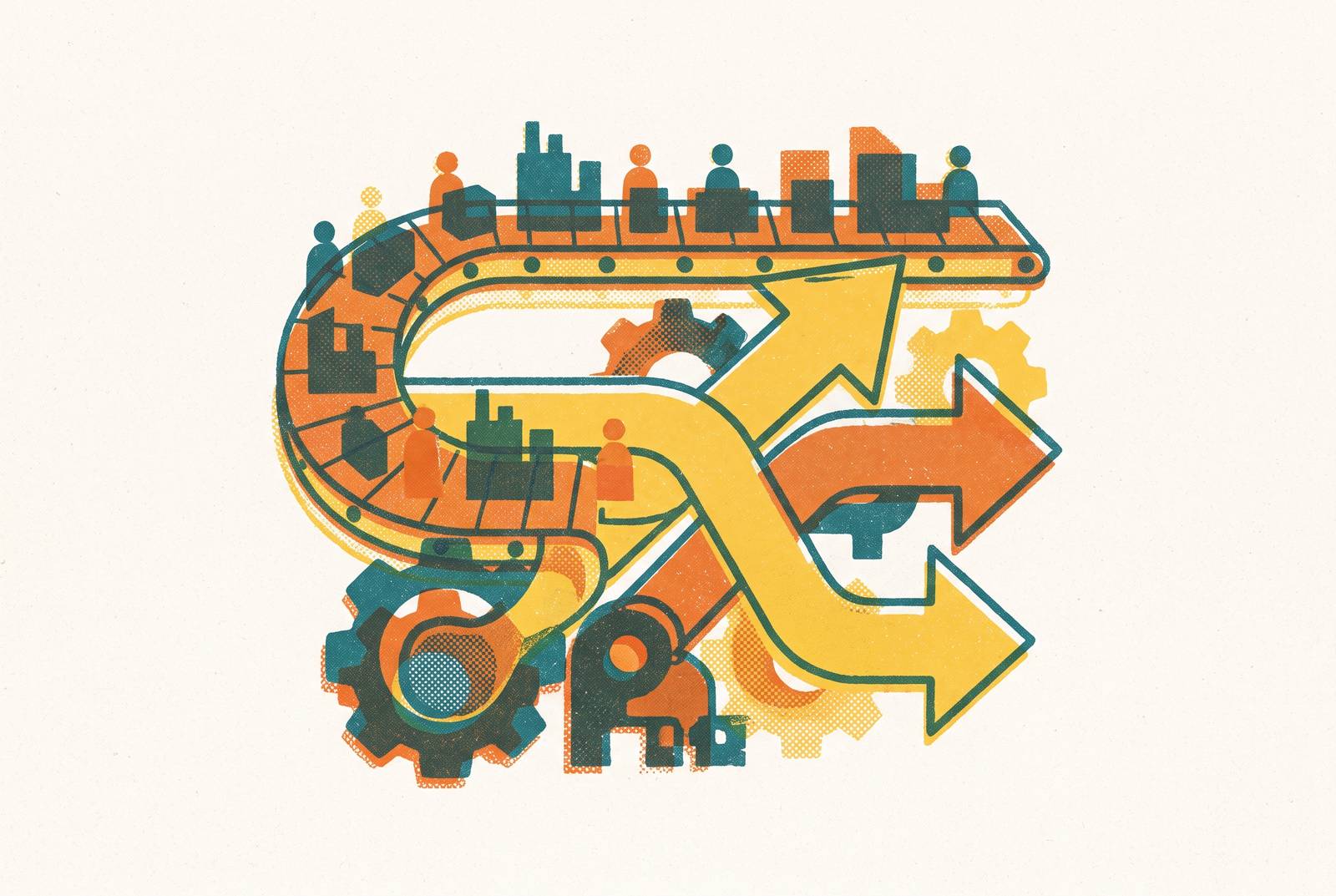
A shift starts with an inaccurate picture of what it is inheriting, and that single fact explains most of the reliability problems that plague shift-based manufacturing. The failure does not happen inside the shift. It happens at the boundary, in the seam where one crew's work has to become another crew's starting point.
Picture the handoff itself. The outgoing operator knows which machine has been running hotter than it should, which exceptions got resolved and which got shelved, which tasks are truly finished and which only look finished on paper. None of that necessarily makes it across the line. The incoming shift gets a status board, maybe a verbal summary if someone has time, and then has to reconstruct, often through trial and error, what actually happened over the last eight or twelve hours. Context does not transfer. Exception state does not transfer. In-progress decisions do not transfer. Most operations have no deliberate mechanism built to carry any of it across, so the incoming crew starts work carrying the accumulated ambiguity of everything the previous shift left undeclared, not just the physical work itself.
This is a structural condition, and it has been building for years. Manufacturing has gone through repeated waves of digital transformation: new systems, digitized workflows, dashboards replacing clipboards. IFS's 2026 manufacturing analysis frames the outcome precisely: through those waves, systems modernized and work got digitized, but the structure around the work never changed. The tools changed, the organizational design underneath them did not, and that unchanged design is the actual constraint on reliability. A plant can replace every paper form in the building with a tablet and still hand off an inaccurate picture at every shift change, because the problem was never about paper or tablets. It was always about what gets declared, what gets owned, and what gets carried forward.
Misdiagnosing the Problem as a Scheduling Fix
Faced with that kind of breakdown, most operations reach for the lever closest at hand: the schedule. Add ten minutes of overlap. Adjust headcount ratios across shifts. Shift the start time by half an hour so the handoff happens when fewer people are rushing out the door. These moves address the schedule, but the actual failure sits in coordination logic, not clock time.
Scheduling tools capture intent. They show who is assigned to a shift and when it starts. They say nothing about what information actually transferred between the outgoing and incoming crews, what exceptions are still open, or what informal calls got made and never logged anywhere. A perfectly staffed overlap window does nothing if the fifteen minutes of overlap get spent on small talk and a rushed walk-through instead of a structured transfer of task state and open issues. The schedule can be flawless and the handoff can still fail completely.
The instinct to fix the schedule is understandable: it is the most visible lever available, and pulling it lets an organization avoid the harder question of what the handoff is actually supposed to produce at the end of every shift. IFS's 2026 analysis points to the deeper cause: organizations built for linear, sequential work trap intelligence inside individual functions, so progress moves at the pace of approvals and hierarchy rather than at the pace the available technology would otherwise allow. Shift handoff is a smaller version of the same pattern. Layering digital tools on top of a handoff process that was never properly designed produces faster noise, not better coordination. A real-time dashboard showing stale or ambiguous task state just lets the confusion spread faster.
What a process audit reveals about how handoffs work today
The right diagnosis starts with watching the handoff happen, not with reading the procedure that describes how it is supposed to happen. The distance between the two is almost always bigger than operations leaders expect, and only direct observation on the floor closes that gap.
A documented process shows a clean sequence: outgoing crew logs status, incoming crew reviews it, supervisor signs off. Field observation shows something messier: steps skipped because the outgoing shift is already five minutes late to leave, decisions made informally between two people and never written down anywhere, exception types that only one person on the floor knows how to handle, with no backup plan for the day that person calls in sick. A process audit collects specific evidence: cycle times for each step of the handoff, exception logs showing what got flagged against what actually got resolved, ownership gaps where a task belongs to nobody or to two people at once, manual overrides of whatever the system assigned, and the gap between what the outgoing shift reports at the end of its day and what the incoming shift actually finds when it starts.
Habitat for Humanity's procure-to-pay process shows what that kind of mapping turns up. When the organization actually traced how procurement worked in practice, it found the entire cycle, including vendor quotations, running on paper forms, emails, and spreadsheets. That manual approach stretched the procure-to-pay cycle to nearly 60 days and left no visibility into where things stood at any given point, the kind of visibility a centralized system would have provided by default. The automation that eventually fixed the problem worked because the audit had already identified where the cycle broke down and why it had stretched so long.
Foundry Management & Technology made a related point in its October 2026 coverage: companies that stop at customizing existing tools end up with better tools, while companies that go further, using what the audit reveals to rebuild how work actually happens around their own specific operations, end up with better systems. The distinction is whether the organization used what it learned from watching the real process to change the process itself, not which software got purchased.
The three coordination failures that handoffs consistently expose
Audits of shift-based operations find the same three coordination failures over and over, regardless of industry or plant.
The first is task state ambiguity. A task sits as "in progress" in the system of record while the last person to touch it considers it finished, or the reverse. The incoming shift has no reliable way to tell what it is inheriting versus what it needs to restart from scratch. It is a direct consequence of handoff processes that have no explicit step requiring someone to declare task state before the shift actually ends, a gap that runs deeper than data quality.
The second is exception orphaning. A problem gets flagged mid-shift, and it is never resolved, never formally deferred to anyone, and never assigned to a person on the incoming crew. It sits in a log somewhere, technically visible, with nobody accountable for it when the next shift starts the clock. The VDA 6.3 automotive process audit framework documents this pattern directly in its common findings, and these are exception-handling failures: corrective actions get closed without any evidence they actually worked, and production data often cannot be traced back to the specific characteristic or operation it was supposed to describe. They have nothing to do with the quality of the technology sitting on the floor.
The third is tribal knowledge exit. The best operator on the outgoing shift knows which machine has been running hot, which supplier delivery is at risk of landing late, which workaround has been quietly in use since Tuesday. None of that lives in any system, and none of it survives the walk to the parking lot. IFS's 2026 analysis treats this as a structural problem rather than a training gap: intelligence gets trapped inside individual people and functions, and the scaffolding built around the work, not the people doing it, is the real constraint.
These three failures feed each other. Exception orphaning gets worse when task state is already ambiguous, because nobody can tell whether the open exception belongs to finished work or active work. Both failures compound further when the specific knowledge needed to resolve them walked out the door with the previous shift.
What rebuilding the handoff process requires
Fixing this requires rebuilding three things, in a specific order: a task-close protocol, an exception-transfer mechanism, and a way for context to move from a person's head into a system and back out again.
The task-close protocol needs to be an explicit, bounded step, not a status field that someone updates when convenient. Every open item on the floor has to be declared before the handoff is considered complete, forcing a real decision on each one: complete, deferred, or in-progress-with-a-named-owner. This is a workflow design question before it is ever a software question. The protocol has to define what each of those three labels actually means and what evidence is required before anyone can apply one.
The exception-transfer mechanism has to guarantee that every open exception reaches the incoming shift with an owner attached, a priority attached, and enough context attached that the incoming crew can act on it without having to track down the person who flagged it. BIC's capital expenditure process shows what happens when this mechanism doesn't exist: intake forms failed to capture the budget information needed to route exceptions, so they piled up in approval queues with no one accountable for moving them forward, while parallel spreadsheet tracking duplicated the work. The fix required redesigning the form, the ownership rules, and the tracking system together. None of those three fixes alone would have solved it.
Context transfer from person to system addresses tribal knowledge directly. The outgoing shift's operative knowledge, what's running abnormally, which workarounds are currently active, which risks have quietly gotten worse, needs a defined step where it gets captured in a form the incoming shift can actually use, not buried in a verbal aside during a rushed overlap. IFS's 2026 analysis states the organizational issue clearly: as people, AI systems, and eventually robots all contribute to outcomes on the same floor, how work moves between them and who is accountable when automation enters the workflow is the real question. Foundry Management & Technology's October 2026 coverage names the technology's actual role here: AI's second-order effect is not automating existing tasks but redesigning how the work itself is structured, so maintenance shifts from a fixed schedule to a predictive model, and quality control shifts from catching defects after the fact to identifying the process conditions that precede them.
The order matters as much as the content. Rebuilding context transfer before the task-close and exception-transfer protocols exist just produces better-documented chaos. It does not produce a better handoff.
Where AI agents belong in a redesigned handoff process
An AI agent earns its place in this process only after the underlying handoff logic is sound. Introduced earlier than that, it just encodes the existing failure patterns and runs them faster.
Once the process is rebuilt, the right job for an agent is narrow and specific: check incoming task state against a known-good baseline and flag anomalies, route every open exception to its correct owner the moment a shift starts, and surface the context an incoming supervisor needs without making that supervisor chase it down manually. IFS's 2026 analysis names the prerequisite directly: AI can connect planning, production, supply chain, service, and workforce activity in real time, and an organization still built for linear, sequential work is the constraint that stalls that value at the first departmental boundary it hits.
Once the handoff process is actually rebuilt, encoding tribal knowledge into an agent's workflow becomes one of the highest-value moves available. An outgoing expert's troubleshooting instincts, their read on which anomalies actually matter, their sense of which workarounds are safe to keep running, can all be made available on every shift, including the night and weekend shifts when that expert isn't on site. Foundry Management & Technology's October 2026 coverage names the limit on this directly: a tool that helps one plant cut scrap might be irrelevant, or even risky, at another plant with different equipment and different failure modes, so any customization has to happen inside boundaries set by safety, quality, compliance, cybersecurity, and accountability.
Some leaders will argue that an agent can skip the audit step entirely, that once deployed, it will find on its own where the handoff is actually broken. That argument gets the sequence backward. An agent deployed into an undefined process will optimize for whatever it can measure, not for the coordination outcome the operation actually needs, and those are rarely the same thing. The audit has to come first.
Why supervisor roles must be redesigned alongside the handoff process
A rebuilt handoff process will fail if the supervisor role sitting on top of it is still defined around manually coordinating the exact things the new process now handles. The role has to be rebuilt in parallel. It cannot be treated as a fixed constant while everything around it changes.
Under the old model, a shift supervisor's value came from knowing things that were never written down anywhere and resolving exceptions through personal judgment and relationships built up over years on the floor. That is precisely the tribal knowledge a rebuilt handoff process is designed to turn into something structural and repeatable, available to anyone on any shift. Once that knowledge is encoded and exceptions route systematically to the right owner, the supervisor's time opens up for reading patterns the process hasn't learned to catch yet, developing the operators on the floor, and making judgment calls on exceptions that are genuinely novel.
IFS's 2026 analysis frames this redesign requirement directly: the goal is not reducing roles, it is removing the structural barriers limiting what people in those roles can actually achieve, and when the structure aligns with how work actually flows, what becomes possible for the people in it rises along with it.
The resistance this creates is real and deserves to be taken seriously. Supervisors who built their authority on being the person who knew what nobody else knew are being asked to trust a process, and a system, with what used to be their personal leverage on the floor. That is not a software rollout. It calls for deliberate change management alongside the new workflow, not a memo announcing that the workflow has changed.