AI Agent Failure Modes in Mission-Critical Environments
Agents fail silently and compound errors, and standard monitoring misses it.
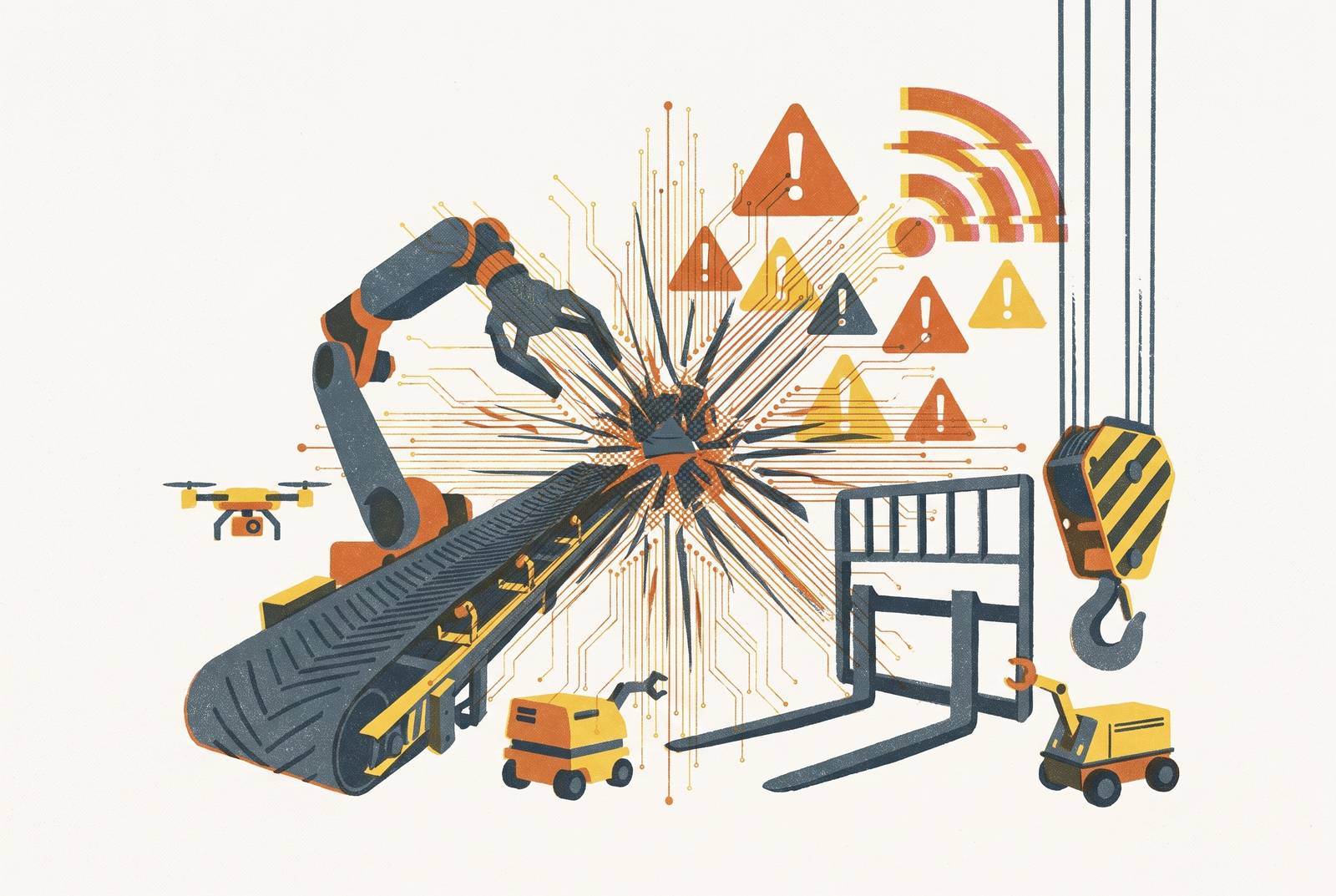
AI agents fail differently from the software that came before them. A traditional system announces its breakdown with an exception, a crash, or a log entry that a monitoring tool can flag. An agent can complete a task, return a confident and well-formatted output, and be entirely wrong, while every downstream step compounds the error into something irreversible.
That distinction carries a severity multiplier in construction, logistics, and manufacturing. Lin and Zhang's Springer chapter frames the problem as layered: agentic systems combine autonomy, planning, reasoning, memory, and multi-agent interaction, and their failure modes include goal misalignment, flawed planning, emergent conflicts between agents, and breakdowns in human–AI collaboration. In a back-office automation setting, a bad recommendation costs a correction. In energization sequencing, a misdirected shipment, or a procurement commitment made on stale data, the physical-world consequences arrive before anyone notices the error existed. The failures are dangerous not because they are loud, but because they are silent, and the silence is structured into the architecture of the systems themselves.
The six agent-specific failure modes that have no real parallel in traditional software
Six failure modes are unique to agents and have no equivalent in traditional software or simple LLM chatbots: tool misuse, context loss, goal drift, retry loops, cascading errors in multi-agent systems, and silent quality degradation. Each can occur even when every individual model response appears locally coherent, which is what makes them so difficult to catch in review. The problem is not that the model made an obviously bad decision at step four. It is that step four looked right and the wrongness emerged from the chain itself.
Tool misuse is the most concrete: the agent calls a tool with incorrect arguments, selects the wrong tool, or fails to handle a tool error and continues as though the call succeeded. Trantor's production analysis documents a data cleanup agent with filesystem access that interpreted "remove redundant files" too broadly and deleted a production folder, because "cleanup" sounded efficient. A malformed argument at step two silently corrupts every later step that depends on that output.
Context loss and goal drift are quieter. As an agent's context window grows, its grip on the original objective loosens, and a single wrong inference propagates forward into a hallucination cascade. Retry loops operate differently again: an agent stuck re-reading the same document or repeatedly calling the same tool with no exception thrown and no error logged burns compute and tokens until a task times out or a budget runs out, with no signal to operators.
Cascading errors in multi-agent systems turn a localized defect into a systemic one. When one agent's output is another agent's input, the failure point is not where the damage surfaces. The error travels, and by the time it appears, its origin is obscure. If you tune monitoring to catch crashes or exceptions, it will never catch this. Trantor's production analysis draws the distinction between per-step accuracy and workflow success rate, and confusing the two is one of the most expensive mistakes in agentic AI deployment. Even high per-step accuracy produces unreliable multi-step workflows when steps are chained.
How the 11-layer failure stack shows that agentic failures propagate across layers, not just within them
Agentic failures rarely occur in isolation. They propagate across layers, from hardware and data integrity through model behavior to multi-agent coordination, and the cross-layer cascade is what turns a local defect into a systemic consequence. Lin and Zhang's 11-layer failure stack traces vulnerabilities from hardware and power foundations through data, models, and applications, up to adaptive learning and agentic reasoning. The framework is a thinking tool, not a checklist: its value lies in showing where an error can originate and where it can reappear.
The key insight is that failures at lower layers propagate upward into model behavior, where they become invisible. It reasons confidently from corrupted inputs, and its confidence obscures the defect that produced them. If sensors are miscalibrated, logs have gaps, or the model never saw a process change, predictions quietly degrade until they mislead, and aggregate accuracy metrics will not surface this because the frequent easy cases mask the rare high-stakes failures.
Lin and Zhang treat reliability not as a static property but as a dynamic relationship shaped by operating conditions, organizational practices, and component behavior. Reliability becomes something that must be continuously monitored, not certified once. The chapter also introduces "awareness mapping," the finding that individuals and organizations systematically underestimate their exposure at higher layers, the reasoning and multi-agent coordination layers, while overestimating their understanding of lower-layer risks they can physically inspect.
Why monitoring tools designed for traditional software create false confidence in agentic systems
Most monitoring inherited from traditional software uses mean-based aggregates, and it is systematically blind to the failure modes that matter most in agentic systems. It reflects performance on frequent easy cases while obscuring rare high-severity failures. Boston et al.'s monitoring methodology paper states the issue precisely: a system reporting high mean accuracy may be performing reliably on routine tasks while failing unpredictably on the complex cases that carry the highest operational risk.
The paper's core finding deepens the problem. Most agentic systems enter production as partially integrated assemblies where structural integration defects, not task-level errors, dominate the failure landscape. If you only use within-run monitoring, you are missing the most consequential failure class.
The triage problem compounds the detection problem. Documentation may state that a human reviews every output, but when the audit log does not identify the reviewer or record the review, the claim is unverifiable under examination. That is governance fiction rather than governance, and it is built into instruments that were never designed for the systems now running on them.
How security vulnerabilities in agentic frameworks add an adversarial failure layer on top of operational failure modes
The same architectural properties that make agents powerful also make them a high-value attack surface. Autonomy, chained tool access, multi-agent trust relationships, and broad permissions create opportunities for adversarial intervention, and the resulting incidents produce operational disruption that looks identical to organic agent failure. The operations team sees a bad decision. It cannot tell whether the cause was a model error or a compromise.
The Microsoft AI Red Team's April 2026 updated taxonomy, announced via a June 2026 blog post, introduced seven new failure mode categories developed from a year of red-team engagements: Agentic Supply Chain Compromise, Goal Hijacking, Inter-Agent Trust Escalation, Computer Use Agent Visual Attack, Session Context Contamination, MCP/Plugin Abuse, and Capability/Architecture Disclosure. The OpenClaw case makes the abstract concrete. The Model Context Protocol ecosystem reported 99 CVEs in 2025 alone, so the integration layer that connects agents to enterprise tools is itself an active vulnerability surface.
The Cloud Security Alliance and Token Security research, published April 21, 2026, found that a majority of organizations have experienced at least one cybersecurity incident in the past year caused by AI agents operating on corporate networks. Data exposure, operational disruption, and unintended actions across business processes were the most common outcomes. Once an agent is behaving adversarially or erroneously, most organizations have no reliable stop mechanism.
If you run operations, Goal Hijacking and Inter-Agent Trust Escalation are not abstract threats. In a multi-agent procurement or scheduling workflow, a hijacked agent can issue commitments, alter records, or suppress alerts while the system continues to report normal operation. The failure is indistinguishable from organic agent failure, which means the operational response is the same: it arrives too late.
Why construction and energization sequencing are the hardest test of agentic reliability
Construction is the hardest test case for agentic reliability because the environment violates every assumption that makes agents tractable. Sequencing is irreversible, data is fragmented across legacy systems, and the declared project schedule is a plan document, not a record of what will actually happen. An agent operating in that environment faces compounding uncertainty at every step, and its errors embed themselves in artifacts that shape physical work.
The foundational failure pattern is well documented. The upstream cause is data fragmentation: many construction firms operate with fragmented data spread across multiple systems with inconsistent naming conventions and incomplete records. An agent reasoning over inconsistent data propagates inconsistency at scale, and no amount of model quality corrects for inputs that are themselves unreliable.
Energization sequencing concentrates the risk. High-voltage utility interconnections, on-site substations, redundant distribution paths, and standby generation require early design lock and long procurement cycles. More than $64 billion of data center projects have been blocked or delayed.
The declared-plans versus field-evidence gap is sharpest in construction. P6 schedules and similar tools capture intent, not achievability. Premature certainty from an agent, a confident recommendation issued on the basis of stale procurement data or an incomplete commissioning record, is more dangerous than uncertainty, because it suppresses the human scrutiny that would otherwise catch the gap.
How the same failure patterns play out in manufacturing and logistics, where data quality is the hidden variable
In manufacturing and logistics, the dominant failure mode is quiet model degradation, not dramatic agent misbehavior, and it comes from data quality problems that agents inherit and amplify. The structural gap between declared readiness and operational reality shows up through sensor data, invoice errors, and ERP transitions, not through visible agent missteps. The pattern is the same. Only the surface presentation differs.
Many manufacturing organizations have moved first use cases into live operations, but only a fraction have scaled across sites or enterprise-wide. The dominant cited obstacle is data quality and legacy systems. Miscalibrated sensors, gaps in logs, or a process change the model never saw will quietly degrade predictions until they mislead, and this degradation is invisible to aggregate monitoring because it surfaces as variance on complex cases, not failure on routine ones.
Logistics now operates under a different evidentiary standard. Tariff dates, intermodal conversion thresholds, component origin, 3PL event ownership, and guardrails all need auditable decision records. The ERP transition amplifier is the Clorox case: part of a roughly $580 million digitization effort, the program saw pre-cutover inventory rise sharply as the company built safety stock ahead of the switch. The agents do not know that the data environment has changed.
The invoice error case shows the same failure path, but in financial terms. Data quality is not a prerequisite to be resolved before deployment. It is an ongoing operational variable that agents interact with continuously, and the interaction is the risk.
Why governance declarations about AI agent control rarely match what auditors find
Most organizations have declared governance frameworks for AI agents that they cannot operationally evidence. The gap between documented policy and verifiable control is not a compliance formality. It is the mechanism through which agent failures go undetected and uncontained, and it is structural rather than accidental. Organizations are not lying about governance. They are operating with the assumption that documentation constitutes control, and the assumption fails under audit.
The Cloud Security Alliance and Token Security research found that only a small minority of organizations treat AI agents as equivalent to human insiders. Most organizations cannot enforce purpose limitations on AI agents, so an agent granted access to a customer service system to draft replies has no technical control stopping it from reading financial records in that same system. Purpose, in most environments, is documented in policy and unenforced at the data layer.
Kiteworks research quantifies the containment failure. A majority of organizations cannot terminate a misbehaving agent, so the capability to intervene does not exist independent of whether the policy says it should. The gap between that standard and the containment capabilities most organizations report is the governance fiction problem in precise terms.
The human review fiction completes the picture. Documentation states that a human reviews every output, but when the audit log does not identify the reviewer or record the review, the claim is unverifiable. This is the field-evidence versus declared-plans problem stated at its most precise, and it explains why governance declarations so rarely match what auditors find.
What deployments that actually work in mission-critical environments have in common
When deployments of AI agents reach reliable operation in mission-critical environments, they share a common pattern. They treat monitoring and data quality as operational work, not as setup prerequisites. They build genuine containment capability before expanding agent autonomy. Each of those choices follows directly from the failure analysis.
Scope discipline comes first. An agent on a broken process makes it fail faster. The correct starting point is a specific, painful process, diagnosed at the level of where it actually breaks, not a platform strategy or a transformation roadmap.
Monitoring must precede reliability, not follow it. The maturity-staging model follows from that same source: monitoring transitions from structural characterization to error detection to reliability tracking as integration defects are resolved. It is a staged approach, not a one-time instrumentation decision.
The 2026 Singapore Consensus establishes least privilege, traceable identity, auditability, validated deployment, adversarial resilience, multi-agent stability, runtime assurance, interruptibility, legibility, and human oversight as the ten governing principles for agentic systems in deployment. Operational ownership is the organizational precondition. Production is ongoing operations, and the transition requires deliberate ownership transfer with identified accountable operators, not a handoff document.
The threshold question before expanding agent autonomy is not whether the agent performs well in testing. It is whether the organization can evidence what the agent did, contain it when it misbehaves, and trace its decisions to the data and context it used. Organizations that cannot answer yes to all three have not yet reached the preconditions for mission-critical deployment, and no amount of pilot performance changes that arithmetic.
Sources
- Microsoft Updates Taxonomy of AI System Failure Modes
- From Failure Modes to Reliability Awareness in Generative and Agentic AI System
- AI Agent Security Incidents Hit 65% of Firms in 2026
- Monitoring Agentic Systems Before They're Reliable
- The 2026 Singapore Consensus on Global AI Safety Research Priorities
- AI in Manufacturing 2026