Selecting the First AI-First Process in a Department
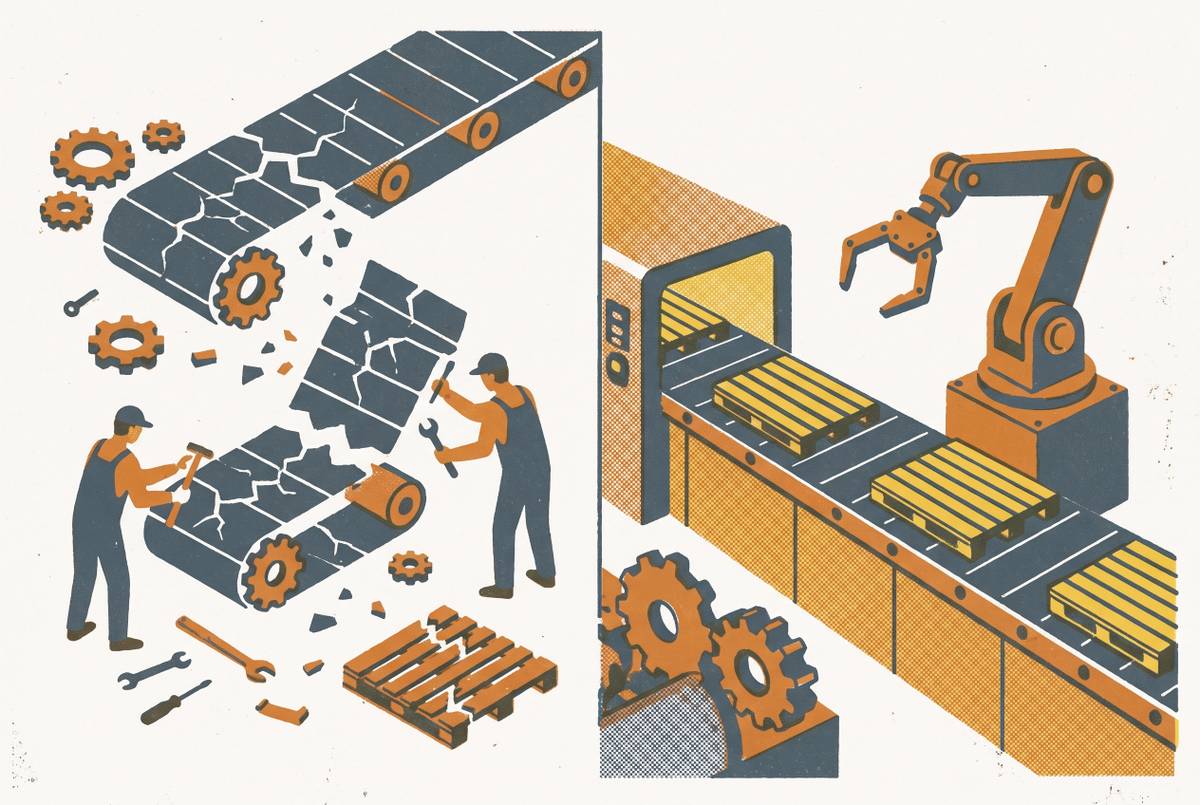
Pick a broken process to fix first, not the easiest one to automate.
Advertisement
Most departments deploying AI today are optimizing processes that already exist rather than rebuilding them, and that choice shapes whether the technology compounds an organization's operational problems or actually solves them. Deloitte's State of AI in the Enterprise report found that a third of organizations are using AI to deeply transform, creating new products and services or reinventing core processes and business models; another third are redesigning key processes around AI; the remaining third are applying AI at a surface level, with little change to how the underlying work actually happens. Only the first group is genuinely reimagining how its operations function. The other two groups, comprising the majority of organizations surveyed, are automating what already exists, at varying depths of commitment.
A department that layers AI onto a broken workflow inherits that workflow's defects running at machine speed, and the failure modes embedded in the old process do not disappear under automation. They accelerate. This matters because the obstacle most enterprise AI deployments face is not model capability. The dominant blockers are agent sprawl, integration gaps, and skills shortfalls. The choice of what to automate first precedes and shapes everything the department builds afterward.
A global manufacturing company illustrates the cost of skipping this diagnosis. The company faced recurring monthly financial close delays, with reconciliation routinely taking nearly two weeks, and when it investigated the cause, it found that the real drivers were process and governance failures rather than gaps in data or technology. Had the company purchased software before identifying those root causes, it would have automated its own dysfunction rather than corrected it.
What makes a process the right first candidate
The right first process is not the one that is easiest to automate, nor the one that is politically safest to touch. It is the process that is repetitive and rule-governed, generates data that can actually be reached, would produce a materially significant result if meaningfully improved, and has a business owner willing to participate in rebuilding it.
Four properties recur across deployment patterns in traditional industries, and a serious first candidate should satisfy all four. The process must be repetitive and rule-governed: there is a logic to how it runs today even if that logic has never been written down properly. It must generate data that is accessible, even where that data is imperfect; the relevant question is not whether the data is clean, but whether it exists somewhere the department can reach it. A meaningful improvement in the process's performance must produce a result a CFO or COO would call material, because low-stakes pilots teach nothing about whether AI can carry real operational weight. And the business owner responsible for the process day to day must be willing to participate in rebuilding it, since without that buy-in, a technically sound redesign will not survive contact with the people who have to run it.
Before any candidate enters a pilot track, it should be assessed across five dimensions of readiness: data quality, technology stack, process maturity, workforce readiness, and governance capacity. A process that scores high on business value but low on readiness does not belong in the pilot track. It belongs on a parallel remediation track, because launching it prematurely produces a failed pilot, and a failed pilot poisons the organization's appetite for the next attempt. It is a legitimate planning outcome that tells the department what infrastructure work has to happen before its most valuable candidates become viable.
The diagnostic skill that matters most at this stage is distinguishing between the process as it is documented and the process as it actually runs under field conditions. Declared process quality and actual process behavior diverge sharply in most departments, and that divergence is where the real selection work takes place. A process that looks orderly on a flowchart but runs on improvisation in practice will not behave the way its documentation suggests once AI is built around it, and departments that skip this verification step are selecting against a description of their operations rather than the operations themselves.
Selection across construction, logistics, manufacturing, and retail
The same four properties apply across construction, logistics, manufacturing, and retail, but the process that best satisfies them differs by sector, because each industry's data environment, failure modes, and operational consequences differ.
In construction, scheduling and procurement readiness stands out as the strongest first candidate, because it sits at the intersection of the sector's worst failure modes: incomplete design documentation, permitting delays, late requirement changes, and breakdowns in coordination across trades, all of which cascade into delays at energization and commissioning. AI risk identification applied during the planning phase addresses these risks directly, and at the closing phase, similar tools can flag incomplete permit documentation, delays in final safety inspections, unresolved punch-list items, and gaps in as-built documentation before they become commissioning problems. A commercial general contractor running a sophisticated scheduling process discovered that its schedules were consistently optimistic, failing to account for trade availability, weather, or rework, and ran materially over schedule year after year as a result; once an AI tool began flagging at-risk activities two to three weeks before they reached the critical path, pilots showed measurable improvement in schedule variance. Construction supply chains compound the problem further, with multiple supplier tiers, volatile lead times, and global disruption exposure, which gives supply chain AI in this sector both accessible historical data and a clean, measurable output in the gap between material availability and project need dates. Mature, production-grade AI already operating in construction, including computer vision for jobsite safety monitoring, AI-augmented BIM for clash detection, predictive scheduling tools that ingest weather and supply chain signals, and drone-based progress monitoring, gives departments a commercial track record to benchmark readiness against.
In manufacturing, predictive maintenance on heavy equipment or production assets is frequently the strongest candidate: it is repetitive, its sensor data is accessible, unplanned downtime carries material cost, and the operational owner in maintenance or plant engineering has a direct financial stake in getting it right. A regional civil contractor with a large equipment fleet that invested in telematics and predictive maintenance saw unplanned downtime fall substantially and total maintenance costs drop, with the investment paying back within two years. The failure mode to avoid is plants that install sensors and models but skip the workflow design around them, so that alerts pile up in an inbox, accumulate false positives, and get ignored until the system is effectively dead; successful deployments treat predictive maintenance as a workflow program that technology supports. IDC's 2026 Manufacturing Industry FutureScape projects that by 2026, more than 40% of manufacturers with an existing production scheduling system will upgrade it with AI-driven capabilities to begin enabling autonomous processes, which is making production scheduling the second dominant first-process candidate alongside predictive maintenance. Further along this path, advanced manufacturers are running supply chain AI agents that operate continuously, monitoring conditions and autonomously adjusting purchase orders, production schedules, and logistics routing within guardrails that human planners set. That represents the target end-state of this kind of deployment for a department beginning the process.
Logistics presents several viable first candidates, including warehouse slotting, transportation planning, supplier performance, inventory positioning, and data-quality orchestration, each with different data requirements and different organizational owners, so the right choice depends on matching the candidate to the department's actual data environment rather than picking the most familiar option. Microsoft's supply chain organization, now scaling past 100 operational agents after reporting hundreds of hours saved monthly, reached that scale by starting with discrete, bounded processes and expanding only once each one demonstrated a real win. Crown Castle, a national telecom infrastructure operator, deployed parallel-orchestration agents to process telemetry across thousands of distributed assets, with multiple agents simultaneously analyzing sensor data, weather feeds, and ticketing events before aggregating the results into a dashboard that flags exceptions for human review, an example built on bounded inputs and a measurable, consequential output.
Retail's strongest first candidates sit in inventory and pricing, where transaction data is already clean, feedback loops are fast, and a meaningful improvement in inventory positioning raises margin directly. One specialty retailer ran an AI system for two weeks beside the store's best service lead, comparing every answer the system produced before trusting it with customer questions, a field-evidence discipline that shows what a minimum validation standard looks like before a process is handed to an AI system.
The real objection: data-ready and highest-pain are often different processes
The strongest counterargument to everything above holds that departments should start with the most data-ready process rather than the most painful one, and the concern behind it is legitimate: choosing a low-pain process purely because it is data-ready produces a pilot that succeeds technically and fails organizationally, teaching the department nothing about whether AI can actually carry operational weight. Without solid data engineering and governance, AI initiatives do not scale, and many construction firms only discover how messy their data is after they have already committed to a process; a scheduling AI tool, for instance, may need a full year of historical schedule data before it can train effectively, and starting with a painful process that lacks that data maturity produces exactly the failed pilot this objection warns against.
The resolution is to treat data readiness as a threshold a process must clear before it is a candidate at all, not as the criterion that ranks candidates against each other. Once a process clears that threshold, the painful one should be preferred over the low-stakes one, because clearing the threshold is what makes pain a usable signal rather than a liability. In practice, this means running a readiness assessment to eliminate candidates that cannot proceed without remediation first, then selecting among whatever remains on the basis of operational consequence rather than data convenience.
Processes that fail the readiness threshold are not failures of the selection process; they are inputs to it. Routing them to a parallel remediation track tells the department precisely what infrastructure work has to happen before its highest-value candidates become usable. The global manufacturing company that fixed its financial close process followed this exact sequence, starting with root-cause diagnosis and governance design before any technology selection, and tying each new role assignment, technology purchase, or process change to a defined intent and metric. That sequencing is what kept the company from making the selection mistake of starting with whatever was easiest to instrument rather than whatever mattered most.
Why low-stakes pilots fail even when they succeed
A pilot built on a low-stakes process can prove that a technology functions correctly in a controlled setting, but it cannot prove that a department can deploy, operate, and trust an AI system once the cost of a wrong output is real. Deloitte's report found that the number of companies with 40% or more of their AI projects in production is set to double within six months, and the obstacle standing between most departments and that outcome is the ability to move from pilot to scale, a capability that low-stakes pilots do nothing to build.
The distinction that actually matters is between improving productivity in a back-office workflow and demonstrating that an AI system can manage a process where a wrong output has downstream operational consequence. Only the second kind of demonstration builds organizational trust in the system. In mission-critical operations, the stakes of getting this wrong are not symmetric: a mistuned recommendation engine in e-commerce loses a single sale, while a mistuned AI system managing a process with physical consequence can trigger failures that cascade across an entire operation. The higher that physical consequence runs, the more a field-evidence validation step has to be built into the first process from the outset rather than bolted on after deployment.
Low-stakes pilots carry a second cost beyond the lesson they fail to teach: IBM's 2026 Institute for Business Value study identified agent sprawl, agents built independently across teams, functions, and frameworks with no coordination between them, as the dominant problem in enterprise AI today, raising both security risk and operational complexity. Peripheral, low-stakes pilots are a primary source of that sprawl, because they generate agents that are never integrated into any real workflow and simply accumulate alongside the systems departments actually depend on. A Fortune 100 consumer goods enterprise avoided this by building a triage layer that routes internal employee requests across specialist agents in HR, finance, and operations, with each domain agent running its own sequential workflow under unified governance, identity, and audit. That governance architecture was only built because the first process the company chose was consequential enough to justify the work; a low-stakes pilot would never have created the need for it.
Running the selection as a diagnostic, not a vote
Selecting the first AI-first process should start with a structured audit of how the candidate process actually runs today, not how it is documented to run, because the gap between those two descriptions is the primary input the selection decision depends on. A planning session that generates a list of candidate use cases on a whiteboard is not a substitute for this audit; it produces a list of what people believe the department does, which is a different artifact from a record of what the department's systems and staff actually do when a process runs under real conditions.
That audit should trace each candidate process against the four properties laid out earlier, repetition and rule-governance, accessible data, material upside, and an engaged owner, before it ever reaches a discussion of which process is most urgent. Running the five-dimension readiness assessment against every candidate that survives this filter separates the processes that can enter a pilot track now from those that belong on a remediation track first, and that separation should happen before pain level enters the conversation at all. Once a shortlist of ready candidates exists, the department should rank them by operational consequence rather than by ease of execution, since the entire argument for starting with a painful, consequential process rests on the signal it generates: proof that the organization can deploy, govern, and trust an AI system under conditions where being wrong actually costs something. A selection process built this way functions as a diagnostic instrument for the department itself, revealing not just which process to automate first but what the organization still needs to fix before it can automate anything well.
Sources
- The State of AI in the Enterprise - 2026 AI report
- How AI Is Rewiring the Construction Supply Chain for 2026 and Beyond
- IDC - Charting the AI-driven future of manufacturing
- On Fulfilling the Exigent Need for Automating and Modernizing Logistics Infrastructure in India: Enabling AI-based Integration, Digitalization, and Smart Automation of Industrial Parks and Robotic Warehouses
- AI for Construction: A Practical Guide for Firms in 2026
- How AI Is Changing Industries from Manufacturing to Logistics