Why P6 Schedules Fail to Predict Construction Delays
P6 was designed to represent plans, not to predict whether they're actually achievable in the field.
Advertisement
P6 schedules fail to predict construction delays because the tool was never built to measure whether a plan can actually be executed. It was built to represent one. That distinction, not user error or inconsistent updating, explains why delay signals in P6 arrive after the conditions causing them have already taken hold.
Why P6 is built to represent a plan, not to track achievability
P6 encodes a project manager's intent: the sequence of activities, their durations, the resources assigned to each one. What it does not do, by design, is check whether the conditions that make that sequence possible actually hold in the field. Deepika Dayalan's June 2025 paper in the International Journal of Innovative Research in Engineering & Multidisciplinary Physical Sciences argues that P6's formal, systematic structure does not flex well in complex or unpredictable project environments. That's a design characteristic built into how the tool models a project.
The same paper draws a sharper line: P6 can show a delay once it has occurred, but its data model works against identifying why that delay happened in the first place. Field crews rarely see the live schedule at all. Most of them work from static exports, PDFs, or spreadsheet snapshots, and any change on the ground appears in the model only after it travels back through the scheduler. That round trip is where the gap opens. The schedule gets corrected to match reality only once reality has already moved somewhere else. Every failure mode that follows in this piece, procurement, trade coordination, energization, is a variation on that same round trip: a plan that looks intact on screen while the conditions it depends on have already shifted in the field.
How schedule quality degrades as projects advance
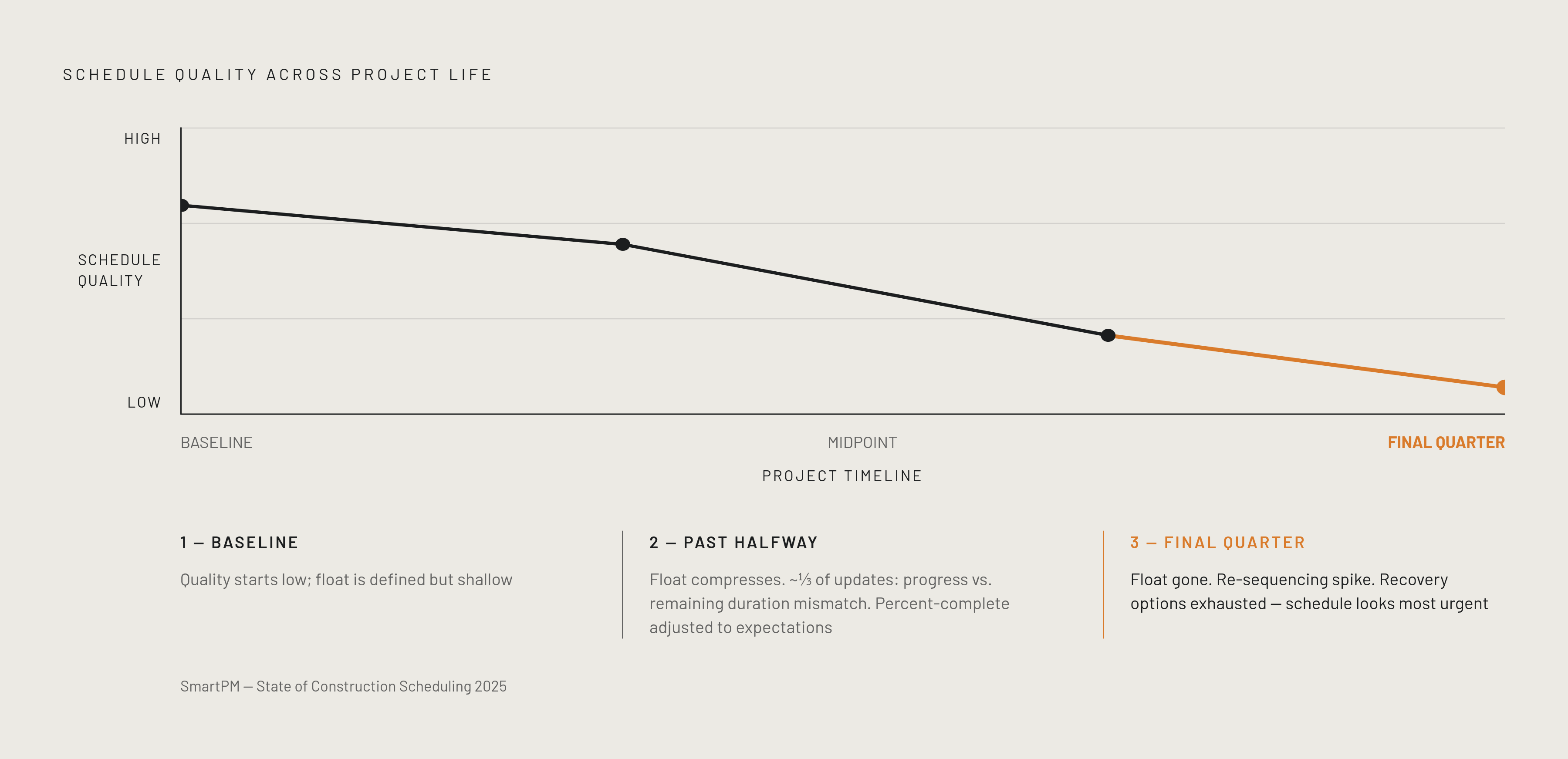
Schedule quality doesn't hold steady until some crisis moment forces a reckoning. It erodes from the day the baseline is set, and it erodes fastest exactly when the project has gotten complicated enough that an early warning would matter most. SmartPM's "State of Construction Scheduling 2025" report, as analyzed by ConstructionOwners.com, found that baseline schedules start out with a low quality rate, and that rate drops even further by the time a project hits 75% completion.
The same research found that most schedule updates altered values, actual start or finish dates, that are supposed to stay locked in once recorded. Roughly a third of updates showed a mismatch between reported progress and the durations still remaining, a sign that percent-complete numbers get adjusted to match what people expect to see rather than what the field is actually producing. That pattern is the fingerprint of a schedule being used as a reporting document instead of a coordination tool, which pulls it steadily toward the story stakeholders want told rather than the one the jobsite is telling.
SmartPM calls the next phase the "compression trap". Most projects start with enough float built in to absorb the small disruptions that occur early. But once a project passes the halfway mark, that float starts to compress, and by the final quarter, schedules show a spike in aggressive re-sequencing and acceleration tactics. Those are last-ditch recovery moves, applied after the float that would have made a calmer recovery possible is already gone.
Why delay signals arrive late
A procurement gap, a coordination failure, a resource shortfall: these conditions take root in a project weeks or months before anyone updates P6 to reflect them. Updating the schedule means someone has to make a decision to acknowledge a problem, and that decision can be politically uncomfortable long before it becomes unavoidable. SmartPM's 2025 data shows delays appear in the underlying project data early, but the formal schedule adjustment that would flag them comes much later. The information is sitting in the system before anyone acts on it.
The planner-field gap makes this worse. Field teams without live access to the schedule have no direct way to log a problem as it emerges. Someone has to notice it, tell the scheduler, and wait for the scheduler to assess the impact and rebuild the logic. Each one of those steps adds lag between the moment a real condition changes on-site and the moment P6 reflects it.
Resource constraints follow an identical pattern. Mastt and Plan Academy both point to resource shortfalls, subcontractor coordination breakdowns, and permitting delays as some of the most common causes of schedule slippage, but these get tracked, if they're tracked at all, in systems that never feed back into P6 automatically. The net effect is a schedule that understates risk during the exact window when a fix would still be cheap, then overstates confidence right when decision-makers most need to see the real picture.
Procurement status as the most common invisible driver of schedule failure
Procurement failures sit at the top of the list of root causes behind construction delays because procurement rarely gets modeled at the level of detail where it actually breaks down. P6 encodes a material-delivery milestone. It does not encode the purchase order status behind that milestone, the supplier's actual lead time, the inspection queue a shipment is sitting in, or the freight routing that determines the delivery date. GanttPRO and Plan Academy both flag supply chain disruptions and poor resource estimating as leading contributors to schedule delay, and these procurement-layer problems appear in P6 only as a missed activity date, well after the fact.
Procurement data lives somewhere else entirely, in ERP systems, vendor portals, email threads, none of which sync with P6 in real time. A supplier can run three weeks behind on a long-lead item, and the P6 schedule will still show green right up until the delivery date is missed.
Design changes stack another layer onto this. The Construction Industry Institute estimates that design changes drive schedule delays on a significant share of projects, and each one typically forces a procurement re-sequence. P6 only shows that re-sequence once a scheduler manually goes in and re-links the affected activities.
Trade coordination gaps that CPM logic does not capture
Critical Path Method logic encodes a sequence of activities and the dependencies that connect them. What it can't encode is whether the coordination agreements, shared access arrangements, and readiness conditions behind that sequence are actually in place, so a schedule's logic can be entirely sound while coordination on the ground falls apart. Mastt's research names communication and coordination breakdowns as a primary cause of delay, pointing out that once teams fall out of sync, small issues stack into larger ones. That stacking happens in conversations, RFI queues, and site meetings, none of which P6 has any visibility into.
Hyperscale data center construction shows this in sharp relief. Cramming electrical, mechanical, and controls crews into the same physical space at the same time can tank productivity across all three trades, which is why sequencing by zone and by system readiness matters as much as sequencing by task. A P6 schedule can show those trades running in parallel on paper while the physical space makes that parallel work impossible.
Megaprojects scale the same problem up. On the Transpennine Route Upgrade, nPlan works across an owner, a Tier 1 contractor, and a government delivery authority, each running its own programme. CPM logic captures each contractor's internal schedule well enough. It has no native way to capture the interface events between them, the handoffs, shared access windows, and joint readiness checks, and those interfaces are where the costliest delays tend to build up.
Energization readiness as the clearest case of a hidden single-point-of-failure
Industrial builds, data centers, cold storage facilities, and advanced manufacturing plants often have occupancy, commissioning, and revenue recognition governed by the utility energization date. Yet P6 usually encodes energization as one milestone, with no sub-activities representing the procurement steps, inspections, or coordination that determine that date.
Terrapin CG's 2026 research on utility power interconnection timelines lays out the stakes: an owner who reaches substantial completion and then sits dark for seven months waiting on a transformer set and a meter is dealing with a financing event, not a scheduling inconvenience. That's a financing event. The project reads as complete inside P6's model while the financial exposure keeps growing, unrecorded in the schedule.
Everything downstream chains off that one date: boiler startup, appliance commissioning, inspections, occupancy permits. All of it gets modeled as following energization, so a utility delay that never appears in P6 quietly invalidates a completion sequence that looks, on paper, fully scheduled. Energization readiness is the sharpest version of P6's structural blind spot: the chain of dependencies behind it is long, and the schedule gives no warning until the utility date is already blown. The same exposure occurs anywhere a project leans on a single outside authority or a long-lead system whose internal status never makes it into P6.
The answer is not better P6 discipline, but what probabilistic forecasting changes
Tighter updating discipline makes a schedule more accurate, but it cannot fix schedules that were structured poorly from the start, because that structural flaw, not inconsistent updating, is what causes schedules to miss procurement status, coordination readiness, and utility interconnection progress. Even a P6 schedule maintained perfectly, updated daily, reconciled against every field report, still can't surface procurement status, coordination readiness, or utility interconnection progress, because that information was never part of P6's data model to begin with. SmartPM's 2025 findings back this up at the source: most schedule failures traced back to schedules that were structured poorly from day one, a structural problem, not to inconsistent updating, which is a procedural one.
Probabilistic forecasting tools change something real here, but only within limits. Machine learning models trained on large libraries of as-planned and as-built schedules can flag activities statistically likely to slip before they slip, surface resource conflicts before they compound, and generate look-ahead narratives. All three of those capabilities depend entirely on clean, consistently updated schedule data going in. nPlan, for instance, trains its models on more than 750,000 programme files and applies deep learning alongside graph neural networks to forecast how every activity in a construction programme is likely to perform, producing a probability range rather than a single fixed date, a real step forward from deterministic CPM when it comes to locating where risk concentrates. Supervised learning models achieve meaningfully higher accuracy than conventional CPM in predicting task durations, a significant accuracy gap that represents the quantitative case for probabilistic over deterministic forecasting.
nPlan's own engineers draw the boundary honestly: a machine learning model alone doesn't get people to make better decisions. Faster, more accurate predictions are only the first step toward better outcomes, not the whole of it. ALICE takes a different angle on the same territory, using generative scheduling to run large numbers of sequencing scenarios and surface trade-offs, which addresses schedule optimization rather than the underlying data gap. Neither approach reaches into procurement systems or coordination logs and pulls that information into the schedule automatically. That's the piece no forecasting layer solves by itself.
Why the data problem is organizational before it is technological
Scheduling tools don't fail to predict delays because the tools themselves are weak. They fail because the processes meant to feed them, procurement tracking, interface management, readiness monitoring for commissioning and energization, are fragmented, manual, or don't exist in any consistent form. Research on enterprise AI agent deployment found that AI programs that stall almost always share one trait: the organization picked a use case for its business value without first checking whether the underlying systems the agent would need to touch could support production-quality access. That failure mode maps onto construction project controls without much translation needed.
Data center scheduling illustrates the fix required: procurement, construction, and commissioning need to connect as one system rather than run as three separate plans, and that connection is an organizational decision before it's a technical one. On the Sizewell C nuclear project, AI is being used to redesign the project controls themselves and rebuild how information about the project actually flows.
National Grid project director Pete Hancock's account of his live megaproject at Didcot, discussed at nPlan's Summer AI Day 2026, gets at the human side of this same problem: what AI changed for his team, what it didn't, and what it actually takes to move people off a status quo that looks like it's working fine. Enterprise research on AI agent deployment reaches the same conclusion from the business side: the most common failure in AI agent deployments is organizational, caused by picking use cases before checking whether the workflows involved can actually support them. Put an agent, or a better forecasting model, on top of a broken process, and the result is a faster broken process.
The practical question for anyone running project controls is which upstream processes, procurement tracking, coordination management, readiness verification, need to be rebuilt so that whatever scheduling or forecasting tool sits on top of them actually has the data it needs to do its job.
Sources
- (PDF) Shortcomings of P6 in Case of Complex Projects
- How to Manage A Schedule Delay: 10 Essential Tips for Construction Project Managers
- Schedule Delays in Construction Projects: 7 Key Factors
- Why 88% of Construction Schedules Fail: Industry Report 2025
- What Causes Construction Project Delays: 9 Reasons that Make Work Fall Behind Schedule