Rebuilding vs. Automating Broken Workflows
Fix the process first, or automation will just amplify what's already broken.
Advertisement
Automation does not repair a broken process. It runs that process harder, faster, and at a scale that turns small defects into large ones, which is why rebuilding has to happen before any automation decision, not alongside it or after.
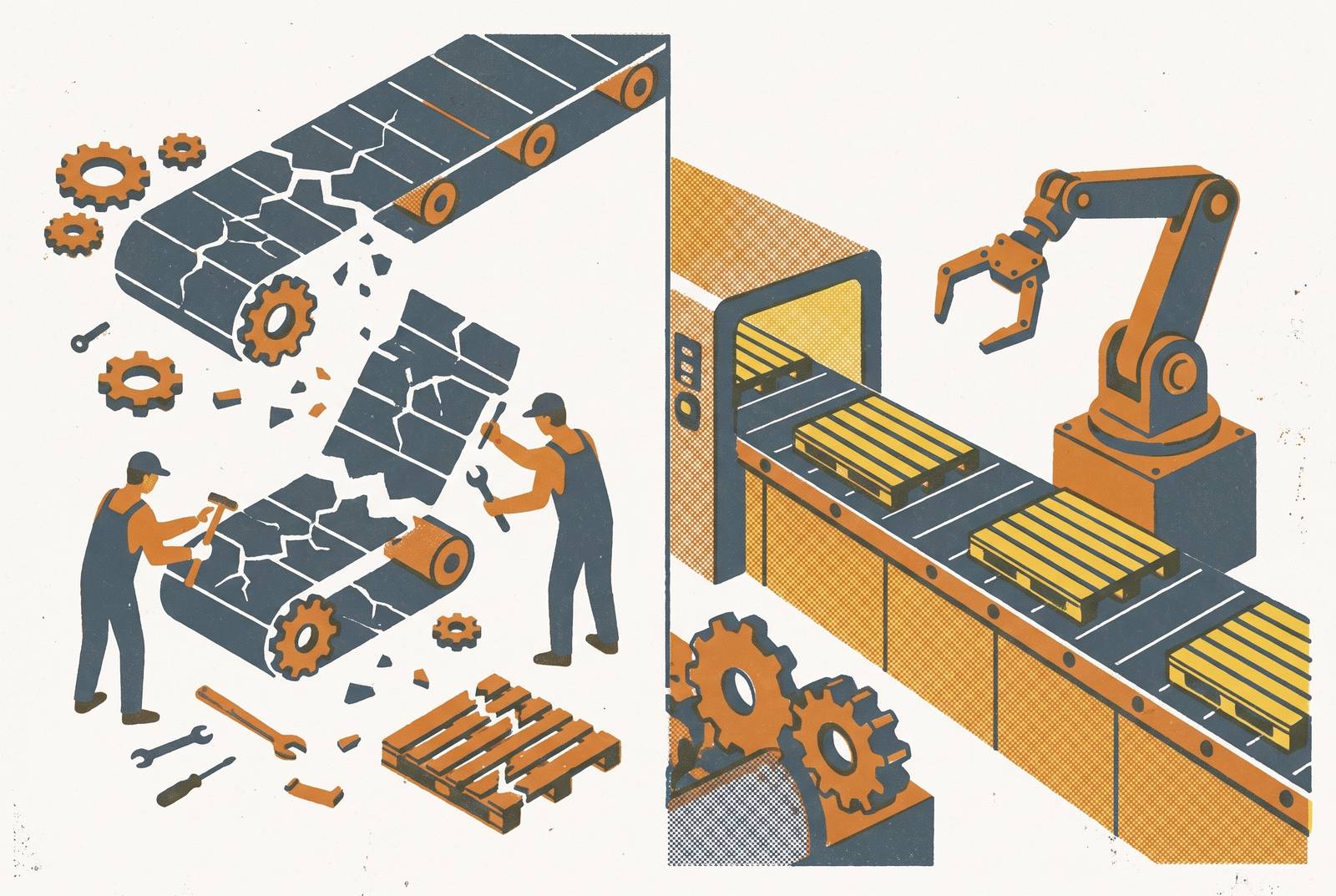
Applying automation to a broken process makes the problem faster and bigger
A workflow with unnecessary handoffs, unclear escalation rules, or data pulled from three systems that don't agree with each other doesn't improve when you bolt software onto it. It just does the same wrong thing more often, in less time. One team learned this the hard way after automating a content approval process without first cutting the redundant review steps buried inside it. The result wasn't fewer delays, it was the same delays arriving faster and more frequently, because the automation gave the team a quicker route to the same bottleneck. Speed made the flaw visible. It didn't make the flaw go away.
That outcome isn't an edge case. Deloitte's 2026 State of AI in the Enterprise report found that only about a third of organizations are reworking their business processes around AI, while 37% are applying it at a surface level, on top of workflows that remain unchanged. Most companies deploying AI right now are decorating the same broken machine rather than rebuilding it.
The counterargument sounds reasonable on paper: fix the process in parallel, while the automation runs. In practice, it rarely survives contact with how teams actually work. Once a process gets automated, its current logic becomes the thing people build around. Staff start optimizing their day-to-day around the automated flow, not questioning the flow itself, and the parallel fix that was supposed to happen quietly falls off the roadmap. Automation doesn't just fail to fix the process. It calcifies it.
How widespread automation-before-redesign is across process-intensive industries
This is not a scattered problem confined to a handful of laggard firms. In asset-heavy, process-intensive sectors, automating before redesigning is the default behavior, not the exception, and the evidence sits close to the surface in every industry that runs on complex, multi-step operations.
Deloitte's numbers set the scene: worker access to AI rose 50% in 2025, and expectations for scale are climbing fast, yet only about a third of organizations report truly reimagining how the business runs. The other two-thirds are polishing or exposing existing processes rather than restructuring them. Supply chain leaders reached a similar conclusion independently by late 2025: no algorithm, however sophisticated, compensates for data that doesn't match across systems or processes that were never standardized in the first place, and most enterprises simply haven't done that standardization work yet.
Logistics shows the pattern clearly. Most operators are stuck running ad-hoc pilots because legacy transportation and warehouse management systems, combined with workforce readiness gaps, block any real structural adoption. Tools are landing on top of architectures that were never built to hold them. Construction tells a similar story from a different angle: close to three-quarters of construction organizations hadn't gotten past early discussions on AI, or had no real capability at all, while the sector simultaneously suffers from near-universal project delays. Those two facts aren't a coincidence sitting side by side. They feed each other, because whatever automation does land gets applied to scheduling and procurement workflows that were already broken. Manufacturing looks more advanced on paper, with 2026 industry analysis treating AI as a board-level strategic priority, but the same analysis lists clean data, governance, and standardized processes as preconditions, and a lot of manufacturers are skipping straight past them.
The Automation-First Instinct
None of this happens because operations leaders are unaware of the risk. It happens because the incentives built into how process-intensive operations get measured and funded make automating first feel like the safer bet, even when it isn't.
Speed is one driver. A live pilot that automates an existing workflow can go live in weeks. A redesign requires mapping the process, auditing where it breaks, and rebuilding it before anything even runs, and that timeline is a hard sell against a quarterly roadmap. Measurement compounds the problem. Supply chain researchers have flagged a value realization gap where standard ROI metrics fail to capture how AI actually changes an operation, so teams fall back on what they can count: task throughput. Automation delivers that number even when the process underneath is broken, so it looks like success on the dashboard no matter what's actually happening on the floor.
There's also a structural trap in how pilots get evaluated. A proof of concept running on a broken process can look like real momentum, because small volumes hide small flaws. The failure only becomes visible once the system scales and the flaws scale along with it, by which point the pilot has already been approved for wider rollout. Deloitte's research adds a talent dimension: insufficient worker skill is the biggest barrier companies report to integrating AI, and the top response to that barrier is educating the workforce rather than redesigning roles or workflows. Companies are teaching people to move faster through the existing process rather than asking whether that process should exist in its current form⟴c10.
Governance lag closes the loop. Only about one in five companies has a mature governance model for autonomous AI agents, Deloitte's 2026 findings show. By the time a broken-process-plus-automation failure becomes obvious, the system has usually already been wired into three or four connected workflows, and pulling it back out costs far more than building it correctly would have.
The operational signals that tell you a process must be rebuilt before it can be automated
A broken process leaves fingerprints before it ever meets an automation vendor. Reading them correctly is what separates a process that's ready for automation from one that needs to be torn apart first.
An unusually high share of automated cases requiring manual review inside the first four weeks of a rollout is the first signal, and it appears fast. That pattern points to the process architecture itself as the cause, not the software running it. The second is a repeat-error pattern across unrelated case types. When the same class of mistake keeps recurring in transactions that have nothing to do with each other, the cause is structural: an ownership gap, a mismatched data source, or an escalation rule nobody wrote down. The third, and maybe the clearest, is when a team quietly stands up a second manual process to catch the mistakes the automated one keeps making. A compensating workaround running alongside the automation is about as direct a signal as it gets that the automation was built on a broken map.
Construction finance offers a granular version of these signals in practice. Project managers approve commitments without seeing current budget consumption. Finance reconciles invoices well after the fact instead of in real time. Change orders live outside the core system entirely, and compliance documents sit scattered across shared drives with no link back to the transactions they cover. Come audit season, teams aren't retrieving evidence, they're reconstructing it from scratch. A related signal appears in how construction projects get coordinated: when estimating, procurement, subcontractor management, project controls, field execution, and financial close all run through disconnected spreadsheets, email chains, and job cost tools that don't talk to each other, automating any single node in that chain doesn't fix margin leakage. It speeds it up.
Kuehne+Nagel is the contrast case worth studying. Facing a customs routing process, the company didn't automate what already existed. It redesigned the triage logic first, building a tiered confidence-scoring system that routes high-confidence cases straight through automation, sends mid-confidence cases to expedited human review, and hands low-confidence cases to specialist brokers. The redesign came first and shaped what the automation was allowed to do.
What Rebuilding a Process Requires
Rebuilding is a different category of work from automation. It's a different category of work entirely, and it starts by mapping how a process actually runs today, not how the flowchart on the intranet claims it runs.
That starting point takes the form of a process audit: sitting down with the people who actually execute a workflow and having them walk through it step by step, including the parts that hurt. Documented procedure and lived execution almost never match exactly, and the space between them is where the operational risk lives. The audit tends to surface the same categories of problems each time: handoffs that exist for historical reasons but carry no real decision authority, escalation rules that live only in someone's head, data entering the workflow from systems that were never designed to talk to each other, and ownership that everyone assumes is assigned but that no one can point to on paper.
Supply chain transformation research lays out the sequence without ambiguity: standardized processes and clean data have to exist before AI integration starts. Normalizing data so it keeps its business context while still working across systems is a requirement the rebuild has to satisfy before automation gets touched. The measurement framework belongs in this same phase, not tacked on afterward. Organizations that define their success metrics, direct cost reduction, operational velocity, strategic capability indicators, before deployment begins are the ones that can actually show value as implementation proceeds, rather than crossing their fingers that ROI shows up eventually.
The rebuild itself has to answer three questions for every step in the process: what gets automated, what still needs a human making a judgment call, and what should simply be eliminated because it never needed to exist. Kuehne+Nagel's tiered confidence model is a clean example of what that looks like in practice, where the triage logic itself was the design output, not something added after the automation was already built. Organizations that optimized their workflows before deploying automation were substantially more likely to see productivity gains in the first year, Forrester's 2025 Automation Landscape Report found. The organizations that skipped that step made up a disproportionate share of the group reporting that automation simply didn't deliver.
By the end of a genuine rebuild, a team should be able to answer, for every single step in the process, who owns it, what triggers it, what counts as a valid output, and how that output gets verified. If a process shows more than a baseline of automated cases requiring manual review within the first four weeks, the process architecture is the problem.
Where AI agents fit into a rebuilt process
AI agents dropped into a rebuilt process inherit clean ownership lines and clear decision logic. AI agents dropped into a process that was never rebuilt inherit every ambiguity that process ever had, and then execute on that ambiguity continuously, without anyone in the loop to catch it.
Deloitte's 2026 findings project agentic AI usage climbing sharply over the next two years, while oversight capacity lags well behind that curve. Only about one in five companies has a mature governance model built for autonomous agents, and that gap turns dangerous fast once agents start operating on top of process architectures nobody has actually examined. Part of what makes agents different from earlier automation is connectivity: agentic systems act simultaneously across CRM, ERP, finance, compliance, and customer-facing tools, which means a flaw sitting in one node doesn't stay contained. It propagates across every connected system at whatever speed the agent operates at. Several organizations that rushed agent pilots into production in 2025 without building real audit trail infrastructure are now finding that scaling those pilots requires going back and rebuilding the permission and logging systems they skipped the first time. That's a second rebuild, forced entirely by the impatience of the first.
The sequence that actually works runs in a fixed order: rebuild the process, define ownership and decision logic clearly, embed the agent at the specific step where it replaces or supports human judgment, and design governance and audit trails into the agent's operating parameters from the start rather than retrofitting them later. Microsoft's supply chain organization, which has scaled past 100 operational agents and reports hundreds of hours saved each month, illustrates what that looks like at scale, and those gains depend on the process architecture underneath being coherent enough for agents to run across it reliably. Supply Chain Management Review's 2026 analysis states the requirement: AI-first supply chains need clean data, standardized processes, and disciplined governance in place before any technology delivers value at the enterprise level. Agent deployment sits at the end of that sequence, not the beginning.
Choosing the first process to rebuild in a complex operation
Every operation running at scale has multiple broken processes competing for attention, so picking the right one to rebuild first matters as much as knowing how to rebuild. The right starting point is neither the most visible process nor the most complex one. It's the process where the field evidence of breakage is clearest and where the cost of leaving it broken can be traced directly to a number someone in the room already cares about.
Three criteria narrow the field: the process should show identifiable ownership gaps, carry a high volume of manual interventions or compensating workarounds, and produce an output that's measurable both before and after the rebuild. In construction, the procurement-to-commitment workflow tends to satisfy all three. It sits at the crossing point of budget control, subcontractor management, and financial close, and its failure mode, margin leakage that only becomes visible once reconciliation happens, is costly and easy to trace back to its source. In manufacturing, predictive maintenance is often the strongest opening move, because the failure it addresses, reactive maintenance triggered by unplanned downtime, is easy to quantify, the sensor and historical failure data usually already exists, and the rebuilt process has a clear path toward agentic deployment once the decision logic is sorted out. In logistics and supply chain, customs classification and freight audit stand out for the same reasons Kuehne+Nagel's redesign worked: high volume, direct error costs, and a triage structure that can be rebuilt cleanly before any agent gets introduced into it.
The discipline that ties all of this together is starting small and starting fast. A first rebuilt process that goes live in weeks, not quarters, proves the underlying principle inside a contained, low-risk domain and gives the rest of the organization a concrete reference point rather than a slide deck. That single proof becomes the argument for doing the same work everywhere else the broken processes are hiding.