AI Agent Orchestration in Multi-Step Logistics Workflows
Single-agent logistics systems stall on structure, and orchestration fixes it.
The limitation that stalls most early AI deployments in logistics has nothing to do with which model a company picks. It's architectural. A single agent asked to run an end-to-end logistics workflow hits hard ceilings that no amount of prompt tuning or model upgrading will move, because the problem isn't intelligence, it's structure. The common design, sometimes called the "God Model" pattern, puts one large model behind one massive prompt and asks it to carry the whole task. That pattern produces slow response times, makes things up once the task gets complicated, and breaks down logically whenever the job runs past a handful of steps. A shipment moving through a real network touches demand forecasting, carrier selection, route optimization, customs paperwork, warehouse dispatch, and exception handling along the way, and no single agent can hold the context, the tool access, and the domain-specific logic for all of those at once without something slipping. The scale of the data makes this worse before it makes it better: a single delivery vehicle throws off more than 25,000 data points a day, and across a full network the volume of signals coming in exceeds what any one reasoning loop can sort through and act on without its performance degrading. A documented fintech deployment shows the same failure pattern outside logistics entirely: agents built for loan approval worked fine individually but fell apart mid-workflow, because nothing above them governed the order of operations, the dependencies between steps, or the state of the task as it moved along. Logistics pipelines fail the same way, for the same reason. Moving from one agent to many isn't an upgrade to the same architecture, it's a different architecture built to solve a different class of problem.
What multi-agent orchestration means as an operating layer
Orchestration is a coordination layer that decides what runs, in what order, with what data, what happens when a step fails, and what gets recorded across the whole workflow. Connecting agents through an API is the easy part. Orchestration handles everything an API alone doesn't: the sequence agents run in, what happens when one of them fails, who has the authority to override a decision, and how the whole run gets audited afterward. Think of the orchestration layer as sitting above the individual models the way a conductor sits above an orchestra. It decides which components play when, routes information between them, manages context at every point where one agent hands work to another, and enforces who's allowed to do what. That work breaks into three distinct jobs: deciding what runs and in what order, moving state from one step to the next (the part where most implementations actually fail), and handling retries, fallbacks, and governance when something goes wrong.
The most common design pattern for this is a supervisor sitting above a set of workers. A supervisor agent takes in the top-level task, breaks it into sub-tasks, hands each one to a specialized agent built for that narrow job, pulls the results back together, and escalates anything that falls outside normal parameters to a human. The agents underneath the supervisor are specialists built for one job each. A procurement workflow built this way might start with a manager agent receiving an instruction as broad as "source and onboard a new logistics vendor." The manager hands sourcing to one agent, contract review to a second, and onboarding to a third, then stitches their outputs into a single result. This is distinct from a reporting layer that just summarizes what already happened. The orchestration layer runs inside the workflow as it happens; it doesn't narrate the outcome after the fact. Deloitte's research on agent orchestration describes this kind of coordination as what "unleashes intelligent workflows," by letting multi-agent systems interpret a request, design the workflow needed to fulfill it, delegate and coordinate the tasks inside it, and keep checking and improving the outcome as it runs. The same research is direct about the downside: weak orchestration can hold back most of the business value a company might otherwise get from these deployments.
The five orchestration patterns that appear in production logistics systems
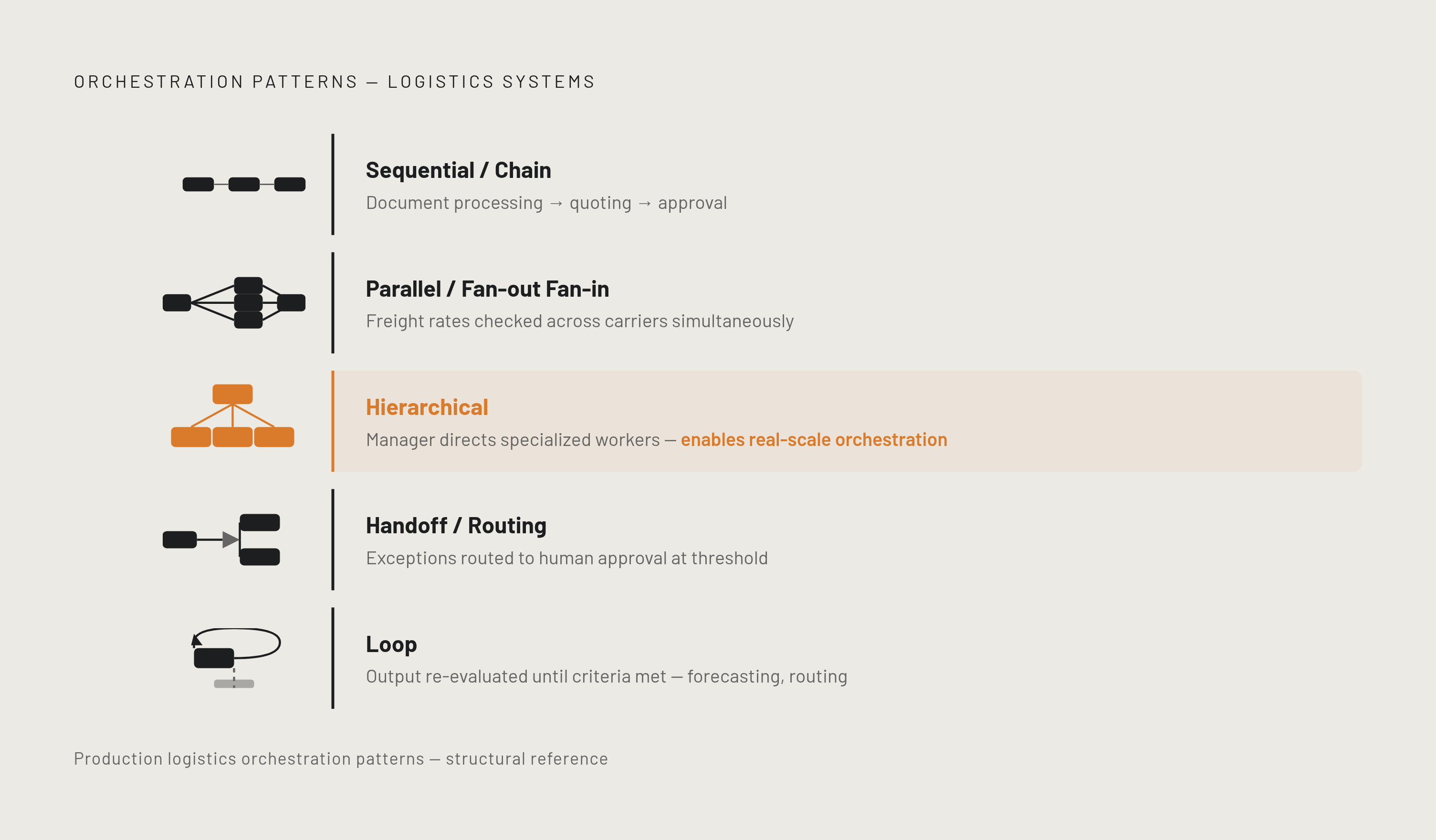
Production logistics systems rarely run on one orchestration pattern alone. They combine several, and knowing which pattern governs which part of a workflow is what separates a design that holds up from one that breaks under its own weight. Five patterns show up repeatedly in production logistics systems, often layered together inside a single deployment.
The sequential, or chain, pattern runs agents in fixed order, with each one passing its output to the next, the way document processing might feed into quoting, which feeds into approval. It's dependable but rigid: if an upstream step fails, there's no good way to route around it. The parallel pattern, sometimes called fan-out/fan-in, has a coordinator agent send work out to several agents at once and wait for all of them to finish before combining the results, a design well suited to something like checking freight rates across multiple carriers at the same time. The hierarchical pattern, with a manager directing specialized workers, is what makes full end-to-end logistics orchestration workable at any real scale, since it lets one supervisor break a complex task apart and route each piece to the agent built for it. The handoff pattern, also called routing, moves a task from one agent to another based on a decision rule, the way an automated fulfillment agent might route an exception to a human-approval agent once it crosses a defined threshold. The loop pattern checks an agent's output against a set of criteria and sends it back for revision if it doesn't pass, which matters most in demand forecasting and route optimization, where a first-pass answer has to meet service-level requirements before anyone acts on it.
Most production systems don't pick one of these and stop there. A real deployment might run document ingestion as a sequential chain, manage exceptions through a hierarchical structure, and validate plans through a loop, all inside the same system. There's a technical reason graph-based orchestration platforms have become the default for this kind of work: they handle loops, retries, conditional branches, and human approval gates in a way that static, fixed coordination simply can't, because static designs have no way to represent a path that needs to change while the workflow is running. Platforms built to persist context across interactions let an agent pause, wait for a human to weigh in, and pick back up without losing track of where it was. This capability affects project viability directly: more than 40% of today's agentic AI projects are at risk of being shelved by 2027 over unexpected cost, the difficulty of scaling, or risks nobody planned for. Context fragmentation often drives those costs quietly: when customer history sits in one system, project context in another, and approval rules in a third, an agent with no synthesized view across all of them treats every workflow as if it's starting from zero, and someone on the operations team ends up re-explaining business rules the system should already know. Most 3PL and carrier networks run several of these patterns at once across a single shipment's life cycle, and recognizing which pattern is supposed to govern which segment is the first step in figuring out where a workflow actually breaks.
Handoffs and shared context across a live logistics workflow
The handoff, not the individual agent, is where most multi-agent logistics systems either hold up under pressure or fail quietly. Context that doesn't get explicitly passed from one agent to the next is context that's gone. A full logistics workflow runs from demand signal intake through inventory positioning, carrier assignment, route optimization, customs and documentation, last-mile dispatch, and exception handling, and each of those segments is a candidate for its own specialized agent. Every boundary between two segments is a handoff point, and each one is a place where the system can either carry its reasoning forward or lose it.
A handoff that works carries more than the previous agent's output. It carries the state behind that output: what was already tried, what constraints are currently in force, what exceptions are already open elsewhere in the system. Without that, the agent receiving the handoff has to re-reason the problem from scratch, and it can end up contradicting a decision another agent already made upstream. Context fragmentation, more than coordination bugs, is what kills these projects, because agents without a shared, synthesized memory of the organization treat every workflow as an isolated event rather than part of a continuous operation. GE Appliances offers a concrete, large-scale version of what it looks like when this works: more than 800 AI agents run across its manufacturing, logistics, and supply chain operations, inside a platform called Brilliant Factory that tracks production performance, part genealogy, and workforce activity across lines, shifts, and plants. The single most impactful agent in that deployment manages communication with more than 600 suppliers, automating the routine order-status queries that would otherwise tie up a procurement team's time. What makes that agent useful at that scale is the handoff between it and the procurement and fulfillment steps downstream, since the supplier-facing agent's output has to land somewhere that can act on it immediately.
BCG's research describes a comparable pattern at a global consumer goods company, where inconsistent data and backward-looking analytics meant the supply chain team spent most of its time firefighting rather than planning. The redesign connected agents across planning and execution so the system itself could spot problems, draft complex plans, and explain its reasoning, which freed the human team to focus on verification and the strategic calls that still need a person. None of this removes people from the loop. It places them deliberately. Deloitte's framing of an "autonomy spectrum", humans in the loop, on the loop, or out of it entirely, treats escalation as something designed into the orchestration from the start, not something improvised the first time a workflow goes sideways.
What breaks in multi-agent logistics systems under operational pressure
Most of what collapses a multi-agent logistics deployment is a gap in architecture or organization that only becomes visible once the system is running real workflows at real scale. The math alone works against long chains: in a 10-step agent workflow, even if every individual step is highly reliable on its own, the end-to-end success rate across all 10 falls off substantially, because the odds compound against clean execution with every added step. Without a recovery path designed in at each one, a long logistics chain is a long chain of chances to fail.
Five failure categories appear repeatedly in enterprise deployments. Governance gaps happen when an agent acts outside policy because no written policy exists covering what it's allowed to access or override, and most enterprises still haven't written one. Transparency gaps happen when a reviewer can't reconstruct what an agent did or why, because the audit trail is missing or too thin to be useful for compliance or for debugging. Coordination gaps occur when agents that passed validation individually drift out of sync once they're running together, because one agent's output becomes another's input under assumptions that no longer hold. Safety gaps open when untrusted input, a supplier email, a carrier status update, works its way into an agent's reasoning, and that agent has write access to a production system that acts on it. The fifth failure, plateaued improvement, is the most dangerous organizationally: a deployment stops getting better even as the underlying model gets upgraded, because the data and the process feeding it were broken from the start, and that looks like a technology ceiling when it's actually unfinished process work.
The dominant failure mode across all of these is organizational. Bad data doesn't just limit how well a system performs, it produces confidently wrong outputs at scale, which makes a flawed automated process more expensive than doing the work by hand. Deloitte's research puts a number on the consequence: more than 40% of current agentic AI projects are at risk of cancellation by 2027 over unanticipated cost, scaling complexity, or risks that weren't planned for. Long-horizon tasks carry a specific version of this risk in logistics, because workflows that span many steps, need sustained context, or coordinate across several systems are exactly where logistics AI aims highest, and exactly where a coherence failure, a wrong decision buried in the middle of a chain, or a state the system can't recover from costs the most. Only a small share of enterprise agents built in pilot ever make it to production, and the agents that don't make it rarely fail because of their own quality. They drop out at the boundaries where orchestration was supposed to hold them together. These gaps are specific enough to name. That means they're specific enough to design around.
What separates orchestration deployments that hold from those that collapse
Organizations whose multi-agent logistics systems survive contact with real operational pressure share a set of design choices that rarely appear in a vendor demo but decide the outcome in production.
The first is sequencing: redesigning the process before deploying the agents, not after. BCG's research is direct that the real breakthrough requires rewiring workflows end-to-end, and that most companies stay stuck on narrow use cases and copilot-style tools that deliver only marginal gains, because they're layering agents onto a process that was never built for them. InPost's experience puts a number behind the cost of skipping that step: the algorithm by itself delivered only a fraction of the eventual improvement, and process redesign delivered the rest.
The second is governance built into the architecture from the start. That means role-based access control for every agent, with each one provisioned under specific permissions scoped tightly to the tools it actually needs, along with written policy covering what agents can access, what they can override, and how every action gets logged for audit. Human-in-the-loop escalation belongs in this same category: a designed handoff point for high-risk decisions, built into the workflow from day one, not an emergency brake added after a failure.
The third is observability as a basic requirement. Deloitte's research identifies outcome tracing, visualization of the orchestration itself, and telemetry dashboards for individual agents as the infrastructure that makes real human oversight possible. Without that infrastructure, oversight is a word on a slide, not a function the system actually performs. The most advanced organizations are building toward a model where humans set the parameters and review the exceptions rather than approving every single step, and that model depends on the observability and governance pieces already being in place.
The last is sequencing the investment itself. BCG's research notes that this kind of transformation can largely fund itself: the productivity gains from an early, well-chosen agent deployment pay for the broader redesign that follows. That argues for starting with one process done right over spending first on a platform and hoping the returns show up later.