AI Agent Deployment in Warehouse Fulfillment Operations
Agents only work in warehouses with rebuilt workflows and trusted data.
AI agent deployment in warehouse fulfillment is a process redesign decision. Agents keep delivering value when they work inside rebuilt workflows with data they can trust, clear decision rights, and systems that connect to each other.
Why most warehouses are structurally set up to fail at AI agent deployment
Most warehouses can see more than they can act on. Dashboards, KPI reports, and BI tools surface problems, but a human still has to trigger the next step. This is a structural gap. Planners spend their days retrieving shipment locations, arrival times, and proof of delivery, displacing decisions that require judgment. An agent can absorb that retrieval load, but only when the information underneath it is trustworthy.
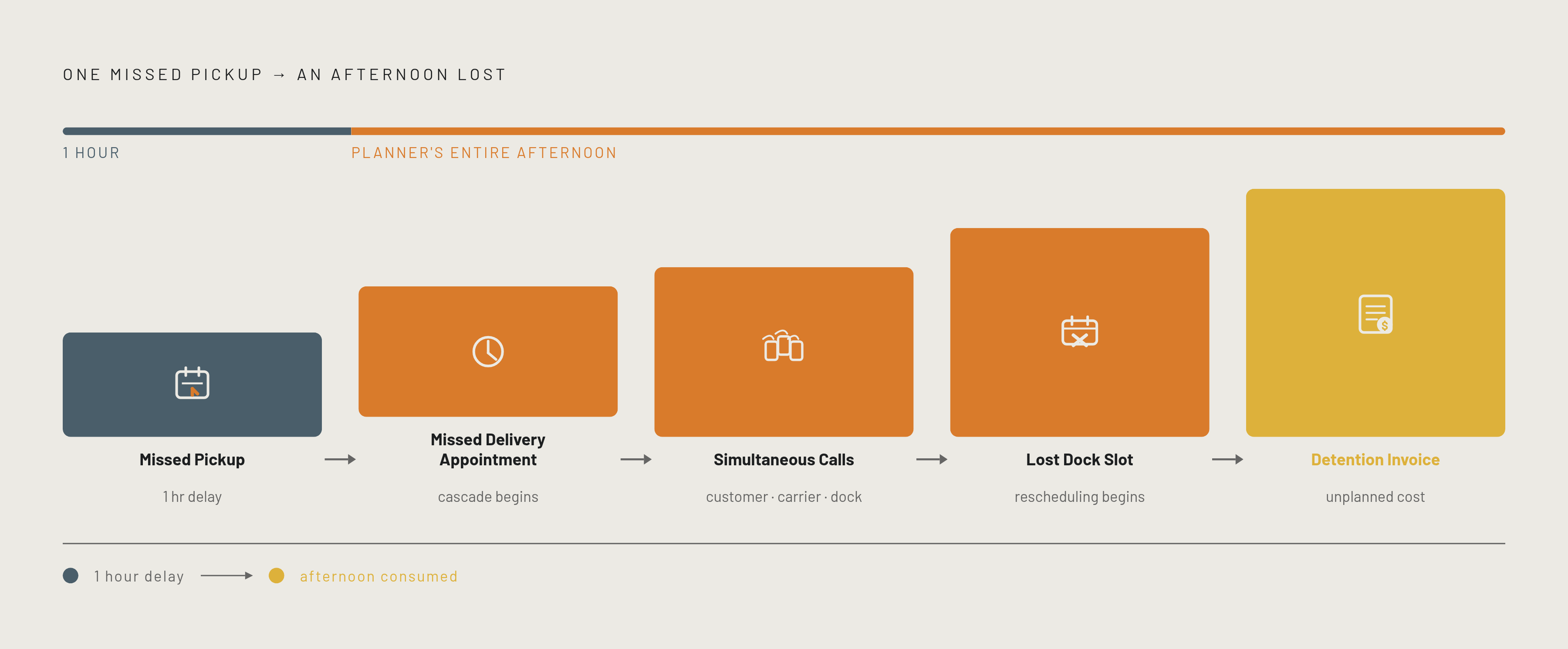
The way most warehouses work in 2026 makes this gap worse through exception management. A missed pickup becomes a missed delivery appointment, simultaneous calls from the customer, carrier, and receiving dock, a lost dock slot, and a detention invoice. The delay costs an hour, while the cascade consumes a planner’s afternoon. Agents intervene in that coordination chain. Purpose-built automation still does the physical work, but software must connect the decisions around it.
The MHI/Deloitte 2026 supply chain report says that growth in e-commerce is changing warehouse floors. As customers expect same-day and next-day delivery, operators are moving toward micro-fulfillment and real-time inventory synchronization across stores, warehouses, and online platforms. At that scale, those demands show the limits of having people coordinate the work one exception at a time. MHI CEO John Paxton states the architectural problem plainly. “Supply chains can no longer be optimized at the edges. They must be rewired end-to-end.”
What AI agents actually do in a fulfillment operation, and what they don't
AI agents are autonomous decision-execution systems. They interpret signals from WMS, ERP, TMS, and IoT platforms to make decisions about routing, inventory placement, and freight optimization. An agent responds to the available evidence, including in situations no one anticipated. When a shipment is delayed or a supplier goes offline, it evaluates alternatives. It then executes a response within its authority or escalates with a recommended action and the relevant context.
Exotec’s 2026 warehouse trends analysis describes agentic AI within the WMS layer beginning to handle situations for which no orchestration rule was written. That capability can clear exceptions before they become late orders, but it does not remove the need for operational boundaries. Agents do not fix roads, override physics, or replace human judgment about cost, risk, and customer relationships. The working oversight model is human-on-the-loop, with agents executing routine decisions and people handling unusual exceptions and policy. It is not a model in which every routine action waits for human approval.
Physical AI is related but distinct. Robotic arms with AI-driven sensors can change their grip force in real time, so fragile SKUs can pass through automated operations that used to need manual handling. That changes what a machine can be trusted to touch. Agentic software instead changes which decisions a system can be trusted to execute.
Where agents are actually landing in fulfillment operations today
Inventory, replenishment, and demand planning are prominent deployment areas, although organizations are at different stages. Dollar General CEO Todd Vasos said on the August 27, 2026 earnings call that the company was building agentic operating systems to reshape workflows and improve productivity. Lowe’s announced in March 2026 that it was scaling its Relex partnership to unify inventory planning and replenishment, with full implementation targeted for early 2027. The MHI/Deloitte 2026 report says AI is already helping with inventory management and demand planning.
Handling shipment status and ETA makes up the largest share of work in dispatch operations. An agent reads the TMS, supplies an answer with a timestamp, and proactively notifies when the ETA changes. USPS also shows how AI is being used in shipment operations, with detection tools helping close more than a thousand accounts that have generated counterfeit shipping labels since January 2026. Its Advanced Expected Delivery program uses machine learning to estimate when deliveries will arrive. For agents, the coordination value lies in sorting an exception into a reroute, a customer notification, or a planner decision.
Enterprise orchestration links several steps in this work. Microsoft’s supply chain organization is targeting over 100 operational agents by the end of 2026 after reporting hundreds of hours saved monthly. Infor’s April 2026 Industry AI release expanded its Industry AI Agent library and enhanced its Agentic Orchestrator. The release connected Infor and non-Infor systems and made it easier to see how agents reason before they go into production.
Freight decisions take the same way of coordinating work beyond the facility. Trax Technologies’ 2026 logistics analysis names autonomous route optimization and freight consolidation as areas to focus on, and carrier selection as another place to start. These decisions happen often enough to produce the data agents need. Across these categories, the shared profile is high volume, low ambiguity, and information that already exists. Agents have the strongest foundation when a unified data plane is in place before they are added.
Why the majority of agent deployments stall between pilot and production
The reported 70–88% failure rate between demonstration and production suggests that failures stem from more than what the model can do. A pilot can show that an agent makes a useful decision without showing that it can operate reliably across systems. Production failures include selecting the wrong cluster, environment, or account, making conflicting decisions across agents, entering runaway workflows, and changing system state without approval. Each exposes a weakness in data architecture or process governance. These operating failures can be foreseen, and deployment can still go ahead.
The less visible failures can be more persistent. An agent may continue running with stale OAuth tokens or expired API keys while its tool calls silently return errors. It still produces outputs, but those outputs no longer rest on successful access to the required systems. As agent fleets have grown, monitoring has fallen behind, making this gap harder to spot.
Many enterprises allow AI access to core systems without effectively governing that access, while cost overruns further weaken the business case. The MHI/Deloitte 2026 report describes leaders as “getting stuck on where to start and what it takes to scale”. It names unclear use cases, automation cost, difficulty building a business case, talent shortages, and budget constraints as blockers. The practical response is to establish the missing conditions before the pilot becomes a production dependency.
The operational conditions that have to exist before any agent can perform
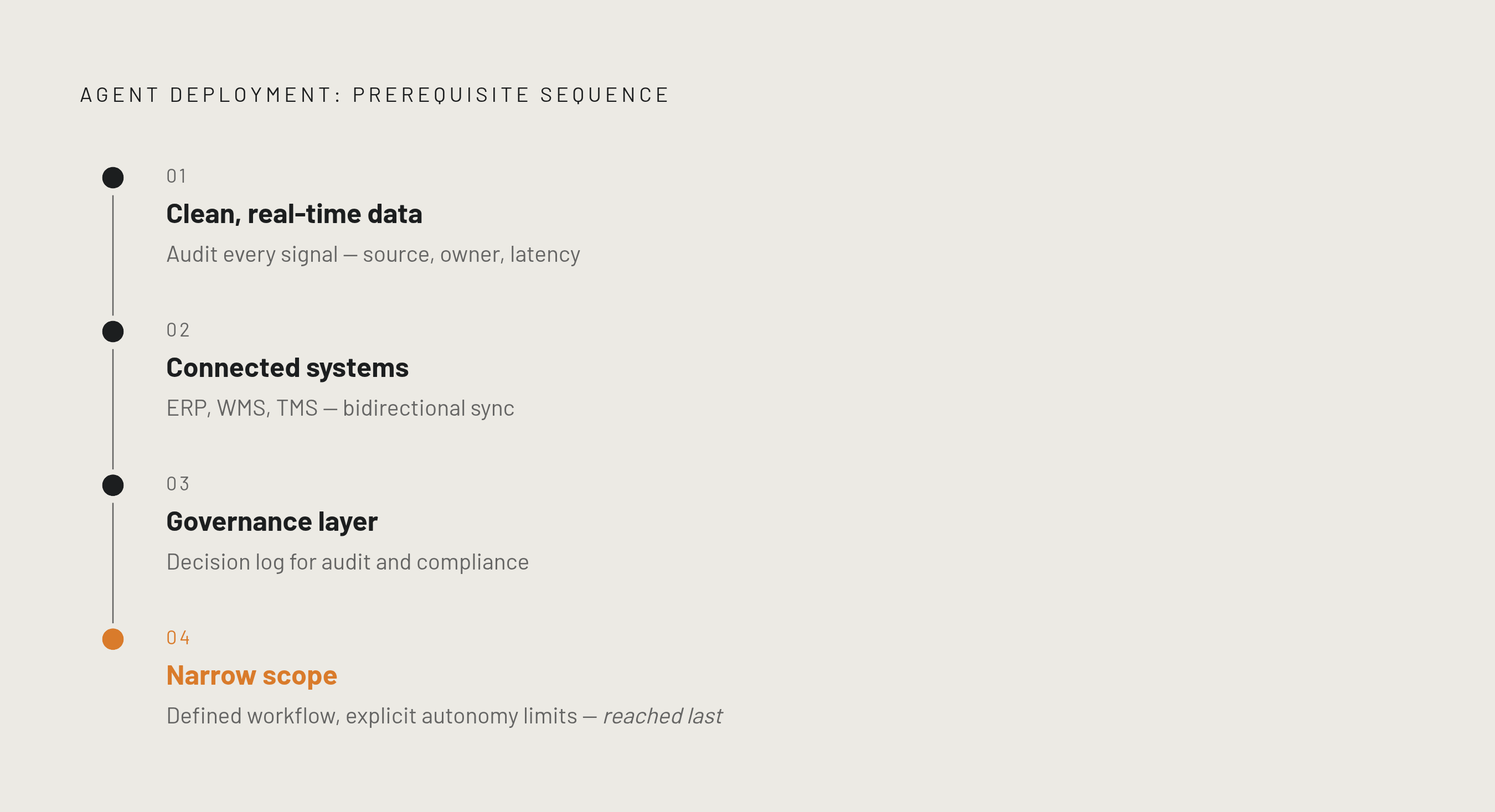
Clean, real-time data is the first condition because an agent can only decide from the signals it receives. Impact Analytics’ 2026 retail supply chain playbook states that an agent without live inventory levels acts on stale numbers. Its recommended data audit maps where each signal lives and documents the system and its owner. Freight invoices, carrier performance records, and operational cost data belong in this assessment when the workflow depends on them.
Connected systems are the next condition because reading a problem and acting on it are different capabilities. ERP, WMS, and TMS connections need the integration depth and bidirectional synchronization required by the workflow. A unified integration layer links those systems, while an intelligence layer keeps track of context across the work. A governance layer must keep a log of decisions for audit and compliance. Together, these address the access, context, and unauthorized-action failures that appear when a pilot moves into production.
A narrow scope makes those controls usable. The first agent needs a defined workflow and explicit limits on autonomous decisions, rather than a broad instruction to optimize fulfillment. Exotec’s 2026 analysis frames the evaluation around which decisions the agent may make, what happens when it is wrong, and what that error can cost the business. The 2026 Singapore Consensus on Global AI Safety identifies governing principles including least privilege, traceable identity, auditability, interruptibility, and human oversight. Those principles have to guide the scope before launch, while there is still time to build authority and escalation paths into the process.
Why agents only hold their value when the underlying process has been rebuilt, not patched
An agent layered onto an unreconstructed workflow inherits its dependencies and ambiguity. Faster execution can carry disconnected information and unresolved decision ownership into more actions. Rebuilding changes the conditions under which decisions are made, including the information available, the authority to act, and the point at which a person takes over.
Inventory planning, delivery estimates, and exception handling depend on shared signals and connected functions. Deloitte Consulting’s Wanda Johnson, Supply Chain Technology Fellow, describes this connection in the MHI/Deloitte 2026 report. “Those who connect operational excellence, AI-driven orchestration, and workforce readiness into a single playbook will not just withstand disruption; they will convert it into sustained performance and growth”.
Starting with the existing process and iterating may appear faster. However, that approach leaves the agent’s decision quality bounded by the process it inherits. Exotec’s 2026 analysis states that AI works best where data is abundant, consistently structured, and mistakes are cheap, while warehouses commonly provide only the first condition. Rebuilding addresses the other conditions by structuring the data and limiting the consequences of autonomous error within a governed workflow. The process audit therefore comes first, followed by the workflow rebuild and then agent deployment.
How to identify the first process worth rebuilding around an agent
The first candidate is a painful, frequent process in which human time goes mainly to retrieval and coordination. It must occur often enough to generate useful data, follow clear and documentable decision patterns, and have a recoverable cost of error. The required information must also exist in a connected system. These criteria turn an attractive idea into an operationally bounded use case. They favor a process that can be understood and governed over one that merely sounds ambitious.
Shipment status and ETA handling, appointment booking and rescheduling, proof-of-delivery retrieval, and exception classification commonly fit this profile. They account for much of dispatch volume and depend heavily on information that already exists. Demand and inventory signals are a later phase in this starting sequence because they require clean historical data and produce recommendations. This distinguishes the prerequisites for planning work from those for routine coordination.
Trax Technologies’ 2026 analysis recommends identifying repetitive decisions with clear patterns, cleaning freight and transportation data, and mapping where people make routing, scheduling, and resource allocation decisions. It also calls for testing autonomous decision-making first in areas where the risk is low. The process audit gives that preparation a concrete form by having teams show exactly how the work runs today and where it hurts. Only then is there a sound basis for deciding what to rebuild, before any technology commitment. The closing discipline is one governed workflow, proven in production, before the next one is touched.