Procurement Risk Signals in Large Construction Programs
Bid gaps, lead times, supplier overlap, and buyout timing flag delays early.

Procurement risk in large construction programs is visible in procurement records before schedule slippage appears in the program report. Lead time exposure, supplier concentration, bid-price-to-input-cost gaps, and buyout timing show whether the delivery assumptions will hold.
Why procurement has become the primary schedule-setting function in large programs
The function that looks administrative now sets the schedule. Procurement decisions made months before site work begins set the delivery dates that the construction sequence can support. Long-lead equipment, supplier constraints, tariff volatility, and complex delivery models have moved those decisions to the front of the critical path. By the time their consequences appear in the field, the program has often committed to assumptions that are expensive to change.
Krane’s September 2026 analysis places procurement at the center of schedule performance and describes manual processes that were not designed for that responsibility. Maintaining logs consumes significant time, while following up with thirty-plus subcontractors can become a full-time job on a large project. Yet activity is not the same as visibility. Construction keeps close track of on-site progress, but upstream it often tracks only whether a document or update has arrived. As a result, the program can appear controlled while the conditions needed to execute its schedule remain unresolved.
Why the bid-price-to-input-cost gap is the first signal to read
The gap between bid prices and input costs shows where that apparent control can break down before a purchase order goes out. When inputs rise faster than bids, the difference reveals pressure on contractor margins and the timing of cost pass-through. It also indicates where cost surprises may emerge as scope moves from estimate to purchase. A low bid is therefore not evidence, by itself, that the underlying supply has become less expensive.
JLL’s mid-year 2026 construction perspective concludes that bid prices in the back half of 2026 will close that gap because contractors have neither the desire nor the capacity to compress margins further. The update identifies tariff pass-through that was slow to materialize through 2025 but is now reaching project estimates. Metals, lumber, and equipment are exposed to more than one tariff regime. The mismatch provides the signal. For an unbought package, a bid based on earlier conditions may no longer describe the cost of securing the required scope.
That mismatch also changes the reading of contractor risk. A contractor bidding thin has less room to absorb scope changes or acceleration and may struggle to do the work. The gap is therefore both a leading indicator of financial stress and a forecast of higher prices. ABC Rocky Mountain’s analysis identifies volatility in steel, switchgear, and asphalt that broad averages can mask, placing the exposure unevenly across specific packages in the estimate.
Lead time exposure as a schedule signal, not a logistics footnote
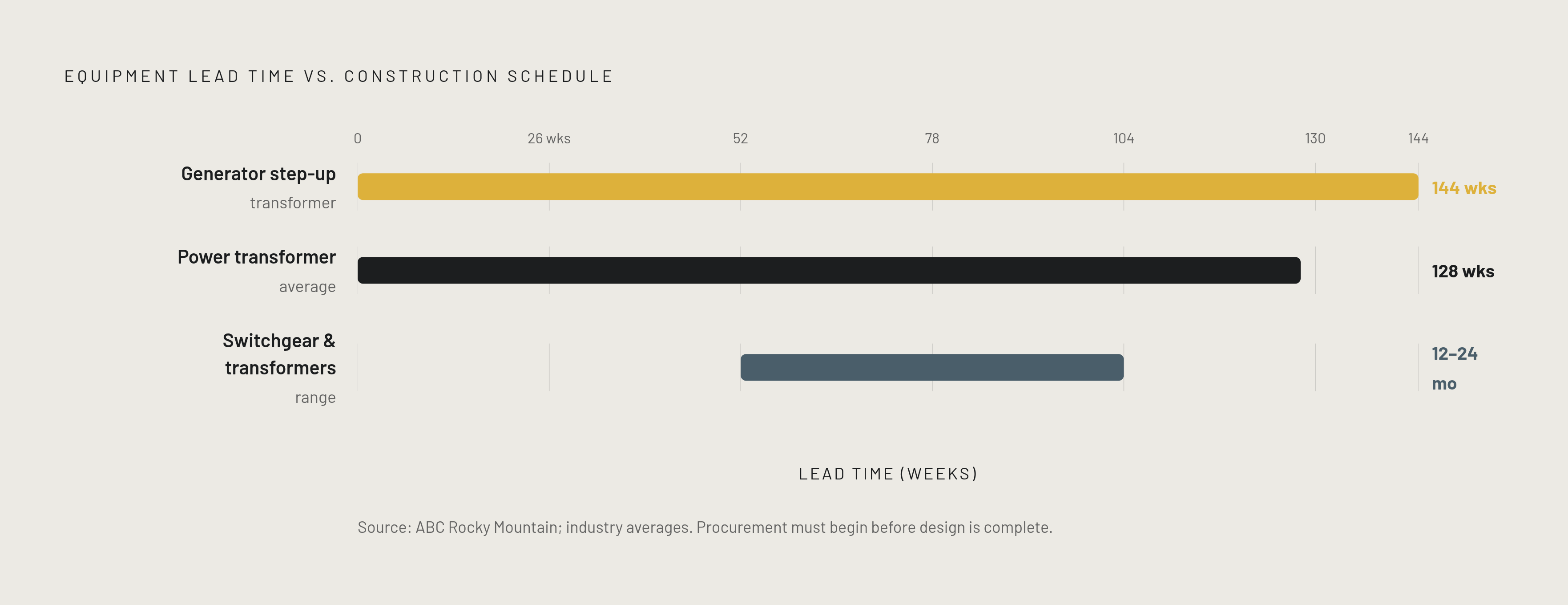
Cost pressure affects the terms of supply, while supply can support the required date only if lead times fit the schedule. Krane’s analysis documents average lead times of roughly 128 weeks for power transformers and up to 144 weeks for generator step-up transformers. Those durations can exceed the construction schedule they are expected to serve. Working faster in the field cannot make up for time already lost while waiting for equipment.
ABC Rocky Mountain’s 2026 playbook identifies switchgear and transformer procurement, with lead times of 12–24 months, as a risk bucket to map before building the estimate. The differing ranges reinforce the need to account for the actual equipment requirement when setting a generic electrical allowance. Where high-voltage transformers and medium-voltage switchgear govern commissioning, waiting until design is substantially complete can make the required date unattainable. Procurement timing then becomes a condition to establish when setting the baseline.
Hyperscale data center programs make this relationship especially clear because energization is the real commissioning gate. The same logic applies to any large program whose occupancy or operation depends on long-lead mechanical or electrical equipment. Quoted lead times that differ from market lead times on comparable projects provide a useful signal. A subcontractor’s estimate alone does not show that the schedule can be met. If the same equipment category or unsupported assumption appears across several jobs, the exposure also needs to become visible at portfolio level before it constrains the other projects.
Supplier concentration as a hidden program risk that procurement logs rarely capture
Even a credible lead time does not describe the full exposure when several packages depend on the same source of supply. Multiple scopes can look independently procured while relying on one supplier, one constrained trade, or one regional labor pool. That dependency makes a program brittle. A package-level log may show each commitment without revealing how much of the program depends on the same capacity remaining available.
JLL’s update identifies 61% of U.S. metro markets as supply-constrained, with pipeline growth running materially ahead of labor force growth and the constrained share rising further by 2027. It also identifies demand concentrated in electricians, mechanical contractors, HVAC technicians, and pipefitters where the existing labor pool is smallest. For procurement, this is not simply a workforce trend. Programs that draw on those pools compete for the same thin supply, even when their contracts name different firms. Geography can therefore create concentration that a supplier-name review alone will miss.
JLL also distinguishes data-center-adjacent demand from other work, leaving a procurement window for programs that do not compete for the same contractor capacity. Overlap between the program’s supplier base and that congested segment affects access to the procurement window. ABC Rocky Mountain’s framework lists supplier insolvency and capacity constraints as risks, especially for electrical switchgear and transformers, and points to diversification and spend analysis as ways to respond. Those responses require a cross-package view. Without aggregated procurement data, repeated supplier names, trade categories, and geographic dependencies remain separate entries that obscure program-level exposure.
Buyout timing as the signal that reveals whether a program’s schedule is real
Buyout brings cost, time, and capacity assumptions into the same test. Its timing and completeness show how much of the declared schedule is supported by current commitments and how much still depends on unresolved scope. Open subcontractor packages at mobilization are one visible condition. Expired quote validity periods, escalation clauses not priced into the bid, and quotes that predate material price movements expose other gaps between the plan and the terms on which it can be delivered.
ABC Rocky Mountain’s playbook describes consistent bid-risk reviews, standardized escalation clauses, documented quote validity, and coordinated handoffs between estimating, procurement, and project management as features of strong procurement discipline. These practices connect the bid to the eventual commitment. Allowance cost analysis at the bid stage addresses a related failure mode, in which underestimated allowances become change orders when the real scope is procured. Those changes arrive during buyout, when margins may already be thin. Buyout incompleteness therefore leaves cost and schedule exposure unresolved at the same time.
DPR’s Q2 2026 observation, “if you wait until they start canceling orders, it's already too late”, distinguishes the outcome from the earlier signal. Several notices from the same vendor can show that its capacity is under strain before it cancels an order. Reading those notices during buyout gives them a different purpose from filing them as correspondence after the delivery plan has failed. Timing also has a competitive dimension. JLL’s update identifies a procurement window for owners who move before it closes, making the date of commitment relevant to access to capacity as well as risk control.
Why these signals stay invisible inside standard procurement processes
Standard procurement processes obscure these relationships because their basic unit of control is usually the package. Supplier concentration is visible across records, and lead times can conflict between packages. A process designed to administer individual commitments will not reveal those relationships merely because each team maintains its own log accurately.
An open submittal tells the reader that work remains, but not whether delay to that item would push the finish date. Vendor estimates and subcontractor updates have a similar weakness when they are recorded without comparison against market conditions or comparable projects.
Weekly status meetings share information teams already know, while the unread signals may lie in relationships that no individual package owner can see. Reconstructed procurement records add another weakness because they provide neither reliable real-time evidence nor timely warning of changing conditions. Even with closer attention to the same fields, the process still needs to link commitments and market evidence to their effects on the schedule before assumptions are locked.
What a procurement signal-reading discipline actually looks like in practice
The starting point for a program adopting this discipline is a process audit. That audit maps how procurement runs today and identifies the specific, painful process that needs to change. It establishes where information arrives too late, where package boundaries hide dependencies, and where updates remain disconnected from schedule decisions. Software selection follows that diagnosis. Otherwise, the program risks accelerating the production of status information without improving its ability to detect exposure.
The operational change is to make schedule impact determine priority. Mapping submittals to the schedule allows teams to distinguish an open item that threatens the finish date from one that does not. Benchmarking vendor quotes against real-world lead times provides a separate test of whether the assumed delivery date is plausible. Both comparisons belong before commitments harden. At portfolio level, aggregating equipment categories, suppliers, and lead-time assumptions allows leadership to recognize repeated exposure early enough to reallocate attention or escalate it.
Krane’s analysis gives AI a specific supporting role in this work, including extracting critical materials from specifications and schedules, flagging missing or incomplete submittal data, and automating follow-up. Its platform gets real lead times from data on active projects in place of vendor estimates or industry averages. This makes AI an operational mechanism. Document AI serves a different control by supporting three-way matching across purchase orders, delivery tickets, and invoices, identifying overbilling, substitutions, and quantity mismatches at transaction level. Those checks strengthen the evidence base but do not replace the earlier assessment of schedule exposure.
Agentic AI in construction in 2026 remains narrow in scope, covering work such as drafting RFIs, first-pass submittal review, tender and bid analysis, daily logs, and schedule risk detection. A handful of firms are piloting agents that re-sequence dependent tasks and notify affected trades when deliveries slip, but these systems are not yet running core delivery workflows. The boundary is important for procurement decisions. The practical test is whether the redesigned process brings a warning into the decision while the program can still act on it, rather than explaining the missed date more efficiently afterward.