Energization Readiness Failures in Infrastructure Projects
Grid queues, equipment lead times, and weak tracking each quietly erode an energization date.
Energization readiness failures in infrastructure projects are the compounded result of identifiable breakdowns in connection queues, procurement, coordination, and tracking. A credible energization date depends on exposing those dependencies early, rather than treating a completed asset and a scheduled connection as proof that a project is ready to operate.
Why energization is now the critical path, not generation
IEA Electricity 2026 identifies grid capacity as a bottleneck for connecting generation, storage, and demand. Generation can be built in one to five years, while new grid infrastructure takes far longer to plan, permit, and complete. A project can remain on schedule for its turbines or panels and still face a years-long wait for a live connection.
The IEA report places thousands of gigawatts of renewable, large-load, and storage projects in grid queues worldwide. The scale makes energization more than a late-stage delivery concern. Where the connection takes longer than the generating asset, it becomes the pacing constraint for the entire project. Finishing the asset does not show how close it is to being ready to operate.
This distinction changes how readiness must be understood. Commissioning is still needed, but it cannot make up for a connection that is not ready when the asset is finished. The grid must be able to accept the project on the date its construction schedule assumes.
How the connection queue became a portfolio without portfolio management
Connection queues were designed as administrative lines. Their structure allows speculative applications to crowd out shovel-ready projects, reducing throughput without reliably distinguishing readiness. A place in line is not proof of deliverability. The queue groups projects with different prospects of proceeding, but does not manage those differences as a portfolio would.
This creates a structural constraint on individual project performance. A well-managed project can complete its own work without removing the speculative applications ahead of it or accelerating the backlog around it. Treating every delayed connection as evidence of poor execution misidentifies the level at which the failure occurs.
They are not evidence that the accumulated backlog has been resolved. Reforms take years to change that backlog, so a change in the governing process does not immediately produce a usable connection date for every ready project. The distinction is between acknowledging a structural defect and working through its consequences.
Even when the queue no longer blocks progress, however, connection readiness is not secured. Equipment supply runs on a separate clock.
Equipment lead times as a compounding failure that schedules ignore
Transformer and cable lead times have stretched beyond the planning horizons most project schedules use. This constraint operates independently of the connection queue. Clearing interconnection does not mean that the equipment needed for energization can arrive in the time left for construction. If procurement has waited until that point, moving through the queue can reveal a supply problem that still stands in the way.
The IEA report finds that prices for key grid components have nearly doubled over the past five years. Waiting can leave a project facing higher costs as well as delays. WEF Energy Transition Index 2026 reports that over half of critical transition minerals are now subject to export controls, up from near-zero in 2020, while concentration among top producers has increased. Geopolitical fragmentation tightens the supply conditions within which procurement decisions must be made.
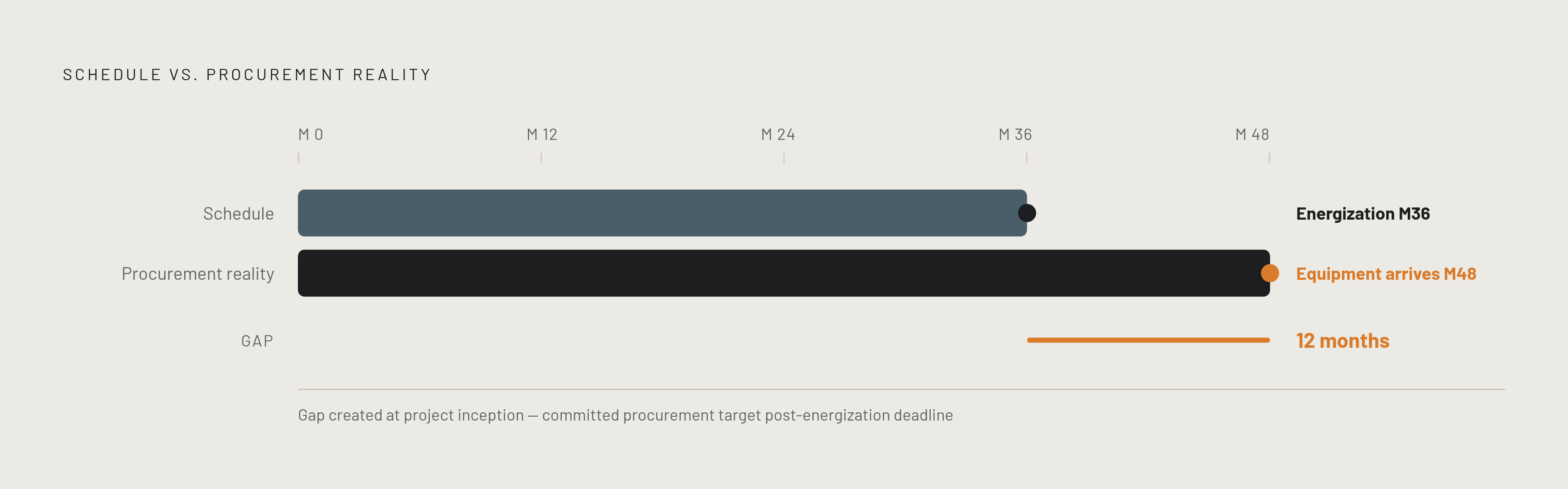
The scheduling failure occurs when equipment takes longer to obtain and the schedule treats procurement as an activity to start later, leaving its constraints unestablished at inception. As an illustrative case, a project may show energization at month 36 while being committed to equipment that cannot physically arrive until month 48. The procurement task can exist in the schedule without the energization milestone reflecting its actual limit.
That contradiction is created before the equipment is needed on site. By the time work in the field hits the missing delivery, it is too late to avoid the conflict by making commitments early. Procurement failure is seeded early and becomes visible late, at the point where another discipline depends on the result.
Where coordination handoffs between design, procurement, and field execution break down
The sequence from design to procurement to field execution creates dependencies that a task-by-task schedule can obscure. Design work must be ready for procurement commitments, and those commitments must fit the order of work planned for the field. Completion within one discipline is not enough. The next discipline needs the right work to be complete when its own work is due to begin.
Orya & Calahorra-Jimenez (2025) associate the large majority of infrastructure construction delay causes with the construction phase, with a smaller share associated with design and procurement. That phase distribution does not mean every problem first visible in construction began there. An earlier procurement slip or unresolved approval can become a construction delay when field work reaches the dependency. The distinction is between where a delay is encountered and where the condition producing it was created.
Touchplan’s analysis of a large sample of scheduled construction tasks identifies waiting for other disciplines to finish as the leading cause of construction delays. That finding makes the handoff a specific unit of risk. Labor, approvals, material deliveries, inspections, and utility energization interact, so a delay in one can constrain the work that follows. Without enough float or a credible recovery option, the dependency transmits the delay.
A commissioning-stage problem can therefore be the late expression of an earlier coordination gap. A procurement commitment slipped, an approval remained pending, or a trade sequence was left uncoordinated while the reported schedule still appeared healthy. The failure was already present at the handoff. Its consequence became visible only when downstream work could no longer proceed as planned.
This is why readiness cannot be inferred from separate reports of design, procurement, and construction progress. The relevant test is whether those outputs connect in time. Yet the tracking systems intended to expose that connection can themselves lack the data needed to assess it.
Why the tracking layer itself cannot see these failures coming
California IOU energization reporting provides a concrete example of a tracking framework exceeding the capability of the systems supporting it. The weakness affects both predicting future delays and the more basic task of reporting what happened, when it happened, and who controlled the elapsed time.
PG&E is still integrating systems and cannot reliably track Step 6 (IOU Site Readiness) or Step 8 (Energization). Only a small fraction of completed tariff projects have start or end dates for those steps. Even a completed project record may lack the dates needed to show how the project moved through its final steps toward energization.
SCE’s third biannual energization report describes a different limitation. SCE provided step-date data across all eight steps, but as of December 31, 2025, it was fully aligned with the start and stop of steps 1, 2, 7, and 8, and only partially aligned with steps 3, 4, 5, and 6. Its systems also cannot separate IOU-controlled time from customer or third-party time. More dates do not resolve that attribution gap.
The same report and the CPUC workshop deck establish why that separation is essential. SCE cannot compare its reported timelines with the CPUC’s utility-controlled targets because the reported elapsed time includes categories its systems cannot distinguish. Those timelines cannot show whether the targets were met or reliably show who was responsible for a delay. The feedback needed to improve performance is missing because the systems were not built to produce it.
The California evidence illustrates a broader process risk within a limited set of utilities. A declared tracking requirement does not establish that operational systems can generate the required evidence. When missing dates and mixed categories obscure where delays occur, teams cannot identify the breakdown points before they compound.
How the AI deployment analogue makes the same compounding mistake
Layering monitoring or AI onto these weaknesses repeats a familiar enterprise deployment error. A pilot can work on curated data while production depends on inconsistent records, siloed warehouses, and processes not designed for automation. The production system must work with unresolved dependencies that a controlled test can leave out.
In construction, that gap connects directly to daily operations. Schedule simulation or computer vision cannot establish a dependable response process when daily logs are inconsistent and nobody has a workflow for resolving the resulting alerts. Detection and resolution are different capabilities. Adding alerts to an uncoordinated process can accelerate the circulation of uncertain signals without improving the underlying readiness of the job.
The Suffolk/MIT study (September 2026) of a San Francisco multifamily project completed between 2021 and 2024 found that several construction workflows must change together for AI to make much of a difference. How people work around the tool determines whether they can act on what it produces. That is the same process-design issue exposed by incomplete energization records and unresolved handoffs.
In the California case, a dashboard cannot supply the missing distinction between utility-controlled and third-party time. The processes for step-tracking, cost reconciliation, and upstream-trigger identification need to be rebuilt. An AI-assisted layer depends on that work.
What catching energization failures early actually requires
For operations leaders, the practical response begins with a process audit. The audit must map how energization work runs today, where responsibility passes between teams, and where the process produces uncertainty or delay. It comes before choosing the intervention. A procurement strategy change, workflow redesign, or AI-assisted monitoring layer addresses different defects, and none can be selected credibly without locating the breakdown.
Procurement must then be treated as a constraint established at project inception. Because transformer and cable lead times can exceed the project’s planning horizon, equipment commitments may need to precede completed designs. That creates a dependency requiring explicit coordination between design and procurement to test supply assumptions. The energization date must reflect when equipment can arrive, rather than when the schedule would prefer procurement to finish.
Teams need to map the work each trade or discipline is waiting for and build float against both those handoffs and individual activities. A recovery option must be credible within the connected sequence. Otherwise, a slip that looks manageable can delay energization as later work loses the time or access it needs.
Tracking must also distinguish project-controlled time from utility-controlled and third-party time. That separation allows accountability and performance improvement to rest on comparable records. Upstream triggers require explicit attention as well. None of California’s major utilities could reliably tell when a tariff project caused an upstream capacity upgrade, even though that upgrade changes the whole energization timeline. Operations teams need to spot that type of risk before what looks like a connection task comes to depend on more capacity upstream.
The IEA estimates that grid-enhancing technologies and non-firm connection agreements could connect a large share of the advanced-stage projects stuck in queues around the world. Those options may ease a grid constraint without repairing an internal procurement or tracking failure. A readiness process that teams can trust keeps those problems separate and shows each dependency early enough for the team responsible to act before it affects commissioning.