Scoping the First Construction AI Process Small Enough to Go Live in Weeks
Four tests for picking construction AI work that can deploy fast.
Getting a construction AI process live in weeks requires scoping the work before selecting the tool. The first process needs existing, consistent inputs, a clear task boundary, correctable errors, and a human owner who acts on the output. Rapid deployment comes from finding work with those properties.
Why most construction AI efforts stall before they go live
First deployments stall when the chosen process is too large, too entangled, or dependent on data that does not yet exist. An ambitious objective can conceal those dependencies until implementation begins. By then, the team is solving a broader operational problem than the one it expected to automate.
Schedules, RFI logs, and procurement records store information, but someone still has to act on it. A computer vision tool that detects site issues produces noise rather than value if nobody has a workflow for resolving them. The cycle starts with too much scope, moves through a long integration and scope creep, and ends when the project either stops or goes live too late to show its value. The path to deployment in weeks therefore starts before any tool is selected.
What does a process need to go live with AI in weeks?
Rapid deployment is a property of the process. Four conditions establish whether the work is ready, and each can be examined through a day of observation. The first is that input data already exists and is captured consistently. The proposed AI must be able to act on what the team receives today, without waiting for a new data-collection effort.
The second condition is a clear task boundary. A suitable process has a discrete beginning and end, with a defined input and output. A role or department is too broad. The third condition is a limited blast radius for errors: a wrong output must be correctable before it propagates into cost, schedule, or safety consequences. The point of correction must be included in the scope.
The fourth condition is a human owner for the output. That person must act on it. A team can observe who handles the current result and whether an AI-generated result would enter the same working process. All four conditions must be present for the weeks-long timeline to hold. Missing one does not make deployment impossible, but filling the gap can move the work from weeks to quarters.
How to run the audit that surfaces the right candidate process
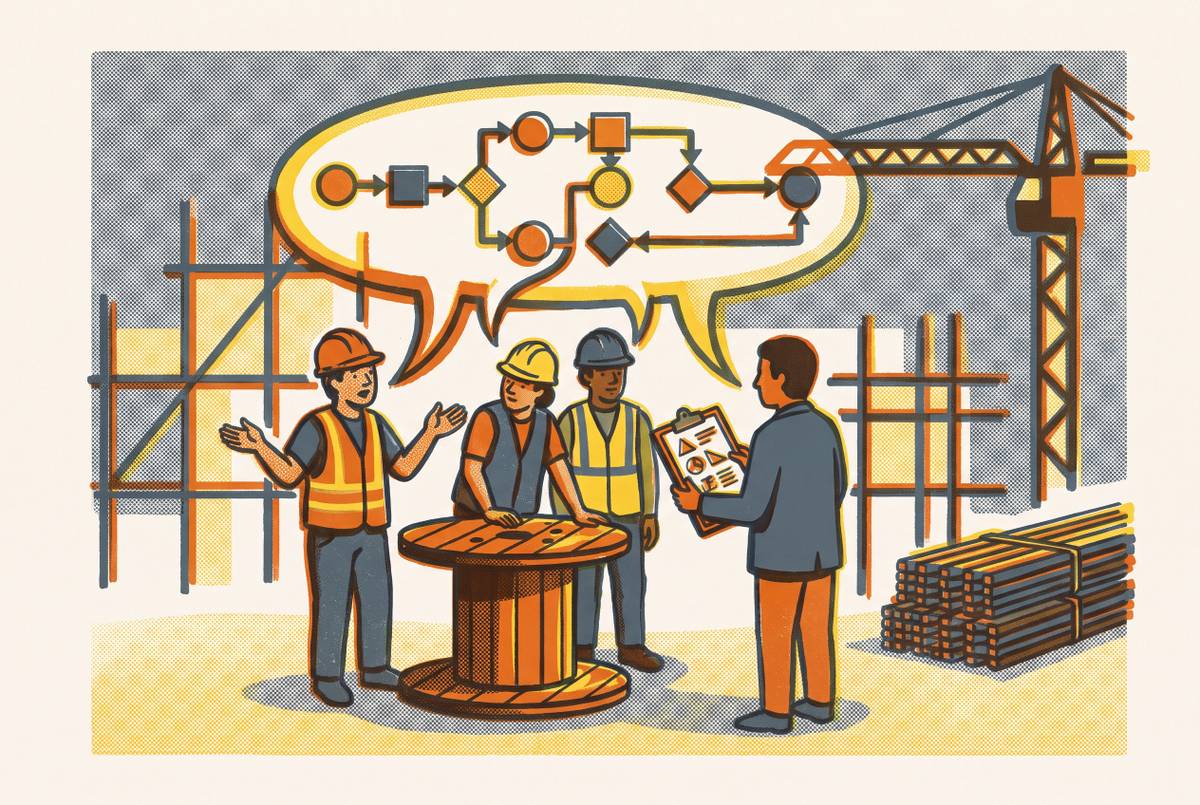
Begin with a task-level inventory of how people spend their hours. Organize the inventory by work performed. “Review submittals” is too broad to expose a deployable boundary, while “check that a submittal package is complete before routing to the engineer of record” identifies a specific piece of work. For each candidate, record what starts it, what information it uses, what result it produces, and who acts next. This shows how the work meets the four conditions without relying on a process map that may hide the steps people do by hand.
Then score each task on automation feasibility, value, and error consequence together. Feasibility asks whether the work involves document extraction, structured comparison, or rule application that current AI can handle. Value combines frequency, time cost, and the salary of the person currently doing the work. Error consequence asks for the worst realistic result of a wrong output and how quickly someone could catch it. Frequent work is not a strong first candidate if its mistakes cannot be contained.
The audit owner must report to the C-suite. An IT-led audit favors tasks that look tractable from a systems perspective and can miss operational value in field coordination, procurement, and document routing. The audit also needs to account for how field expertise affects adoption. An experienced site foreman may correctly override an AI recommendation that conflicts with intuition. For that reason, a candidate must allow the AI’s reasoning to be shown, so that the person responsible can assess the basis for the output.
Which process types consistently pass the four-condition test in construction
Document completeness checks before routing have a strong structural fit. Submittals, RFIs, and permit packages have defined required contents, giving the task both an input and a comparison standard. The output is specific. A check can identify missing attachments, wrong revision numbers, or absent sign-offs before the package moves onward. The documents already exist, the task ends before routing, and the project engineer is an obvious human owner. Because the check supports review rather than replacing the downstream decision, an incorrect finding can be corrected before it causes a delay.
Three-way matching in procurement has a similar shape. The work uses quotes, purchase orders, delivery tickets, and invoices to check for discrepancies. The task looks for overbilling, substituted materials, or quantity mismatches rather than attempting to manage procurement as a whole. A flagged mismatch is actionable for a procurement manager. Where those records are already captured consistently, the inputs are available, the comparison has a clear end, and human review keeps an incorrect flag from becoming a downstream decision. When the task comes up often and costs a lot to do by hand, it can save more without taking on more work.
Schedule risk signal monitoring can also pass the test when the signal is narrowly defined. It reads schedule progress, procurement status, and field reports to find a missing condition for a named work package. The distinction is important for the task boundary. A predecessor that remains incomplete, material that is not confirmed, or an inspection that is not scheduled gives the AI something specific to flag.
For that monitoring process, source records that are kept consistently meet the input condition, and the output names the missing condition. A named accountable owner makes the signal usable. The error remains bounded when the output is a flag for that owner to assess. Its suitability therefore depends on the audited workflow. Like document checking and procurement matching, it applies a defined comparison to existing information and ends with a human action.
What makes a process fail the test even when it looks like a natural fit
Schedule optimization tackles a clear source of trouble, but it often fails the input-data condition. Most baseline schedules do not meet high-quality standards, and fewer maintain that quality through execution. Optimization cannot repair that premise by itself. When a model starts with a poor schedule, it produces an optimized version of a bad plan. Energization and commissioning readiness face a related input problem because commissioning logs, permit status, contractor punch lists, and utility coordination are often fragmented across systems and partly unstructured. Those systems must be connected before the readiness process can go live quickly.
Site safety monitoring through computer vision can fail the human-owner condition even when the technology is already good at detecting hazards. Consistent camera coverage and reliable feeds are necessary, but so is a workflow for resolving a flagged hazard. An alert needs someone who will act. Without that resolution path, alerts accumulate and teams stop responding.
Many AI systems in wide use have been trained on textual and structured data, though frontier models now handle visual data natively. Reliable interpretation of real-world site conditions remains a limitation. Where a wrong interpretation can flow into cost, schedule, or safety decisions before correction, the limited-blast-radius condition is not established. A task that depends on deciding whether site conditions match plan assumptions is therefore outside the reliable zone for a first deployment. High value does not establish deployability.
How scoping down changes the deployment timeline in practice
Existing, consistent inputs avoid a data-collection buildout, while a task contained within an established workflow avoids having to create that workflow during deployment. A clear boundary also reduces the demand to connect every siloed system involved in a broader operation. These are substantial differences in the work required. The team is configuring and connecting AI to an existing process rather than constructing the operating conditions the AI needs.
By contrast, a poorly bounded first deployment absorbs work that was not visible in the original proposal. Integration expands to reach missing records, change management is needed to establish new handoffs, and sparse or inconsistent data can lead to iterative model retraining. The tool may be ready while the process is not. Narrowing the task changes that dependency, because the first deployment no longer has to solve every surrounding problem before it can handle useful work. Checking a package before routing is a different undertaking from automating the full review process.
The definition of “live” must be equally precise. The process must handle real work, and its output must reach a human owner who acts on it. A synthetic test case does not qualify. Neither does a dashboard that nobody checks, even if the AI behind it produces results that are technically correct.
A long deployment timeline is itself a diagnostic signal. If integration is taking months, the response should be a return to the audit. The team needs to revisit which condition the selected task did not actually meet. A first process intended to prove value in weeks cannot depend on completing a larger transformation first.
Where to look in construction operations when starting from zero
For a firm with no prior AI deployment, the strongest starting zone is the interface between document management and human coordination. Look for information already on hand that someone moves between systems by hand or checks against another document. Procurement handling sits squarely in that zone. Quotes, purchase orders, delivery confirmations, and invoices are increasingly digital, although many firms still handle them on paper or through manual work. Where digital capture is consistent, defined matching logic and a clear discrepancy owner make procurement a strong candidate, with enough frequency for modest automation to save time immediately.
RFI and submittal routing provide the next place to look. Their inputs are structured, and routing rules often exist even when they are informal. The cost of a missed or delayed RFI is visible in the project schedule, which makes the benefit of catching problems early legible to deployment sponsors. Daily reporting is a less risky place to start when field notes are already captured digitally. It gives teams useful output with errors that do little harm, so they can get used to working with AI-generated drafts before taking on higher-stakes processes.
These starting points also lead toward an agentic pattern that is already being put to work. An agent maintains persistent project state, remembers context across pauses, and hands specific missing conditions to named owners. The first version can remain tightly bounded. That gives the organization a way to develop working habits around the pattern without taking responsibility for an entire project process at once. As more construction positions go unfilled and a large share of experienced workers near retirement, teams should look closely at tasks that consistently capture and use institutional knowledge. The right first process is not the most impressive one, but the one that goes live, proves the model, and creates the conditions for the next deployment.