Week-Scale AI Deployment Timelines in Industrial Settings
Infrastructure readiness and process clarity matter far more than model sophistication.

Advertisement
Week-scale AI deployment in industrial settings is achievable: four to eight weeks from scoping to production is a realistic target for a well-chosen first project. But which model a team chooses, or how sophisticated it is, has almost nothing to do with whether that team hits that window.
Why the model rarely determines deployment speed
Operations leaders approaching a first AI deployment tend to spend the bulk of their diagnostic energy on the model: which algorithm, which vendor, which architecture will produce the most accurate output. That instinct makes sense given how AI is marketed, but it misdiagnoses where the time actually goes in an industrial setting. In manufacturing, physical infrastructure dependencies, including sensor installation, edge computing hardware, network upgrades, and the bridging of operational technology with information technology, extend timelines in ways no amount of software configuration can resolve. A better model does not install a sensor. A better model does not bridge a PLC that has never been networked to anything. These are physical and organizational constraints, and they sit upstream of any question about model quality. Teams that diagnose their bottleneck as a need for a better model will spend their limited runway tuning something that was never the constraint, and they will still miss their deployment window. Once the model is set aside, what actually makes a four-to-eight-week deployment possible is the condition of the process being automated.
What process characteristics make a four-to-eight-week first deployment possible
Three characteristics decide whether a candidate process can realistically move from scoping to production inside that window, and they function as go/no-go filters rather than a scorecard to optimize against.
The first is transaction volume. The process needs to generate enough events that a system can be trained on real examples and validated against real outcomes without waiting months for enough cases to accumulate. A process that produces a handful of relevant events a month cannot support a four-to-eight-week build regardless of how well everything else is scoped.
The second is rule-demonstrable logic. The majority of cases handled by the process need to follow a pattern that can be defined and documented. Processes whose outcomes depend heavily on tacit judgment calls, or that are dominated by one-off exceptions rather than a repeatable pattern, are not candidates for fast deployment. That is not a comment on the value of the process; it is a statement about what can be scoped quickly.
The third is a pre-committed success metric. A clear before-and-after measurement has to exist before the work starts. Without that metric agreed upon in advance, there is no way to declare the deployment complete, and no way to defend the result internally once it is live.
These three criteria work as a filter to run before scoping begins. A process that fails one or more of them is not ready for agent deployment, no matter how painful it is or how high a priority the business has attached to it. Forcing a fast deployment onto a process that fails the filter does not compress the timeline; it just moves the schedule risk from the planning phase into the build phase, where it costs more to fix.
Data integration and infrastructure readiness in manufacturing and logistics schedules
The gap between what is technically achievable on paper and what organizations actually experience in practice traces, almost without exception, back to infrastructure and integration work that should have been scoped and started earlier than it was.
In manufacturing, the convergence of operational technology and information technology is a structural problem, not an incidental one. Programmable logic controllers, SCADA systems, and MES terminals frequently lack digital connectivity on their own, and integration work, such as protocol gateways, OPC-UA, or MQTT layers, has to happen before any AI system can read live data off the factory floor. That work has to be planned into the roadmap from the start. Discovering mid-deployment that a critical data source has no path into the system is one of the most reliable ways to blow a committed timeline. The correct starting point for any manufacturing deployment is an OT/IT connectivity audit: mapping every data source on the floor, identifying which assets already have digital connectivity, and flagging which ones require retrofitting before anything else can happen. Running that audit before scoping is finalized is what separates a four-to-eight-week deployment from a six-month one.
The same logic holds in construction, even though the physical assets look different. AI-augmented scheduling and procurement workflows depend entirely on whether site, sensor, and supply chain data already flow into a usable system. Where those flows do not exist yet, the first deployment has to be scoped around the data that is genuinely clean and available, not around the data the business wishes it had. A scoping conversation that starts from an aspirational data environment rather than the real one will produce a timeline that collapses the moment the build begins.
Process clarity as the organizational bottleneck technical teams underestimate
Even when the data pipeline is ready and the infrastructure audit is complete, deployments stall for a second reason that has nothing to do with data: the process being automated was never fully documented, or the documented version no longer matches how the work actually gets done on the ground.
Automating a process that is not fully understood does not speed that process up. It takes whatever ambiguity already existed and embeds it permanently into the system, which makes it considerably harder to diagnose later when the outputs start coming out wrong. The failure pattern is specific and recognizable: a team starts building the agent before anyone has mapped the process from end to end, so edge cases and exception-handling logic appear for the first time during deployment rather than during scoping. Each one that surfaces late adds time to a schedule that was already committed to stakeholders.
This is an uncomfortable finding for technical teams, because it means a non-technical factor gates their build. A process audit means sitting down with the people who actually run the process and having them walk through how it works today and where it breaks. It is the technical prerequisite for scoping an agent that can be deployed. That audit tends to reveal a different process than the one written down in the standard operating procedure: the workarounds nobody put in the manual, the manual corrections made every shift, the one step that a single person on the floor knows how to handle and nobody else does. Processes with heavy dependence on that kind of tacit knowledge are not fast-deployment candidates even when they clear the volume and measurability filters described earlier. The tacit knowledge has to be made explicit first, and making it explicit is itself additional scope that has to be planned for, not discovered.
The two-speed change management problem on the shop floor and in the cab
Change management in industrial AI deployments runs at two distinct speeds, and each speed needs its own plan. Treating them as one problem is a reliable way to stall a deployment after it has already been built and technically works.
Corporate and administrative staff, including planners, procurement personnel, and analysts, can typically adopt a new AI tool within weeks. Their workflows are already largely digital, and a new interface or a new recommendation engine slots into habits that are flexible by nature. Shop-floor operators, including maintenance technicians, quality inspectors, and machine operators, do not adopt at that same pace, and for good reason. They need hands-on demonstration, time to observe that the new system performs reliably under real conditions, and a genuine trust-building process before they will modify routines that, in many cases, exist because deviating from them has historically caused problems. No volume of training material compresses that process. A dispatcher can start using a new scheduling recommendation the week it ships. A driver will not change how they handle a route, or trust a system's flagged exception, until they have watched it be right enough times in a row to believe it.
A deployment plan that does not separately account for these two adoption curves will produce a system that is technically live and essentially unused on the floor, which, from a business outcome standpoint, looks identical to a failed deployment. The practical response is to build the shop-floor adoption track as its own parallel workstream with its own milestones from day one, rather than treating floor-level training as a cleanup task to be handled after the system goes live.
The failure pattern of pilots that never reach production
Most enterprise AI agent pilots never make it to production, and decisions made at the scoping stage, not model quality or any algorithmic shortcoming, cause the failure modes behind that statistic.
Two anti-patterns appear repeatedly in field deployments. The first is building without an identified owner: a consultant or outside team builds the system, hands it over, and no one on the operating side is accountable for running it, so the workflow drifts out of alignment with the business within weeks of handover. The second is skipping the shadow run, where the team cuts over to the new system before its output has been validated side by side against the manual baseline it is replacing. Both are governance and scoping failures. Neither has anything to do with the technical sophistication of the system being deployed.
A related but distinct problem is the lack of observability in deployed agents. A system that produces a wrong output without flagging it as uncertain is harder to catch than one that fails loudly and visibly, and in industrial settings a silent wrong output can affect equipment, inventory, or safety, which raises the stakes considerably above what a silent error would cost in a back-office software tool. Model drift compounds this risk over time: predictions degrade as the real-world data the system encounters diverges from the data it was trained on, and a one-time audit performed at launch will never catch drift that emerges months later. Continuous monitoring has to be treated as a deployment requirement from the start, not an optional add-on considered after something has already gone wrong.
A deployment that goes live without a named owner, a documented shadow-run record, and an ongoing monitoring plan has not actually reached production. It is a pilot that happens to have a few extra steps attached to it.
What a scoped, production-ready first deployment looks like end-to-end
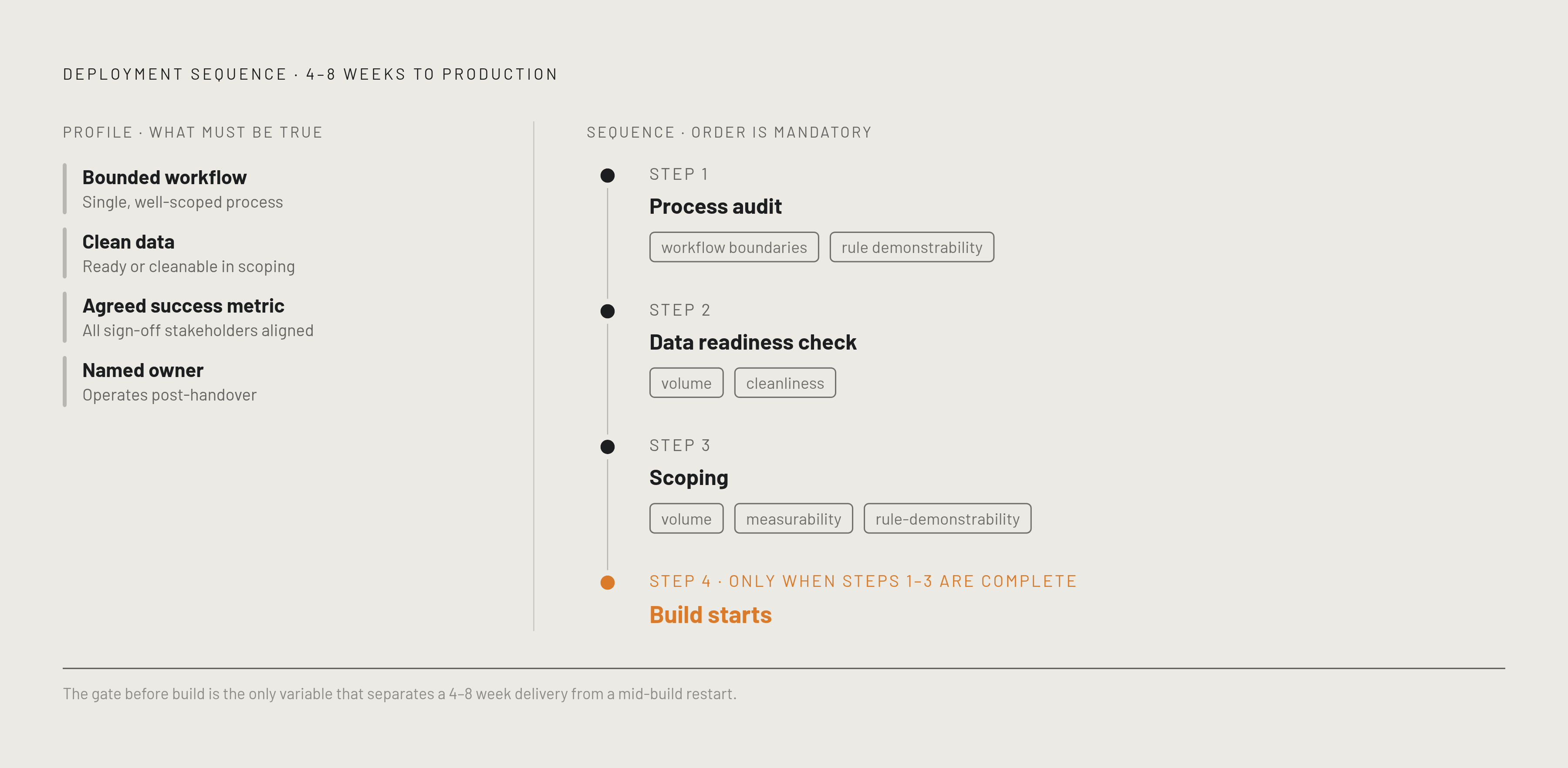
The deployments that move from scoping to production inside four to eight weeks share a structural profile that is visible before a single line of the build begins, and that profile is replicable by any team willing to do the diagnostic work upfront rather than skip to the build.
That profile has four parts: a single, well-bounded workflow rather than an attempt to automate several processes at once; data that is already clean, or that can be made clean within the scoping phase itself; a success metric that every stakeholder with sign-off authority has agreed to in advance; and a named owner who will operate the system once it has been handed over.
The sequence matters as much as the profile. A process audit comes first, surfacing the real workflow as it is actually run rather than the one written in the procedure manual. A data readiness check comes second, confirming that the pipeline can genuinely be built within the time available. Scoping against the three criteria of volume, rule-demonstrability, and measurability comes third. Only then does the build start. Deployments that try to run the audit and the build at the same time predictably hit blockers mid-build that force the scoping clock to restart, which erases whatever time parallelizing saved.
In manufacturing specifically, installation, testing, and cutover have to be planned around maintenance windows, shift changes, and planned shutdowns, not around a generic software release cycle. That constraint has to be built into the timeline from day one rather than treated as a scheduling inconvenience discovered partway through.
Once that first deployment is live and validated, it produces something beyond its own operational result: a playbook covering sensor configuration, model training, and operator onboarding that becomes the accelerant for every deployment that follows. Manufacturers who standardize that playbook see per-site deployment cost fall sharply after the first three implementations. The right place to start is always a specific, painful, well-bounded process. The value of that first deployment includes the operational knowledge it generates about what the organization's data, process, and people are actually ready for, which is the knowledge every deployment after it will depend on, beyond the outcome it produces on the floor.