How Construction Operations Managers Kill the Multi-Year Implementation by Scoping AI as a Process Problem Not a Platform Purchase
Audit one broken workflow first, and AI can go live in weeks.
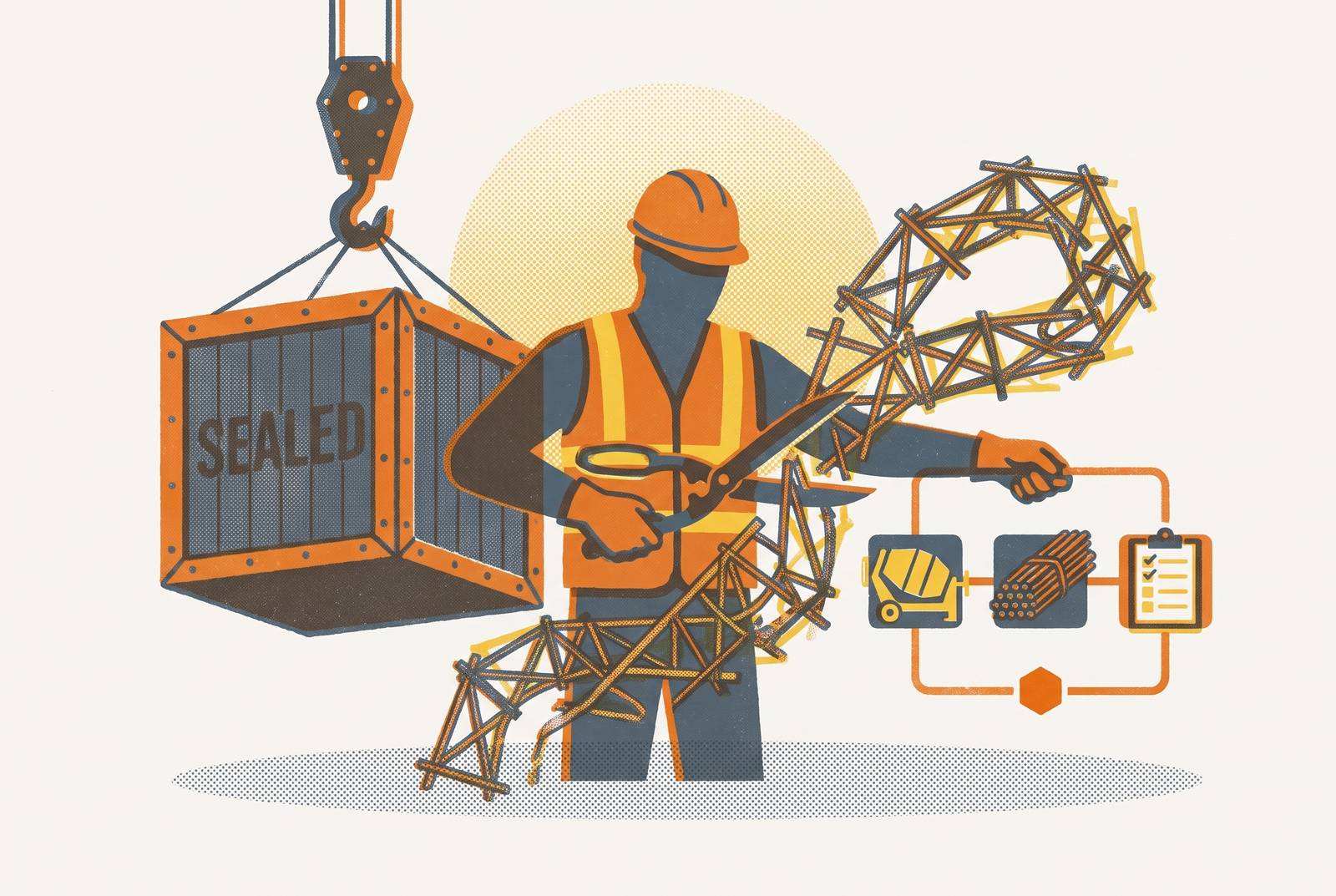
Fast-cycle AI operations deployment in construction and logistics starts with a process audit. The route out of a years-long IT project is to observe one broken workflow, redesign it, establish data authority and measurable outcomes, then select the tool. When those foundations are ready, a first live process can operate in weeks.
Why most construction AI programmes stall before they produce anything
Broad experimentation in construction AI coexists with shallow implementation. Firms say they are committed and buy tools, yet few put AI to work across their operations. The gap is not simply a shortage of capable technology. Data quality, misaligned goals and buying before understanding the problem repeatedly prevent a promising trial from becoming routine work. These failures often start before implementation has officially begun.
A mid-size civil firm spent six weeks and significant budget trying to surface patterns in its closeout reports. Its reports were spread across three different formats, two SharePoint sites and a shared network drive nobody had migrated. Half the PDFs were scanned images with no searchable text. The tool had been purchased before anyone examined the data. The project died because the purchase assumed a usable information base that did not exist.
That distinction changes the explanation for the stalled programme. The firm had not first established what its chosen task would require from its records. It discovered the prerequisites during an implementation already consuming time and money.
How the operations manager's instinct to scope a purchase creates the failure before procurement begins
Given a problem, an operations manager identifies a tool category, writes requirements and starts procurement. That habit turns an operational difficulty into something the organisation knows how to buy. It is understandable, but it skips asking whether AI has a useful role at all.
How does the process actually run today, where does it break, and should it run differently before a tool is introduced? A requirements list can describe desired functions while leaving the current handoffs, exceptions and sources of delay unexamined. Procurement then evaluates software against an assumed workflow. The scope is wrong before suppliers are assessed.
The tool consequently works in the demonstration but never enters actual operations. One AI consultant described the pattern as “enthusiastic pilot, quiet cancellation, nobody talks about it. The distinction is between demonstrating a capability and making it useful within a working process.
What construction's data architecture does to AI tools scoped as platform purchases
When departments use different project naming conventions and cost codes, AI cannot reliably tell which information belongs together across the job. Inconsistent records of labor hours, production quantities and equipment utilization then weaken predictive outputs. The inputs do not describe work on common terms. A platform purchase does not, by itself, create those terms.
Authority is a separate problem from consistency. Finance, project management and operations may hold different versions of the same project data, but an AI system cannot independently decide which one governs. This is especially clear in scheduling, where optimization depends on inputs that fit together. Even with consistent records, a model can confidently optimize around a missing site condition known only to a veteran superintendent. A model that performs well on average can still make that costly mistake.
Electrical procurement is now the critical path on most hyperscale construction jobs. A procurement platform bolted onto an existing RFQ workflow cannot see or manage multi-year constraint chains involving transformer lead times, interconnection queues and utility delivery timelines. The workflow’s boundary is too narrow for the problem. Here, an audit must show the dependency chain before the firm can choose a tool that can deal with it.
What separates the small fraction of firms seeing real returns — and what they did first
Firms that get strong returns stand out for the work they do to prepare, even when they have access to better tools. They redesign the target workflow before selecting what will support it. Proven returns cluster in well-defined, repeatable problems with structured data and measurable outcomes, including estimating and takeoff automation, schedule optimization, computer vision safety monitoring and progress tracking. These are bounded operational tasks. Their scope makes success observable.
A logistics company’s claims process shows what this distinction means in practice. The company planned to automate a process involving multiple interactions. Instead, it redesigned the process so that 80% of claims were resolved on first contact by an AI agent with full decision authority. It did not merely automate the original exchanges. It eliminated most of them before defining the agent’s work.
That case also separates process redesign from faster execution. Automating each existing interaction would have preserved the structure that made the process cumbersome. Changing the resolution path altered what the system needed to do. Full decision authority was part of that redesigned workflow. In construction, too, firms need to set the bounds of a decision and the conditions under which it will be made before choosing an AI capability.
The process audit as the step that changes what gets built
A process audit establishes whether work is worth automating, worth redesigning or worth abandoning. It begins with observation. The audit examines how the process actually runs and where it hurts. Watching execution exposes how the work required to reach an outcome differs from the documented procedure. That difference determines the scope.
Controls, approvals, transfers between systems, queue time and fixing earlier errors can take up much of a firm's processes without helping get the work done. Some of those steps can therefore be left out when the process is automated. An audit makes those steps visible so that redesign can distinguish useful work from avoidable handling. AI introduced into the original structure may only accelerate waste.
Readiness then depends on three specific criteria. The process must have high volume, with enough transactions to train and validate, and be rule-demonstrable, with a large majority of cases following a defined pattern. It must also be measurable through a clear before-and-after metric. An attractive demonstration cannot compensate for a failed criterion.
The civil firm’s closeout-report obstacles could have been surfaced in days, before implementation began. Scheduling, procurement and energization readiness are particularly consequential audit targets because weak data and unclear processes can redirect or kill the planned purchase. That is a useful outcome. Discovering that the proposed tool addresses the wrong problem is a reason to change the scope.
How to deploy construction AI without a years-long IT project
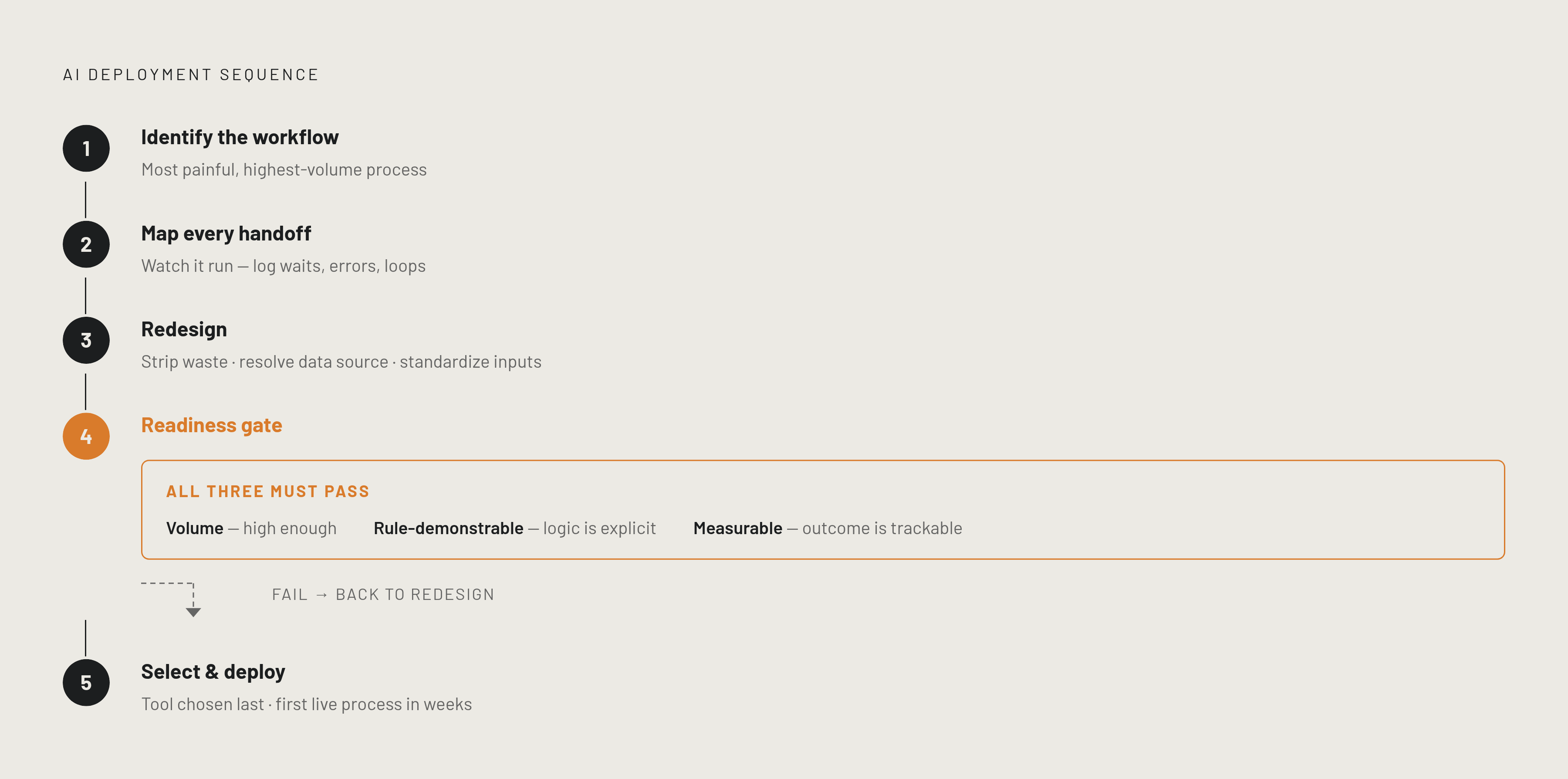
For an operations team ready to act, the sequence begins with one process. Identify the single most painful, highest-volume workflow with a clear cost of failure, rather than opening with a platform strategy or transformation roadmap. The boundary must be specific enough to observe. Starting small gives the audit something specific to test and keeps a broad goal from turning into an implementation with no end in sight.
Next, watch that process run and map every handoff, wait and loop in which errors are fixed. Record where it breaks and why, rather than relying on descriptions of what should happen. Then redesign the process without assuming that AI belongs in it. Strip out non-value-adding steps, resolve which data source is authoritative and standardize inputs. Some of these changes will be worthwhile without automation.
Apply the readiness criteria to the redesigned process. Volume establishes whether enough work exists to train and validate. Rule-demonstrability establishes whether most cases follow a defined pattern. Measurability supplies the success condition. If the process fails these tests, continue the process work before purchasing a tool. Passing them turns tool selection into a narrow operational decision.
Only then select and deploy against the redesigned workflow. With the process defined and the data structured, a first live process can be operational in weeks. Prolonged timelines at this stage signal that earlier work may have been skipped or rushed. The proof of concept now asks whether the redesigned process works in production. It no longer stops at whether the software can perform in a demonstration.
Where agentic AI fits into this sequence — and why it makes the order of operations non-negotiable
Agentic AI makes it more urgent to prepare because agents carry out multi-step workflows, going beyond help with single tasks. Their work can include submittal review, change order impact analysis and schedule re-sequencing. To do this work, agents need data quality, permissions, business context and integration across systems. An agent inherits the process it is given. Broken handoffs and unresolved authority do not disappear when execution becomes autonomous.
Simpler assistants can tolerate technical debt that an agent exposes while moving between systems and decisions. Where the original process contains inconsistent inputs or unclear permissions, faster execution amplifies those weaknesses. For a purchase-led programme, agent deployment is therefore where an early scoping error becomes especially costly.
Production uses remain narrow, including drafting RFIs, first-pass submittal review, tender and bid analysis, daily logs and schedule risk detection. Only a handful of firms are piloting agents that re-sequence dependent tasks and notify affected trades when deliveries slip. That distinction limits what current deployment demonstrates. It does not support treating autonomous coordination as a ready-made replacement for process design.
For teams considering agents, the audit-first sequence is minimum preparation. The process must be understood before its steps can safely be delegated. The logistics claims case shows this order, though full decision authority may not suit every construction task. Its agent operated within a redesigned resolution process.
What to do Monday morning: how to run the first process audit in construction operations
Start by choosing one visibly painful process and watching it run from trigger to completion. It should involve familiar delays, rework or manual correction loops, occur frequently enough to audit quickly, and produce an output that can be measured before and after. No purchase is required to begin this work. Scheduling, procurement tracking and RFI management are useful starting points because their frequent, painful workflows commonly depend on inconsistent data.
While watching, record where work stops and waits. Note where someone corrects an earlier step or re-enters and reformats data for a downstream system. Examine decisions made without a consistent rule. Each finding is either an opportunity to redesign the process or evidence that it is not ready for AI.
Produce a process map with broken steps marked and a data inventory with quality gaps identified. After redesign, record a yes-or-no answer against volume, rule-demonstrability and measurability. These are the audit’s practical outputs. They are not a requirements document disguised as process work. If the process passes, selection can proceed against a defined task and success condition. If it fails, redesign may remove the problem that prompted the purchase.
An external partner should begin in the same place. A partner who starts with the process audit asks to see the work run before proposing a solution. An operations manager can make that request without hiring anyone or buying anything first. Monday’s useful deliverable is evidence of how the process works and where it breaks.