Crew-Level Process Interviews as the Foundation of Construction AI Readiness
Interviewing field crews first shows what AI can automate safely.
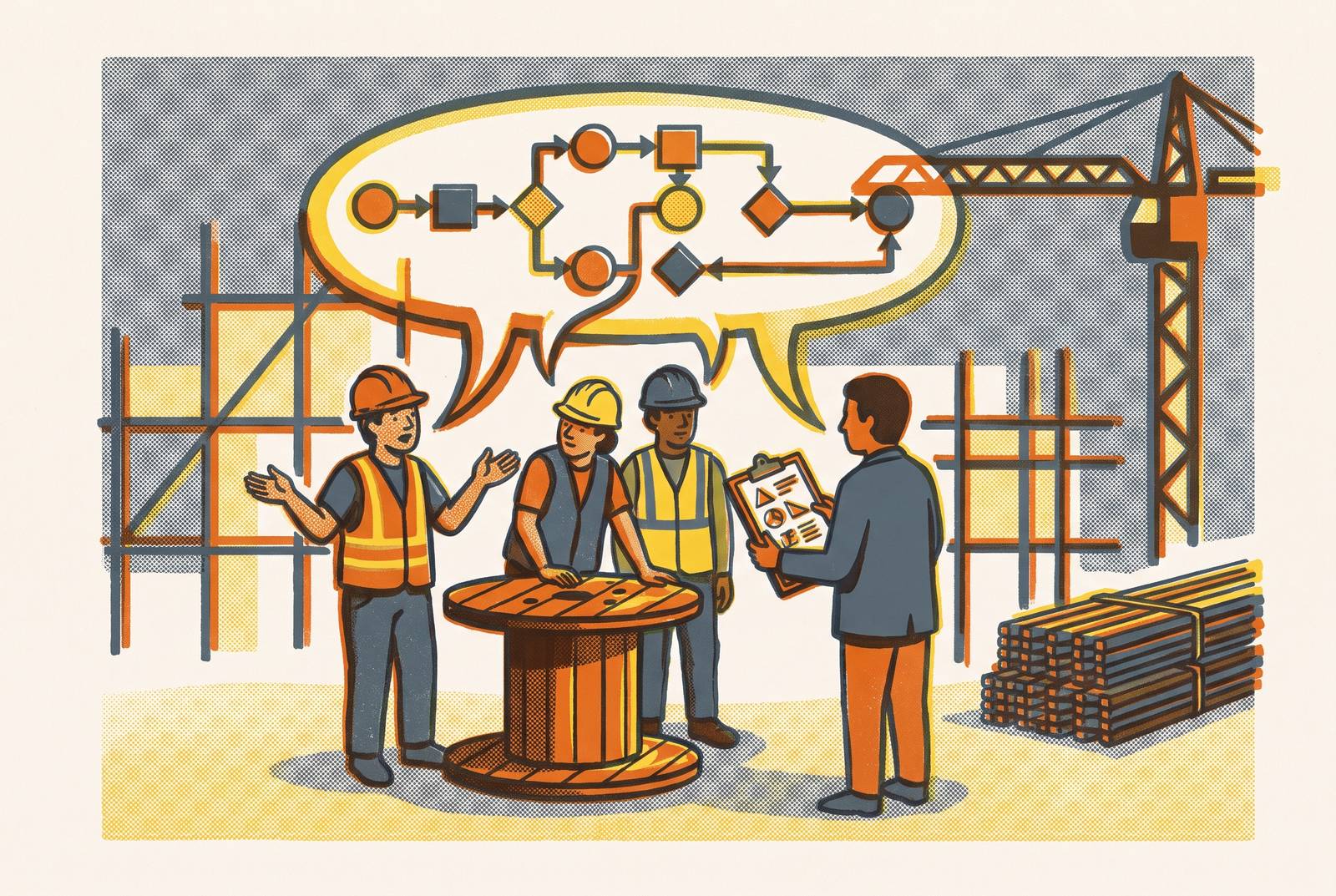
Crew-level process interviews are the foundation of construction AI readiness because they reveal how work actually happens before automation is designed. A process audit before AI deployment in construction and logistics operations should reconstruct actions, decisions, handoffs, workarounds, and data gaps with the people performing the work. The resulting map determines what AI can safely automate, what must be repaired first, and where deployment should not begin.
Why construction AI implementations keep failing at the process layer
An agent left to guess what a process metric means is already operating without the knowledge its task requires. Better model capability does not resolve an undefined operational meaning. When the underlying process has never been accurately documented, an agent can produce confident wrong answers and repeat them at scale. In construction, a procurement sequencing error or a missed energization sign-off can put the project-wide schedule at risk.
The central failure is therefore a process-knowledge failure. AI tools need processes that are clearly defined, information they can rely on, and workers who know how the technology fits the work they do. An org chart shows who is responsible, and a project schedule shows what work is planned, but neither explains the decisions people make to get the work done. Deploying against those records alone leaves the system to operate across gaps its designers have not identified.
The RICS 2025 AI in construction report found that most organizations have no AI implementation or remain in early pilot phases, with organization-wide deployment below 1%. That pattern is consistent with deployments stalling before an operational foundation has been established. It does not, by itself, establish the cause.
What the declared plan conceals and why field crews hold the operational truth
The P6 schedule, BIM model, and milestone report capture intent. They describe what is planned without fully recording the informal coordination needed to make it possible. Schedules, submittals, and RFI logs preserve intended actions or escalated problems. They do not capture every sequence adjustment, skipped step, or undocumented dependency that a foreman navigates during execution.
The missing knowledge is distributed across the crew. One person knows where a handoff stalls, while another knows the workaround that allows the next task to proceed. Procurement sequencing, energization readiness, and inspection sign-off workflows contain particularly dense layers of this tacit knowledge. Their documented sequence can therefore look coherent even when actual progress depends on decisions absent from the record.
Field decisions happen in real time and may be recorded retrospectively, if they are recorded at all. The resulting document often preserves what was decided without explaining why or how. Changes across project phases further limit how well a written account represents current practice.
Consequently, historical logs and executive interviews cannot reconstruct the whole process. An agent built on daily logs, drawing sets, or submittal registers consumes the products of documentation. The unresolved gap lies between those records and the knowledge held by the people doing the work.
What crew-level process interviews are and what distinguishes them from standard discovery
A crew-level process interview is a structured, field-conducted conversation that reconstructs a worker’s actions, decisions, and points of breakdown. Its unit of analysis is the task. The purpose is to establish the operational reality an AI system would have to navigate.
That distinguishes the interview from conventional requirements gathering. A feature request describes something a worker wants, but it may leave the underlying sequence unexplained. A process interview goes through that sequence, including steps the worker thinks are too routine to mention. Similarly, an executive or project-manager interview establishes what leadership believes happens, rather than supplying a substitute for task-level evidence.
The distinction from documentation review is equally important. The interview concerns the practice of the people executing the work. Where practice and the SOP diverge, that difference becomes part of the account. The interview is also role-specific, because a procurement lead and a commissioning coordinator hold knowledge about different process chains.
The output is a task-level process map annotated with decision points, handoff failures, informal workarounds, and data gaps. It is design material. Its usefulness depends on whether it explains the actions and dependencies that ordinary discovery leaves implicit.
Who should identify process gaps before AI deployment, and in what sequence?
Discovery should start at the execution layer. Foremen, field engineers, procurement coordinators, and commissioning leads hold the detailed knowledge needed to reconstruct their respective process chains. Starting with a superintendent or project manager instead can anchor discovery to the declared plan. The resulting map may appear complete while omitting the actions through which crews make that plan workable.
Interview order should follow dependencies. When the question is whether material delivery sequences match schedule assumptions, the procurement interview should precede the scheduling interview. That order allows the scheduler’s account to be examined against the delivery process rather than treating schedule assumptions as established facts. Management interviews come after the field-level map has been drafted, so divergence becomes visible.
For energization readiness, interviews start with the craft worker who installs equipment, move to the commissioning coordinator who tracks sign-offs, and end with the project manager who manages the milestone. Each account adds a different operational perspective. The purpose is not to privilege one role’s account automatically, but to prevent the milestone description from replacing the underlying work.
Handoffs also require accounts from both sides. The person delivering work and the person receiving it may describe different conditions for completion. Subcontractor foremen, inspection authorities, and supplier contacts can expose dependencies outside the prime contractor’s internal map. Excluding those roles leaves external constraints unexplained precisely where the proposed system may depend on them.
How to structure the interview to get operational truth rather than polished answers
The interview should begin with the most recent instance of a task. “Walk me through the last time you got a material delivery notice” directs attention to a recoverable sequence. By contrast, asking how the delivery process works invites a cleaned-up account of normal practice. The obstacle is not necessarily worker resistance. People naturally describe how work should proceed unless the conversation anchors them to a particular event.
From that event, the interviewer should trace the sequence of actions. Routine or uncomfortable steps are easily skipped in a fluent account. Slowing the sequence down and asking what happened between stated actions makes those omissions visible. Questions about where work most often stalls, or where a failure begins, then locate the breakdown within the sequence.
Workarounds need the same direct questions because workers may not say on their own that the work differs from the official process. The interviewer should ask where that difference occurs and then examine the information needed at that step. Where does it come from, how often is it wrong or late, and what happens when it is unavailable? Those answers show what data quality problem the proposed AI would face.
Discussion of how the proposed AI would behave should wait until the account of how the work is done is complete. Describing it early can steer workers toward an idealized process that seems suitable for automation. The stated purpose can remain mapping how the work actually happens. Finally, the account needs corroboration across roles, particularly by comparing a foreman’s description of a handoff with the receiving person’s account.
What the interview output should contain and how to use it in AI system design
The process map should record discrete actions, decision points, handoffs, and failure modes, with the information each step consumes and produces. Consistent workarounds belong in the main map. Treating them as exceptions would conceal the very practices the system must accommodate. The map must describe execution.
Each finding should constrain a design decision. If workers depend on information that is frequently wrong, late, or inconsistent, the affected step cannot be automated before that data problem is resolved. If a task changes substantially across project phases or site conditions, its variability must be understood before an agent is configured. Such a task is not an early automation candidate simply because it appears repetitive in the schedule.
The design must also account for differences between how management and crews say the work is done. They identify where the declared plan cannot serve as the basis for AI training or evaluation. Without that distinction, a system could be judged against a description that crews cannot reliably execute. The interviews would then have generated documentation without changing the assumptions behind deployment.
The resulting boundary should be narrow enough to support a live first process within weeks. Selection should favor a step or subprocess with consistent execution, reliable data, and a recoverable failure mode. Steps that are broken or poorly understood stay outside that boundary. Automating them would accelerate confusion.
The objection that modern AI can discover process patterns without formal interviews
Modern AI can infer useful patterns from operational data. Vision-based systems can read jobsite conditions, while agent-based systems can support a general contractor managing by exception, reducing the need to manually reconcile every record. For tasks with structured inputs and recoverable failure modes, this is a legitimate deployment approach. Formal interviews are not the only possible route to useful AI.
The narrow case includes drafting RFIs, first-pass submittal review, tender analysis, daily log generation, and schedule risk flagging. In these settings, an error can be caught before it propagates. That recoverability separates them from mission-critical process chains. It is not evidence that the same approach can safely infer every dependency in field operations.
Procurement sequencing, energization readiness, and inspection sign-off present a different risk. A confident wrong output can set later steps in motion before anyone catches the mistake. Without prior process grounding, hallucination is therefore disqualifying in these chains. Inconsistent documentation across crews or project phases can make even a larger dataset reflect recording practices, leaving gaps in understanding the process itself.
Agent coordination introduces a related design problem. A more capable model does not, by itself, define the handoffs or dependencies through which multiple agents must work. Assigning those responsibilities requires a sufficiently reconstructed workflow. Crew-level interviews build that understanding before the system is designed, so it does not have to be learned through errors once the system is in use.
How to run a process interview program across a construction project without stalling the work
Interviews should fit the natural breaks in construction work instead of taking crews away for long sessions in a conference room. The period after a pour, the end of a shift, or a natural hold point keeps the conversation close to the task. Memory is immediate at those moments. That makes it easier to recover the actual sequence without requiring workers to reconstruct distant events.
The interviewer needs enough process knowledge to recognize a skipped step, but must not fill the gap with an assumption. Familiarity should sharpen the questions. After each interview, the first draft of the process map should be built and shown to the worker. Asking what is wrong with that map can bring out steps the first conversation missed.
Procurement and commissioning interviews need not wait for each other when their outputs can be compared afterward. Within each chain, however, coverage must include both sides of the relevant handoffs. A modest number of well-structured interviews can be sufficient when further conversations stop producing materially different accounts.
For a single priority process chain, the program should produce usable design input in days to a few weeks. If the effort takes longer, it has grown to cover more than the first deployment needs. The target is a bounded operational account that supports a live first AI-first process within weeks. Discovery ends when the evidence is sufficient to define that first process and its limits.