Why Asset-Heavy Operations Leaders Let the Worst Shift Run Decide the First AI Target
Stress-testing the process first shows where AI belongs.
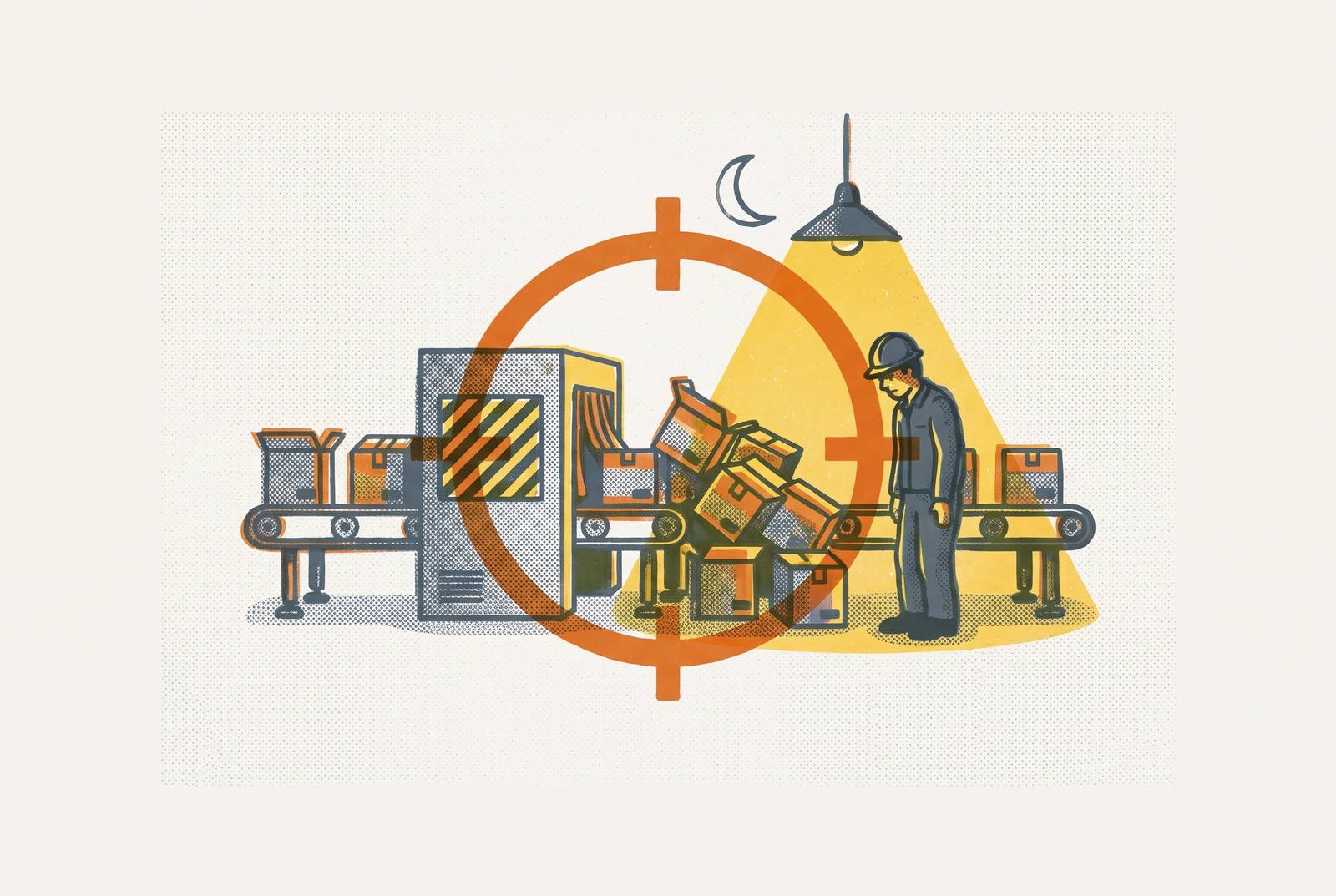
AI operations transformation in asset-heavy industries can start with one broken process, without a platform strategy or a digital roadmap. The first target should come from the worst shift, where understaffing, equipment degradation, and peak load expose the workarounds and ownership gaps that normal performance conceals. That evidence determines what must be rebuilt before AI is introduced and where a narrow deployment can help.
Why declared processes lie and stress-tested conditions reveal the truth
Factories that added electric motors to steam-era layouts gained little. Productivity gains came when manufacturers redesigned their systems around the new capability. The distinction was not simply between old and new equipment, but between changing the power source and changing how work happened. AI bolted onto a legacy workflow faces the same constraint. A better tool cannot make up for a wrong picture of the process it serves.
The declared process says how work should go. The actual process includes machines with quirky behaviors, operators with different experience levels, maintenance histories, supplier delays, and strict quality thresholds. A documented procedure cannot capture all of those conditions. Generic AI can summarize documents and analyze spreadsheets, but its usefulness on the plant floor depends on understanding the particular equipment, people, and decisions it supports. The document is therefore evidence of intent.
A process audit looks at the gap between them. Cycle times, exception logs, SLA breaches, ownership gaps, and manual overrides show what happens when the procedure meets real conditions. These traces reveal where work slows, where responsibility becomes uncertain, and where people bypass the formal system. Without them, a redesign optimizes the nominal case while leaving the failure state untouched.
What good-shift performance hides that the worst shift exposes
Full staffing, predictable demand, and equipment without anomalies allow skilled operators to bridge gaps without recording the intervention. A handoff works because someone knows who to ask. A difficult step succeeds because an experienced operator knows the workaround. The completed work appears to validate the formal process, although the result depended on knowledge outside it. Good performance can therefore conceal a weak operating design.
The worst shift removes that protection. Understaffing makes the experienced person less available, while peak load or equipment degradation puts more demands on the remaining team. Handoffs that held under low load become brittle. Decisions stall because nobody knows who owns them, and steps that looked routine turn out to depend on one person. What looked like an orderly process is exposed as a set of compensations.
Those compensations are part of the actual process the audit examines, even when the process map omits them. The 2026 AI/ML Roadmap for Smart Manufacturing names the complexity of industrial data, how to manage that data well, and how to keep systems working in a trustworthy, reliable way when the stakes are high as key challenges for deployment. Stressed conditions make those challenges concrete. An audit confined to favorable shifts leaves the AI design least informed about the conditions where dependable operation is most important.
Why automating the average case scales the breakdown instead of fixing it
Once AI acts on the nominal process, the diagnostic omission becomes an operating risk. Poor data feeds into automated decisions, and handoffs stay broken even when the output comes faster. An ownership gap leaves no one in charge of acting on an agent’s recommendation.
Pipelines with too much automation can also be at risk from single points of failure. Rare faults, distribution shifts, or degraded inputs force the system to handle conditions it was never built for. Operational safety depends on holding up when demand surges, sensors degrade, or disruptions cascade, which requires precise operational context for operators, technicians, and engineers.
A demonstration can show that the AI handles a clean input and takes the expected path. It cannot show how the process around it will respond when that path breaks. IBM found that only 16% of AI initiatives had grown to reach the whole enterprise. That figure is consistent with the broader difficulty of turning nominal-case success into reliable production use.
How the worst shift functions as a process audit in construction scheduling and procurement
Construction has its own equivalent of the stressed plant shift. It appears when the declared schedule meets a site constraint that was always present but invisible to the planning layer. When progress is confirmed weeks after the work is done, teams have little sense of where the project really stands. By the time the schedule reflects reality, the opportunity for corrective action may have passed. The weakness is not simply a poor forecast, but a lag between work, evidence, and response.
That lag limits what AI scheduling can do. When schedule data records what was planned rather than what happened in the field, even a better algorithm works from a poor picture of the project. Scheduling trials then struggle because the data they use is too poor to help teams make useful decisions. Procurement makes this divergence particularly clear. PJM Interconnection data showed that permitting accounted for the single largest share of milestone change requests, with supply chain disruptions close behind.
Energization readiness exposes how consequential an omitted dependency can become. Grid interconnection timelines in many regions are measured in years. A power-readiness schedule that tracks utility upgrades, energization permissions, and phased deployment dependencies makes that constraint explicit. It performs the same diagnostic role as a worst-shift audit by forcing the plan to acknowledge what can prevent execution. Field-versus-plan divergence is therefore more than an isolated data-quality problem, because it reveals whether AI is aimed at the declared schedule or the conditions under which that schedule fails.
What enterprise AI agent failures have in common when the worst shift was ignored
Logistics deployments reveal the same pattern beyond construction. AI investments can fail to deliver measurable ROI because teams start too broadly, deploy on inconsistent data, or underestimate integration complexity with existing TMS/WMS systems. The technology may work while the deployment fails. In those cases, how well the model works cannot by itself clear up doubts about the data or the workflow the agent must fit into.
The connection is the unexamined exception path. A deployment optimized for typical inputs can break when a rare fault, a distribution shift, or a degraded input reaches it. These are precisely the conditions a worst-shift audit is intended to expose before deployment. Integration complexity becomes an operational concern rather than an implementation detail when the agent and the existing system cannot support the same decision reliably.
Successful logistics teams in 2025–2026 focused on smaller, well-defined bottlenecks where AI could reduce ambiguity, surface risks sooner, and compress decision cycles. Their deployment philosophy was “narrow and specific”. That scope connects an AI capability to a documented break point instead of asking it to transform an inadequately understood operation.
How to use the worst shift to choose a first AI target without buying a whole platform
For operations leaders applying this method, the audit begins with decisions that stall because no one has a named responsibility to act. Ownership gaps are visible when people look at each other before proceeding. They predict a specific deployment risk, which is an AI output that nobody is accountable for using.
An override marks a place where the formal system cannot handle the current condition, so people bypass it. An AI deployment built around that same limitation is likely to be bypassed when conditions shift. An informal fix shows that a step depends on what one person knows but the procedure leaves out. Training data drawn only from the formal process omits the workaround that makes the step function.
Lag accumulation measures how much time passes between an event and a response that can help. Information delivered after the opportunity to act has passed cannot change the outcome, even if it is accurate. Exception volume exposes the breadth of the same coverage problem. The relevant comparison is between decisions handled by the documented procedure and those that fall outside it during the stressed shift. High exception volume warns that the easy cases provide an incomplete basis for deployment.
Together, these signals make the first target legible. The process with the highest exception volume, the most manual overrides, and the clearest ownership gap offers explicit evidence of what must change before AI can hold. That makes it a well-defined starting point for deciding which defects require reconstruction and which operational gaps AI can support. The audit determines what gets rebuilt, what gets automated, and in what order.
The objection that auditing a broken process just encodes the breakage
The strongest objection is that a detailed map of a broken process remains a map of something broken. Building AI from that map could keep in place the workarounds, confusion over who does what, and shaky decisions that should have been removed. On that basis, redesign should precede automation. The principle is correct, but it does not eliminate the need for diagnosis.
The audit’s purpose is to distinguish structural breakage from operational fragility. A process without workable decision ownership needs rebuilding before AI touches it, while a manageable gap may be suitable for AI support during that work. The electrification parallel reinforces this distinction because redesign around a new capability requires an understanding of what the existing arrangement prevents. Worst-shift evidence supplies that understanding rather than prescribing the old arrangement as the new design.
What operations leaders do differently when they start with the worst shift
Operations leaders who begin with stressed conditions change the first conversation. Instead of asking where AI might add value, they ask where a named process falls apart when conditions are bad. Their question identifies a failure to investigate. That ties the first scope of work to a problem teams can study through exception logs, manual overrides, and ownership gaps.
The evidence then changes the deployment sequence. Structural defects are rebuilt before automation, while manageable fragility becomes a candidate for narrowly defined AI support. The first use case is selected for the clarity of its break point. This distinction also changes how readiness is judged. Leaders test against worst-shift conditions before calling the deployment live because nominal-case performance alone is not enough.
After deployment, exception logs remain part of the operating discipline. They help expose context decay as conditions change and new failure patterns emerge. A process that was suitable for a narrow deployment can become less dependable if the conditions supporting it change, and continuing observation keeps targeting grounded in the work.
A well-targeted first deployment builds operational context, data quality, and organizational trust. Those gains make subsequent deployments faster and more credible, while an early failure under stress can destroy the confidence needed to continue. The audit is therefore an investment in the next deployment as well as the first. Before any AI targeting conversation, the practitioner’s opening request is “show me the worst shift.”