Department-Level AI Transformation vs. Enterprise Platform Rollouts
Department rebuilds beat enterprise platforms when AI fixes the process, not just the speed.
Advertisement
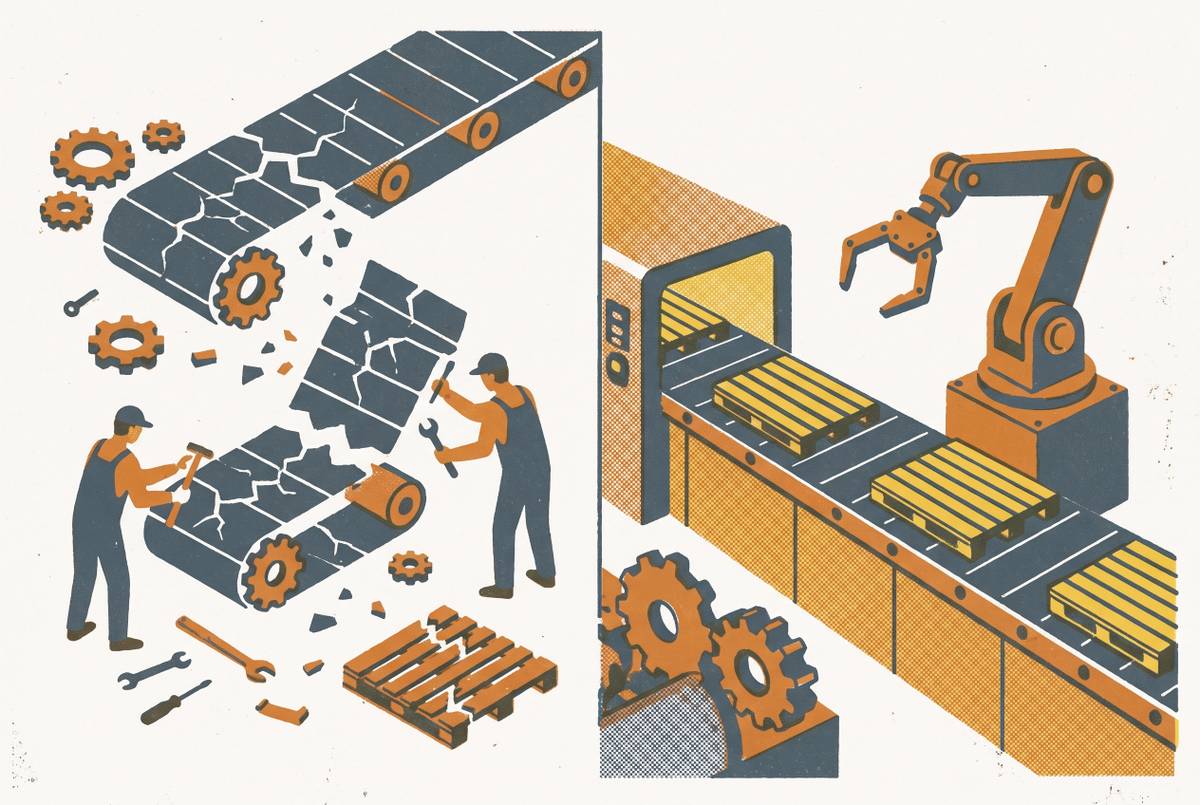
Sedimentation is what happens when AI gets layered onto a process without changing the process itself: the tool sits on top, the old workflow keeps running below, and nothing about how decisions actually get made is any different. That is the dominant outcome of enterprise AI spending right now, and transformation is a different thing entirely: rebuilding the process, not layering a tool on top of it. A 2026 enterprise AI adoption survey found that deployment is now nearly universal, but only a minority of organizations see significant return on investment from generative AI. Dataiku's 2026 guide draws the line cleanly: adoption means stacking tools on top of existing processes, while transformation means rebuilding the processes themselves, and most enterprises have done the former while describing it as the latter. The gap appears most clearly in how executives talk about their own strategy: the same survey found that a large majority admit their AI strategy functions more as a show for stakeholders than as actual operational guidance, strategy theater standing in for redesign. Organizations deploy AI tools onto processes that remain fundamentally unchanged, and that architectural choice, not any shortage of model capability, is why sedimentation builds up at scale. Terminal Use, an AI-first operations rebuilder, starts from the opposite order: a process audit identifies the specific painful workflow first, the AI agents get built around it second, and its clients report changes in how operations actually run.
How enterprise platform logic makes the sequencing problem worse
An enterprise platform is not a neutral container that transformation simply gets poured into. Platforms are built to standardize at scale, so whatever process the platform meets first gets institutionalized, broken or not. Dataiku names two risks that compound when this happens: governance debt, meaning agents and models running in production with no central inventory, no risk scoring, and no audit trail, and competitive lag, which sets in while competitors who rebuilt their processes first pull ahead. Both are what you get when AI transformation stalls inside a platform that was never asked to fix the process it sits on. The instinct to govern this risk is a reasonable one. A majority of executives in the same survey believe their company has already suffered a data breach tied to unapproved AI tools, and shadow AI is a real exposure. But the fix for shadow AI is not a platform mandate handed down from the top; it is process clarity built department by department, because a mandate without a rebuilt process just moves the same broken workflow onto bigger infrastructure. Microsoft's May 2026 post on enterprise AI execution names the pattern directly, stating that pilots don't transform businesses. Its own prescription, more platform, more integration, more scale, says nothing about why the pilots stalled to begin with. That's the gap this piece is built around: a platform can distribute a process everywhere at once, but it cannot tell you whether the process it's distributing was ever worth running.
What "Department-First" Means
People mistake department-first transformation for a pilot, a proof of concept, or some sanctioned version of shadow IT, but none of those labels fit. A genuine department-first rebuild is a deliberate reconstruction of one specific, painful process with AI agents built into its center, scoped tightly enough to produce a live operational result in weeks. Dataiku's framing supplies the right test: adoption layers tools, transformation reshapes the process, and a department-first rebuild is transformation carried out at the smallest scope that still counts as transformation, not adoption on a smaller budget. A pilot tests whether AI can perform a task. A rebuild replaces the process outright, and the old way of doing the work stops being available as a fallback. If the previous process is still running in parallel six months later, whatever was built was a pilot, regardless of what it was called at launch. The survey cited earlier identifies this exact gap as the "productivity-to-ROI disconnect," where individual task wins never accumulate into a structural outcome. A department-first rebuild closes that gap by tying AI directly to decisions, handoffs, and cycle time, not to the speed of an individual task performed the same way it always was. Finding the right process to rebuild starts with a process audit, an operational walk-through in which the department shows, step by step, how the work moves today and where it breaks, before anyone decides what gets rebuilt first. Terminal Use's own principle, that a first process should go live in weeks rather than quarters, depends on this same constraint: the rebuild stays narrow, scoped to one painful process, rather than stretched across an enterprise platform or dressed up as permanent pilot infrastructure. The test that separates a real rebuild from a stalled pilot is whether the process now changes decisions, handoffs, cycle time, and quality, or whether it only changes the speed at which the same decisions get made the same way.
Where processes break in construction, logistics, and manufacturing
In asset-heavy industries, the process that actually breaks rarely appears on the project schedule. It lives upstream, in the coordination and data-integrity work that the schedule assumes is already solid.
Construction offers the clearest case in procurement. The highest-return rebuild target in this sector is not a better schedule visualization tool but the procurement and material-flow process itself: document AI capable of reliable three-way matching across quotes, purchase orders, delivery tickets, and invoices, catching overbilling, substitutions, and quantity mismatches before they compound into real cost. Data center construction makes the stakes concrete. Schedules in this sector routinely overestimate power availability and understate lead times on long-lead equipment such as transformers, generators, switchgear, and chillers, and the energization dates built into those schedules often rest on utility assumptions that were never checked against interconnection realities or permitting timelines. An AI agent built into the procurement process itself can change those decisions and handoffs as they happen. Field evidence and procurement records reveal that false certainty well before it appears in a declared schedule, so the declared schedule is the wrong place to look for the fix.
Logistics carries a parallel version of the same failure in freight audit and allocation, where dispatch decisions often depend on information scattered across systems that were never built to talk to each other, so the breakdown again sits upstream of anything a dashboard would show.
Manufacturing shows the pattern just as clearly in supply chain planning and audit preparation. In one illustrative case of internal audit prep, finance keeps its evidence in email threads, HR keeps its own records in local folders, and operations works from unversioned spreadsheets. That fragmentation is the actual process that breaks audit preparation, and replacing it with a structured, AI-augmented workflow changes real cycle time and the defensibility of the findings themselves, not just the speed of the same disorganized process. The broader trend in manufacturing backs this up: predictive AI adoption is climbing, but the distance between how widely it's adopted and how deeply it changes the operating model means most of that adoption hasn't reached the threshold where the process itself gets redesigned.
What ties these three sectors together is where the process audit has to look. It needs to trace where decisions actually get made, meaning vendor communication logs, material-flow records, and commissioning backlogs, rather than the clean workflow chart drawn up for a client presentation. That gap between the documented process and the real one is where AI agents can run decisions in real time, while a tool layered on top of the documented process will miss the problem.
Why AI agents fail in production
Most enterprise AI agents that get built never reach production, and the reason is almost never a model quality problem. It's a governance and process-sequencing failure, and it's one a platform rollout cannot fix by itself while a genuine department-first rebuild addresses it as a built-in part of the design. Agents that demo well and clear budget approval routinely stall once they hit pre-production review: they fail security checks, lack basic observability, and run into governance requirements that no prototyping environment was ever built to satisfy. Airtable's 2026 platform evaluation guide points to the permission model as a common place where this breaks down at scale. An agent scoped correctly for one department's data will break, or overreach, the moment it gets deployed into a second department, if the permission architecture was never designed for the organization as a whole from the start.
It shows that sequencing is what needs fixing. Scoping an agent's governance, observability, and permissions to a single rebuilt process is achievable in weeks, because the boundaries of that process are already known and finite. Scoping the same governance architecture across an entire enterprise before any single process has been rebuilt is a different undertaking altogether, and it is not one that resolves itself in weeks no matter how much platform gets thrown at it.
Evaluating whether a department-first approach is genuine or another rebranded pilot
The practical test for a department-first rebuild is whether it changes operational decisions, handoffs, cycle time, and output quality, not whether it deploys agents or produces a dashboard. A few concrete checks make that test usable.
Start with the process audit before the platform conversation. The right opening question is "show me exactly how this process runs today and where it hurts," not "which tools are you already using." A partner who leads with platform recommendations before understanding the process in detail is running a rollout, not a rebuild.
Treat the timeline as a signal. A genuine rebuild should produce a live first process within weeks. If a timeline runs in quarters before anything is actually live, that suggests a platform-first approach wearing department-first language.
Apply Dataiku's benchmark directly: does the AI change decisions, handoffs, cycle time, and quality? If the honest answer six months in is "we have a dashboard and some productivity gains," the old process is still running, just with a new interface on top.
Check the governance architecture. Do the agents deployed in this process inherit the organization's existing role-based access controls, or do they require a separate permission model built just for them? A separate model means governance has been deferred, not fixed, and the same gaps will resurface the moment the process scales.
Apply the fallback test last. If the previous way of doing the work is still the default and the AI sits beside it as an optional layer, it's a pilot. A rebuild is finished once the old process is no longer available as a fallback.
Terminal Use fits this diagnostic closely enough to serve as a working example of it: a process audit comes first, a first process goes live in weeks rather than quarters, and the work concentrates in construction and logistics operations where the sector examples above actually live. Organizations weighing this choice have other paths too: they can hire a systems integrator to run a platform migration, or stand up an internal transformation office to coordinate pilots across departments. Both can produce real value if you scope and govern them well. The diagnostic above applies to any of them equally: the question is never which vendor or which internal team is running the project, but whether the result changes decisions, handoffs, cycle time, and quality, or whether it just adds a layer on top of a process nobody rebuilt.
The sequencing conclusion: the platform follows the rebuild
Enterprise coherence, a single AI strategy working consistently across every department, is a legitimate goal, and nothing in this argument says otherwise. The mistake is treating that coherence as something a platform rollout can manufacture on its own, ahead of any actual rebuild. Coherence is an outcome, the product of department-level rebuilds that worked once and then got repeated elsewhere in the organization once the pattern was proven. A platform deployed before any process has been rebuilt does not produce coherence; it reproduces whatever process it found first, at scale, governance debt and all. The sequencing conclusion stated throughout this piece holds here too: get one process live, get it changing real decisions and real handoffs, and only then does it make sense to ask what a platform should look like once it has something real to standardize. The platform is just the wrong place to start transformation.