How Manufacturers Run a Live AI Process Pilot Without Touching the ERP Stack
Pick one paperwork-heavy workflow, test AI in shadow mode, and leave the ERP alone.
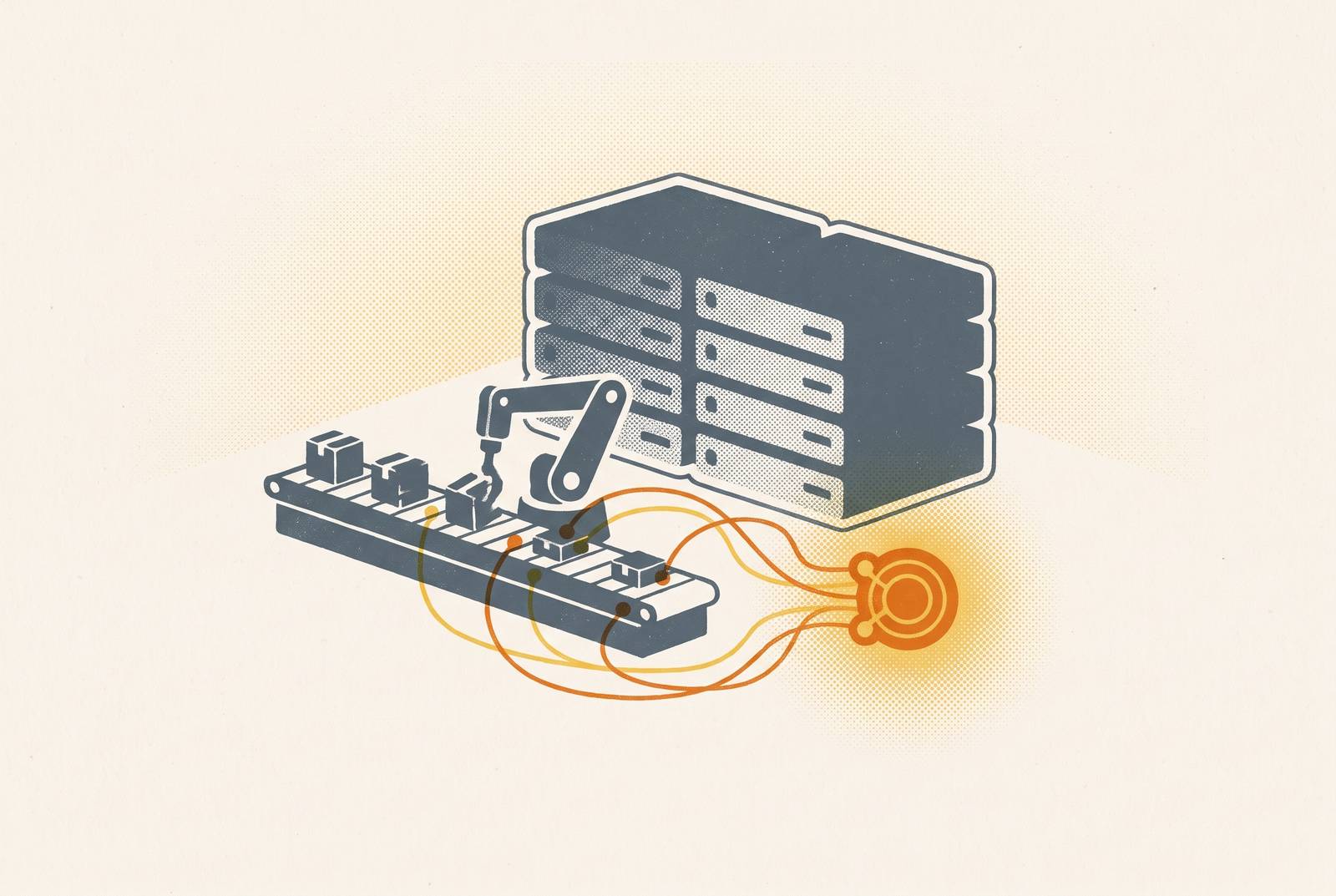
Manufacturers can run a live AI process pilot without replacing the ERP by targeting one manual workflow between systems, connecting only the data it needs, and testing outputs before allowing automated action. Repetitive paperwork usually offers the fastest start. This approach makes AI operational improvement possible without buying a whole platform or first committing to an enterprise software strategy.
Why the real AI opportunity in manufacturing sits outside the ERP
The ERP provides the operational foundation by tracking inventory, purchasing, order management, and production transactions as the stable system of record on which operations depend. Yet that transaction role does not mean it can read a supplier PDF, extract order details from a customer email, or notify departments when a production run finishes early. People fill those gaps, often through work that never appears as a distinct process in the system.
A sheet metal fabricator illustrates the distinction. Its office manager spends roughly six hours a week retyping purchase order details from supplier email PDFs into the ERP. The transaction system has not failed. The missing connection is between the incoming document and the record that the business needs, so replacing the destination would not directly address the handoff.
The decision rule follows from that distinction. If the ERP handles core transactions reliably and the pain sits in surrounding paperwork, the starting point is integration and automation around it. Replacing it means data migration, retraining, and rebuilding reports, work that takes months and could disrupt production. With those costs, replacing an ERP that works just to get AI is almost always the wrong trade.
Where manual work actually accumulates around an ERP
AlphaCIS identifies recurring manual work around order intake, reporting, inventory, approvals, and departmental updates. Employees copy customer email details into the ERP and re-enter fields from supplier PDFs. Elsewhere, they build production reports from several spreadsheets or update inventory spreadsheets separately from the transaction system.
The same pattern extends beyond data entry. Teams chase approvals through email threads, send status updates between sales, production, and shipping, and move the same data between sales tools and production systems. These activities can look like incidental administration when viewed separately. Taken as operating evidence, however, they reveal where the business depends on people to keep information moving.
ERP governance helps explain why these workarounds persist. The system enforces policy and auditability across plants and geographies, while teams route work around it to complete tasks it does not handle directly. Those workarounds become the real process, even though they sit outside the governed transaction path. Because they sit outside that system, they are easy places to run pilots without changing core infrastructure.
To turn that map into a selection decision, the audit needs measured manual time and error rates for each candidate workflow. Pain alone is not a usable baseline. The later comparison must show whether the pilot cut the work or mistakes the team had to deal with.
How do you pick one broken plant process for an AI pilot?
The best process to start with has plenty of manual work, data that is easy to get, and little need for integration with operational technology. Strategic importance alone is a poor selection rule. A workflow may be costly enough to deserve attention but still depend on data or production-system connections that cannot be established within a tightly scoped pilot.
Phosai Labs’ enterprise AI roadmap scores candidates against four criteria, namely cost of the problem, data availability, OT/IT complexity, and team readiness. Cost covers what downtime and defects cost each year, along with the hours spent on manual labor. Data availability asks whether the needed information is already collected and accessible, while OT/IT complexity tests the need for real-time production integration. Team readiness adds a separate question about whether the people receiving the output will trust it.
The roadmap favors document generation and work order automation because of their low OT complexity and fast adoption. It also identifies shift handover summarization and knowledge capture as starting points that require no OT integration. Purchase order processing fits the same selection logic. It combines high volume and repetitive entry without a real-time dependency on production equipment.
The roadmap defers autonomous production scheduling, multi-vendor supply chain optimization, and real-time process control adjustments. These require, respectively, mature data and governance, complex data coordination, and proven reliability before autonomy. Scheduling may still be the plant’s most painful problem. The reason to defer it is not its importance, but the foundations it requires, which a simpler first process can help establish through better data habits and team trust.
What “ERP-adjacent” integration actually looks like technically
An ERP-adjacent AI layer connects through the interfaces the existing system exposes, including APIs and data exports. The system of record stays in place. AlphaCIS identifies file-based imports and vendor connectors as viable routes for older ERPs without suitable APIs, so the absence of a modern interface does not automatically require a rebuild.
For a pilot using shop-floor data, the roadmap recommends OT/IT connectivity limited to that use case. Read-only API access to MES, CMMS, and SCADA comes first. Automated work orders, alerts, or other write-back capabilities follow only after read-only performance has been established. This sequencing places a clear boundary between testing an output and allowing it to affect operations.
Modern cloud ERP and SaaS platforms may offer API-first architecture, stronger workflow automation, and scalable analytics. Those capabilities can influence a modernization decision, but they do not make modernization a prerequisite for every AI pilot. The integration design for now should use only the data the chosen workflow needs. It must also be validated against what the ERP actually surfaces.
If planners distrust inventory balances, routings, or supplier lead times, a predictive model built on those records will amplify noise. The technical connection is therefore necessary but insufficient. Its value depends on whether the information crossing it is fit for the intended use.
Running the pilot through observation mode and a 30-to-60-day window
Observation mode keeps the existing process in control while the AI produces outputs for comparison. The team validates those outputs against technician judgment and historical records, measures false positives, and refines alert thresholds before any automated action. This is how the pilot earns operational trust. A convincing demonstration alone cannot show how the output behaves across the work the team encounters daily.
The champion-challenger framework makes the handover condition explicit. The existing automation or human process remains the champion, and the AI acts as the challenger until it consistently outperforms that process. Before the pilot starts, the team must agree on what “outperforms” means. Otherwise, a successful test can leave operations and leadership arguing over whether the system is ready.
A 30-to-60-day pilot window should serve that evaluation, with handover contingent on performance. A focused agent can reach a proof of concept in as little as two to six weeks when the workflow is tightly scoped and the data is accessible without new OT integration. Broader deployments across several workflows or sites typically require a three-to-six-month phased programme.
Phosai Labs reports that companies that put governance in place early scale faster than those that add it later. Observation mode helps with that discipline by giving the operating team calibrated thresholds, a false positive rate it understands, and a record of performance it can judge. Speed depends on clear boundaries and agreed evidence. It does not require ERP replacement, plant-wide integration, or a platform strategy.
The failure modes that kill pilots after they work in the demo
A controlled pilot can hide data problems that show up when it runs across the whole operation. OEE, for example, can return three different numbers from three different systems. An agent querying raw sensor data rather than certified, governed data products may inherit that disagreement. Better model performance cannot resolve an unsettled definition of the result.
Process documentation creates a similar trap for pilots. An approval may exist in the workflow but function only as a formality, while a scheduled reconciliation may leave differences uninvestigated. A system control can also exist technically while users routinely bypass it offline. Transaction records, system logs, and field observation are needed to expose these differences before the pilot is declared ready to scale.
The data audit must test more than accuracy. Missing values and time periods create completeness gaps, while different identifiers for the same machine across MES, CMMS, and ERP create consistency failures. Latency determines how old the information is when it reaches the AI. Failure records that show work order closure but omit failure mode reveal labeling gaps, and sources requiring manual exports expose access barriers.
Phosai Labs identifies leadership losing confidence before value arrives as a recurring abandonment pattern. Observation mode and champion-challenger testing defend against that outcome only when success has been agreed in advance. Autonomous process decisions remain out of reach until machine data can be surfaced consistently and trusted.
What process redesign looks like when it works
Danfoss put automated email-based order processing to work on the same manual intake tasks that make a strong first pilot. Google Cloud’s case study reports high automation of transactional decision-making and the potential for near real-time customer response across a significant volume of orders. Danfoss began with a bounded administrative workflow. Its relevance lies in connecting incoming information to order processing rather than replacing the underlying transaction system.
Suzano deployed natural language querying of SAP materials data through an agent layer above the ERP. Google Cloud’s case study reports a 95% reduction in the time required to query Insumos and MRO material. The improvement came from changing access to existing information. This is a different workflow from order entry, but it uses the same separation between an AI interface and the system of record.
Unilever’s January 2025 release describes how AI and weather inputs help make volume forecasts more accurate for its Ice Cream supply chain. Production lines can then be adjusted for weather-driven consumption shifts. This is human-aided planning.
Phosai Labs also describes AI beginning to automate material-readiness confirmation in construction before final energization sequences. Predictive models use schedule progress and site readiness signals to suggest how much material to order and when, coordinate staging locations, and cut the risk of a stockout before crews mobilize. The parallel is coordination across an asset-heavy operation. However, these examples do not provide a complete public account of every preceding data audit or rollout stage, so their reported outcomes cannot substitute for readiness evidence at another site.
How to audit the process before committing to the pilot
The pre-pilot audit starts with the team showing how work runs today, using transaction records, system logs, and field observation to explain where information enters, where people intervene, and where the process hurts. This establishes the workflow before technology is selected.
For each data source the candidate depends on, the roadmap recommends assessing completeness, consistency, latency, labeling, and access. The test is fitness for the use case. Data need not be perfect, but it must support a meaningful signal, and the team must be prepared to assess an output that disagrees with its intuition. Otherwise, teams may still choose not to use the output even when it is technically accurate.
Documenting the actual process also serves change management. It brings disagreements between teams into the open before an AI system exposes them under production pressure. Those disagreements can concern the meaning of a record, the authority of an approval, or the reliability of a handoff. Settling them is part of shaping a pilot that can work.
The resulting sequence is process audit first, use case selection second, and technology selection third. A process-first implementation firm asks the client to show how the work gets done today before deciding what, if anything, needs to be rebuilt. That order keeps the investment tied to a specific operating problem. Otherwise, automating a broken process makes it go wrong faster.